

Graphene is a material extracted from graphite and is composed of pure carbon, which is one of the most important elements in nature.Graphene oxide powder, as a new type of material, has great application potential in energy storage fields such as lithium batteries, lithium-sulfur batteries, air batteries, hydrogen storage, and supercapacitors. Graphene possesses extremely high electron mobility, specific surface area, tensile strength, and excellent flexibility. It not only can enhance the energy and power density of lithium batteries, achieve higher lithium storage capacity and better fast charging performance, but also helps overcome the solid-solid interface technology problems of solid-state batteries.
1. Graphene structure and properties
Graphene is a two-dimensional nano-material composed of carbon atoms, presenting a hexagonal lattice structure resembling a honeycomb. The C-C bond length of graphene is 0.141 nm, and its theoretical density is approximately 0.77 mg/m². The thickness of graphene is only the diameter of a single carbon atom.

Carbon atoms participate in hybridization in an sp² manner, allowing electrons to conduct smoothly between layers.
Therefore, graphene has excellent electrical conductivity and is currently the material with the lowest resistivity known. This is one of the reasons why graphene has broad prospects in the field of batteries.
The basic working principle of graphene batteries is similar to that of traditional lithium-ion batteries, with the main difference lying in the use of electrode materials.
In graphene batteries, the electrodes are typically made of graphene-based composite materials, which enables the batteries to have higher electrical conductivity and faster ion transmission speed.The high surface area of graphene provides more active sites, allowing for the storage of more charges and thereby increasing the energy density of the battery.
Graphene materials possess excellent thermal conductivity. The theoretical room-temperature thermal conductivity of a single-layer material can reach 3000-5000 W/(m·K). This property can be utilized to study the heat dissipation issue during the operation of batteries.
Graphene materials have excellent mechanical properties and are a material with extremely high toughness and strength. They can be used to develop and study flexible electrode materials.
2. The advantages of graphene in battery applications
2.1 Ultra-high electrical conductivity
The electron mobility of graphene is extremely high, allowing electrons to move rapidly within the material, thereby significantly increasing the charging speed of the battery. According to relevant data, the charging speed of graphene batteries can reach 5 to 10 times that of traditional lithium batteries.

2.2. Enhanced energy density
The atomic structure of graphene allows for a greater surface area and electrochemical activity, which helps batteries store more energy and increases the overall energy density of the battery.
2.3. Improved thermal stability
The excellent thermal conductivity of graphene helps with the thermal management of batteries during charging and discharging, which can reduce thermal runaway incidents and enhance the safety of the batteries.
2.4. Environmental Friendliness
Graphene can be mass-produced through methods such as chemical vapor deposition, which is more environmentally friendly compared to the production methods of traditional battery materials.
3.The Application of Graphene in Lithium-Ion Batteries
3.1 Graphene negative electrode material
Graphene is directly used as the negative electrode material
Graphene has excellent electrical conductivity, but its two-dimensional microscopic structure's tendency to stack easily leads to unsatisfactory research on independent graphene electrode materials. The main manifestations are poor rate performance of the battery and low cycle efficiency, etc.
Graphene composite negative electrode materials
At present, the main graphene negative electrode composite materials include: transition metal oxide/graphene composite materials and graphene-modified silicon-based materials, etc. The research direction of this type of composite materials is to utilize the conductive properties and structural characteristics of graphene materials to assist nanomaterials, improve the lithium-ion transmission rate, thereby enhancing the rate performance of lithium-ion batteries and compensating for the deficiencies and shortcomings of raw materials.
3.2. Graphene Conductive Agent
The basic function of conductive agent materials is to establish fast ion transmission channels between the active particles of the electrodes, thereby increasing the speed of electron transmission. Carbon-based materials have the advantages of light weight, high conductivity, high thermal conductivity, and good chemical stability. They are currently the most widely used type of conductive agent. However, traditional conductive agents such as conductive graphite and conductive carbon black in carbon-based materials can no longer meet market demands. The research and development of new conductive agents is imperative.
- Graphene Monolayer Conductive Agent
Graphene, as a two-dimensional nanomaterial, exhibits excellent electrical conductivity. Graphene with a large specific surface area is attached to the surface of the positive electrode particles and interweaves with each other to form a huge high-speed conductive network. This can effectively increase the migration rate of lithium ions and electrons.
In the case of low-rate charge and discharge batteries, as the amount of graphene added increases, the discharge specific capacity first increases and then decreases. Compared with commercial conductive agents, adding a small amount of graphene can achieve good conductive effect and the battery performance is also improved accordingly. However, when the battery undergoes high-rate charge and discharge, the performance of using graphene alone as a conductive agent is inferior to that of the conventional conductive agent.
- Graphene and Carbon Black Composite Conductive Agent
When graphene and carbon black are combined to form a composite conductive agent material, a large number of two-dimensional graphite sheets are uniformly wrapped around the original networked carbon black structure. The gaps between the sheets are filled with carbon black, serving as the framework structure.
Through cooperative conduction, the original two-dimensional conduction at the points is transformed into three-dimensional conduction at the points. At the same time, the problem of graphene stacking and aggregation is solved, and the structural stability and conduction efficiency are improved.
- Graphene and Carbon Nanotube Composite Conductive Additive
When graphene/carbon nanotubes are added as conductive additives to lithium-ion battery materials, the two can form a three-dimensional conductive site network.
Carbon nanotubes run through each layer of graphene sheets, transforming the original two-dimensional conducting space into a three-dimensional bridging structure for transmission channels. It provides a faster and smoother electronic conducting path, significantly improving the transmission efficiency of the battery positive electrode and the transmission rate of lithium ions. At the same time, the framework effect of carbon nanotubes effectively enhances the stability of the graphene structure, preventing agglomeration and accumulation.
4. Interface modification of solid-state batteries
At present, significant progress has been made in the research of high-conductivity solid electrolytes. However, the wetting properties at the solid-solid interface formed with the electrodes are poor, which adversely affects the interface resistance, chemical compatibility, and interface stability.
In the negative electrode interface region, the three-dimensional graphene framework, laminated plates and hollow spheres can inhibit the formation of lithium dendrites and the volume expansion of the electrode during charging.
In the positive electrode interface region, graphene is combined with the electrode material and the electrolyte to improve charge transfer. Additionally, graphene acts as a buffer layer, enhancing interface compatibility and thereby improving the overall performance of the battery.
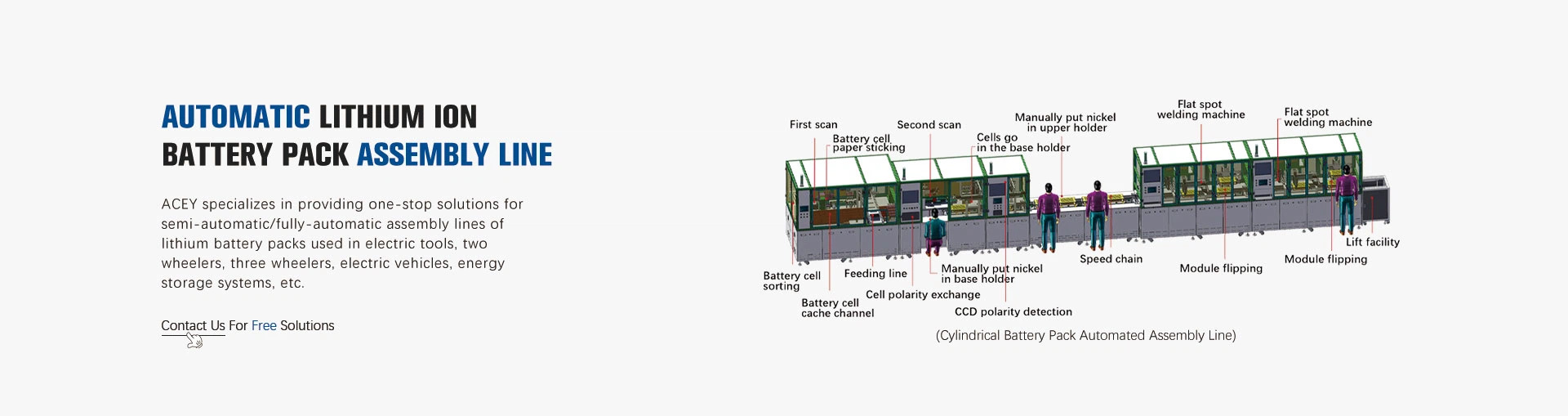
Acey Intelligent is specialized in researching and manufacturing of high-end equipment for lithium-ion batteries. We can not only provide one-stop solution for lithium ion battery production line for cylindrical battery, coin cell, pouch cell, but also provide one-stop solution for lithium battery pack assembly line, if you are new in lithium ion battery industry, and want to build your own lithium ion battery production line or lithium ion battery pack assembly line, we can provide you professional technical support and guidance, please feel free to contact us!