

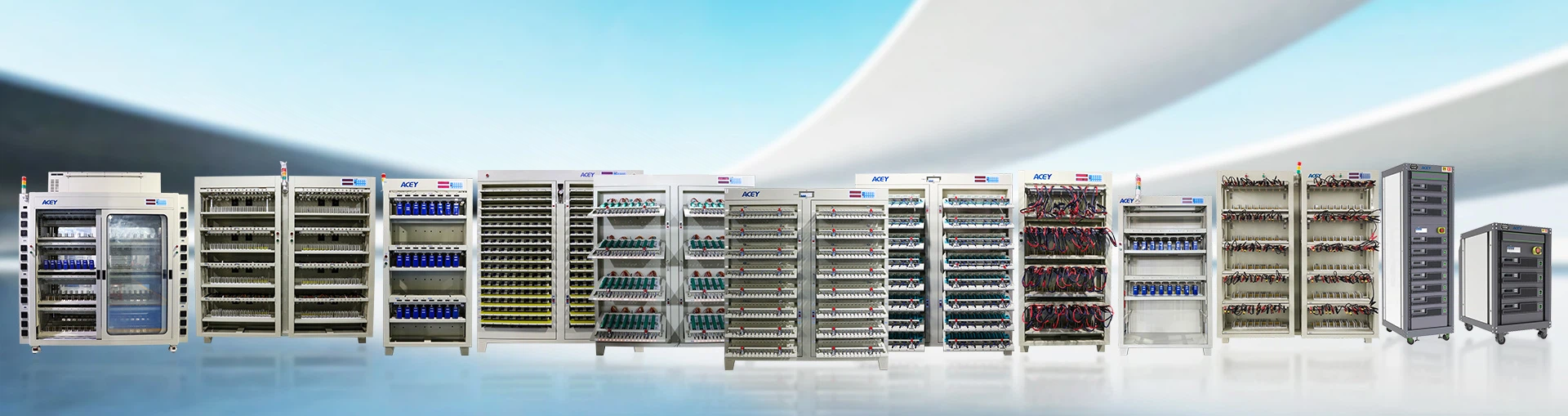
Drying Oven
Our goal is to become your true partner in the field of battery cell tester in China. Acey Intelligent Equipment is a high-tech enterprise and specializes in the development of high-end equipment for lithium-ion batteries. We providing enormous production capacity, as well as a professional R&D and after-sales service team with over 15 years of experience in this field. Our company is committed to applying advanced manufacturing technology and strict quality control standards to every product. The price is competitive and the product is quality-assured, which is a good choice for your long-term cooperation.

Why Choose Us
Product market:
We have produced products that are well received by the market and are sold to more than 40 countries around the world.
OEM and ODM services:
Our factory has advanced manufacturing equipment and our R&D team has more than 20 engineers to support customers' various customized needs.
Our certification:
Our products are rigorously tested and evaluated during the design and manufacturing process to ensure safety, reliability and environmental sustainability, and strictly comply with European regulatory requirements.
After-sales service:
We have a professional after-sales engineer team to provide 24/7 all-weather service, and the product supports one-year warranty and lifetime maintenance. We provide complete after-sales services, including technical support, warranty repairs, spare parts supply, customer training, etc., to ensure that the equipment operates efficiently and meets your long-term needs.
Advantages of Drying Oven
Versatility in applications:
Laboratory ovens are used for a wide variety of tasks, including drying, sterilization, baking, heat treatment, and material testing.
Precision and temperature control:
Lab ovens provide excellent temperature uniformity, ensuring consistent results across the entire chamber. They can reach high temperatures (up to 300 °c or more, depending on the model) and maintain precise control, which is critical for sensitive processes like sterilization or heat treatment.


Efficient drying and dehydration:
Laboratory ovens use convection heating to dehydrate samples without exposing them to direct radiant heat, which can damage delicate materials. A venting system allows humidity, volatile organic compounds (vocs), and fumes to escape, ensuring efficient drying and preventing contamination.
Cost-effectiveness:
By offering tailored solutions and efficient performance, laboratory ovens help reduce operational costs in both laboratory and small-scale production environments.
Types of Drying Oven
Convection drying ovens: Convection drying ovens are the most commonly used type of laboratory drying ovens. They rely on natural or forced convection to circulate heated air evenly throughout the chamber. These offer precise temperature control and are suitable for drying delicate samples or heat-sensitive materials.
Vacuum drying ovens: Vacuum drying ovens utilize reduced pressure or vacuum conditions to lower the boiling point of liquids, allowing faster and gentler drying. They are ideal for drying heat-sensitive materials, as they minimize the risk of thermal degradation.
Gravity convection drying ovens: Gravity convection drying ovens operate without any mechanical fans. Instead, they rely on natural convection, where heat rises and circulates throughout the chamber.
Forced air drying ovens: Forced air drying ovens, also known as mechanical convection ovens, employ powerful fans to circulate heated air uniformly within the chamber. This ensures faster drying and reduces drying time significantly. They are suitable for bulk drying, heat-resistant materials, or processes that require rapid drying.
Infrared drying ovens: Infrared drying ovens use infrared radiation to transfer heat directly to the samples, bypassing the air as an intermediary. This method enables rapid and efficient drying, making it suitable for drying coatings, paints, or solvent-based materials.
Microwave drying ovens: Microwave drying ovens employ microwave energy to generate heat directly within the samples, resulting in faster and more uniform drying. They are highly efficient and are particularly useful for drying organic materials, such as food products, herbs, or pharmaceutical compounds.
Specification of Drying Oven
|
Temperature accuracy |
0.1℃; |
|
Uniformity |
5℃ (the temperature difference is between the center and the edge of the cavity); |
|
Voltage |
Single-phase standard AC 220V 50/60HZ; power: <1500W max 10A; |
|
Inner cavity size |
415 mm x 345 mm x 375 mm; |
|
Vacuum |
<133Pa; |
|
Dimensions |
710mm X 565mm X 555mm |
|
Weight |
70kg |
Observe the items in the working room at a glance. Using integrally formed high temperature resistant silicone rubber sealing ring to ensure high vacuum in the box.
The inner tank is made of stainless steel, and the surface of the box body is sprayed with high temperature electrostatic to ensure the product is durable. Support precise PID control with automatic adjustment. Passed radiation protection and anti-theft system. Temperature multi-level control, temperature gradient control. Tilt heating, pressure keeping, air cooling, all can be set. There are two movable stacking racks.

Application of Drying Oven
Annealing:
Certain materials like glass or steel require a few steps to increase their flexibility. Since laboratory ovens can heat and cool the matter without damaging it, they are used in metallurgy or medical device industries. The materials that went through the process of annealing are easily cut and modeled into designated products.
Baking:
Material science labs of the pharmaceutical industry have a great use from laboratory ovens. The process of baking heats the matter without dehumidifying it. In other words, it saves the humidity of the substance.
Drying:
Drying is necessary for clinical and biological labs to preserve the materials by dehumidification. Vacuum ovens and forced air ovens carefully remove the moisture to dry the sample at a lower temperature, while gravity convection ovens take out the humidity from samples through a lighter airflow as these delicate particles are more likely to shatter.
Curing:
Curing is another convenient application of laboratory ovens. Semiconductor industries and scientific fields that use polymer in their research benefit greatly from the process of curing. It is a means of making glues, epoxies, and a variety of polymer compounds.
Precautions for Use Drying Oven
The drying oven should be placed indoors with good ventilation conditions and kept at a distance of more than 10 centimeters from surrounding wall equipment. Flammable, explosive, and combustible materials should not be placed around it.
The power supply of the drying oven should be plugged into a dedicated socket with a power greater than its rated power, and ensure good grounding. The socket should not be shared with other equipment.
Before use, follow the operating steps in the equipment manual and do not modify the original settings of the equipment without authorization. The drying oven does not have explosion-proof devices, and flammable, explosive, volatile, and corrosive materials are prohibited from being placed to ensure safe use.
Do not place items in the drying oven too tightly, pay attention to the load-bearing capacity, and leave space. During the use of the drying oven, do not touch the door, observation window, or surface of the box to prevent burns. After the drying is completed, turn off the equipment switch and wait for the box to cool to room temperature. Then, remove the dried items from the box and promptly clean up any debris to ensure the cleanliness of the workspace.
Packaging and Shipping of Drying Oven
|
Packing |
Plywood Case |
|
Shipping |
Shipped by road, sea, rail or air |
Other Service of Drying Oven
|
Order(Moq) |
1 set |
|
Compliance |
CE Certified |
|
Product Origin |
China |
|
Warranty |
One-year warranty with lifetime support |
|
Payment |
T/T, Western Union, PayPal, Ali Trade Assurance |
FAQ
Find professional drying oven manufacturers and suppliers in China here! Please feel free to buy high quality drying oven from our factory. For customized service, contact us now.
drying oven, Small Lab Drying Oven