

How to Test Lithium Battery Capacity: Methods and Practical Guide
Lithium battery capacity is an important indicator of battery performance, directly affecting how long a battery can operate. Charge and discharge testing provides a direct measurement of discharge capacity, while internal resistance testing, real-world usage testing, and software-based estimation offer additional ways to evaluate battery performance and condition.
This article introduces common lithium battery capacity testing methods, their basic principles, and the role of professional testing equipment in battery manufacturing.
Table of Contents
- Charge and Discharge Testing
- Professional Battery Capacity Testing Equipment
- Internal Resistance Testing
- Real-World Usage Testing
- Software-Based Capacity Estimation
- Conclusion
- Frequently Asked Questions (FAQ)
Charge and discharge testing is one of the most direct methods for measuring lithium battery capacity. It involves charging a battery under specified conditions and then discharging it according to preset parameters. By recording the discharge current and duration, the battery's actual discharge capacity can be calculated.
To obtain consistent and comparable results, several test conditions should be controlled, including ambient temperature, charging current, charging voltage, discharge current, and discharge cutoff voltage. The battery should also be tested according to the manufacturer's specifications or the applicable testing standard.
Common Charging and Discharging Procedures
1.1 Constant Current Discharge
Constant current discharge is a widely used method for battery capacity testing. The battery is first charged according to the specified charging procedure. It is then discharged at a constant current until its voltage reaches the preset discharge cutoff level.
The discharge capacity is calculated based on the current and discharge time.
Calculation Formula:
Capacity (Ah) = Discharge Current (A) × Discharge Time (h)
This formula applies to constant-current discharge. When the discharge current varies over time, capacity must be calculated by integrating the current over the discharge period.
For example, a battery cell discharged at a constant current of 1A for 5 hours has a measured capacity of 5Ah.
This method directly measures a battery cell's discharge capacity under defined conditions, making it suitable for comparing cells. However, the testing time varies depending on battery capacity, discharge current, and cutoff voltage.

1.2 Constant Resistance Discharge
Constant resistance discharge uses a resistor with a fixed resistance value as the load connected to the battery. As the battery discharges, its voltage gradually decreases, causing the discharge current to vary accordingly.
To calculate capacity, the voltage, current, and discharge time must be recorded throughout the process. Compared with constant current discharge, this method has a simpler circuit setup but requires more data processing because the discharge current is not constant. This can also make standardized capacity comparisons between cells less convenient.
Since the discharge current changes as the battery voltage decreases, capacity cannot be calculated simply by multiplying a single current value by the total discharge time. Instead, the current must be integrated over the discharge period:
Capacity (Ah) = ∫ I(t) dt
where I(t) represents the discharge current over time.

1.3 CC-CV Charging and Constant Current Discharge
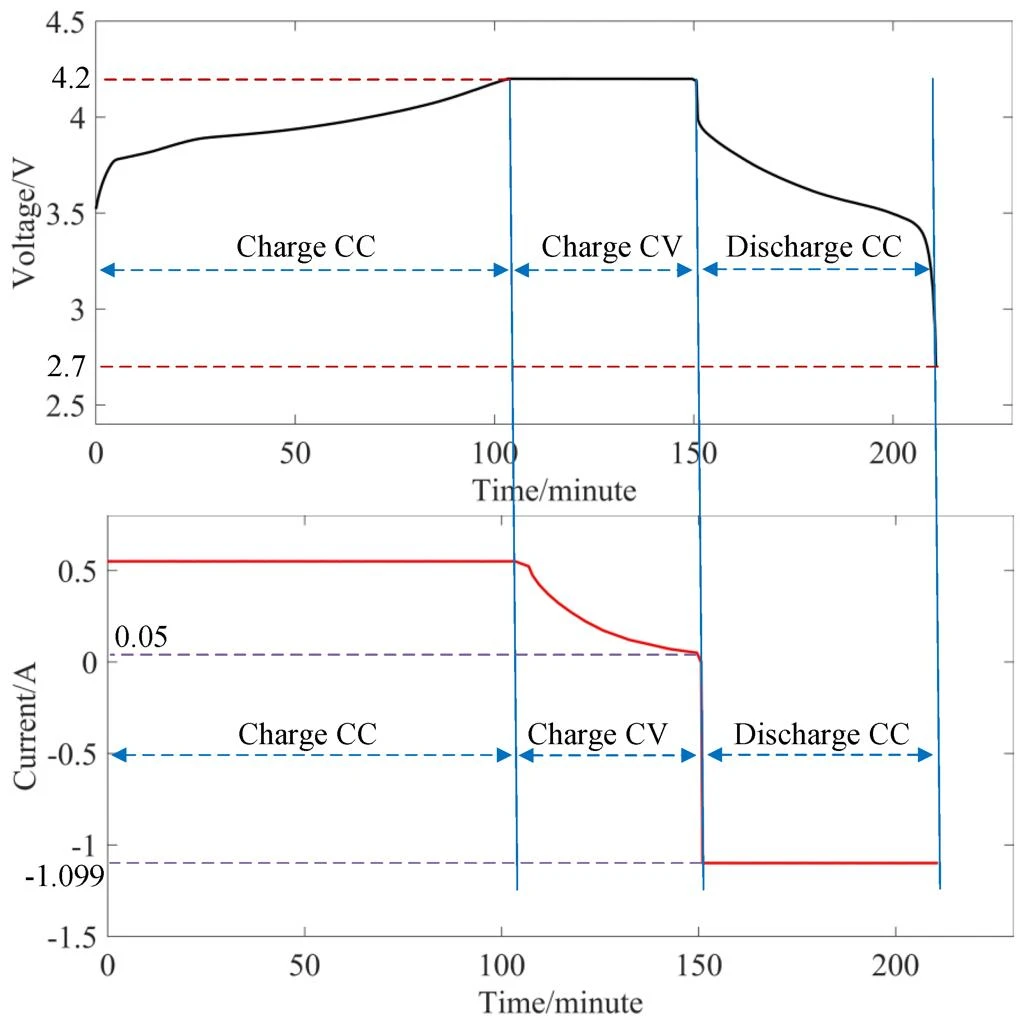
In lithium battery capacity testing, the charging stage may use constant current (CC), constant voltage (CV), or constant current-constant voltage (CC-CV) charging, while the discharge stage generally uses constant current.
With CC-CV charging, the battery is initially charged at a preset constant current. Once it reaches the specified voltage limit, the charging process switches to constant voltage and continues until the preset cutoff condition is met. The battery is then discharged at a specified constant current to measure its actual discharge capacity.
This procedure provides consistent control over charging and discharging conditions, helping ensure reliable comparisons between battery cells. It is also commonly used in battery capacity grading processes.
The specific charging and discharging parameters should be selected according to the cell chemistry, manufacturer's specifications, and intended testing requirements.
A professional Battery Capacity Tester automates the charge and discharge process, making it easier for manufacturers to handle large-scale cell testing while maintaining consistent measurements and data records. Manually measuring and recording voltage, current, and discharge time is not practical for high-volume production, making automated testing equipment an important part of battery manufacturing.
2.1 Key Functions of Professional Battery Capacity Testing Equipment
Professional battery capacity testing systems generally offer several core capabilities:
- Energy Regeneration: Recovers energy generated during battery discharge and feeds it back into the power grid, helping reduce energy consumption during large-scale battery testing.
- Charge and Discharge Control: Automatically regulates charging and discharging based on preset current, voltage, and cutoff conditions.
- Multi-Channel Operation: Allows multiple cells to be tested simultaneously, with each channel operating independently to accommodate different testing requirements.
- Data Acquisition: Monitors and records essential parameters, including voltage, current, test duration, and battery capacity.
- Programmable Test Procedures: Supports customized test steps and cycle sequences to meet different cell evaluation requirements.
- Capacity Grading: Sorts cells into different capacity categories based on their measured performance.
- Data Export and Analysis: Saves test records and performance curves for further evaluation, traceability, and production quality management.
- During production, multiple cylindrical cells can be tested simultaneously through independent channels. After completing the programmed charge and discharge procedures, the system records the capacity and other test data of each cell. Based on predefined grading criteria, the cells can then be classified into different capacity groups for subsequent battery pack assembly.
2.2 Case Example: Automated Grading in Practice
For large-scale cell inspection and capacity classification, a battery capacity grading machine combines charge and discharge control, data acquisition, and cell sorting within one system.
ACEY-BCT506R-512 Energy-Regenerative Battery Capacity Grading Machineis designed for high-volume cylindrical cell testing. It supports several common cell formats, including 18650, 21700, 26650, 32650, and 32700, making it suitable for different cylindrical cell manufacturing requirements.

Its main features and technical specifications include:
- 512 Independent Test Channels: Each channel has its own constant-current and constant-voltage control circuit, allowing individual charging and discharging parameters to be configured.
- 5V 6A Operating Range: Supports a voltage measurement range of 0–5V and charging and discharging currents of 60mA–6A.
- Programmable Multi-Step Testing: Accommodates up to 32 test steps and 256 cycles, providing flexibility for different cell testing procedures.
- Four-Wire Measurement: Minimizes the effect of lead resistance on measurement results, helping improve voltage measurement accuracy.
- Automated Data Collection: Records voltage, current, test duration, and capacity, with corresponding data curves and cycling graphs available for performance evaluation.
- Cell Capacity Grading: Enables classification based on capacity, discharge time, open-circuit voltage (OCV), and discharge plateau.
- With 512 independent channels, the equipment enables simultaneous testing of multiple cells, supporting efficient testing in high-volume production. Test data is then processed according to predefined grading criteria to facilitate cell matching and production quality control.
Why Is Capacity Grading Important for Cell Matching?
Capacity grading classifies cells based on key performance parameters, including discharge capacity, discharge time, voltage, and discharge plateau. Grouping cells with similar characteristics helps maintain consistency within battery packs and supports reliable pack assembly.
Internal resistance is an important indicator of a cell's electrical performance. Measuring this parameter with a dedicated resistance tester helps manufacturers assess cell condition and identify potential inconsistencies.

Under the same measurement conditions, higher internal resistance typically results in greater voltage drops and energy losses during operation. However, there is no direct proportional relationship between internal resistance and battery capacity, meaning capacity cannot be reliably determined from resistance measurements alone.
Two common approaches are AC internal resistance (ACIR) measurement and DC internal resistance (DCIR) measurement. ACIR is commonly measured using an AC signal at a specified frequency, often 1 kHz, while DCIR is determined by observing voltage changes in response to a DC current pulse over a defined period. Their results are not directly interchangeable because they use different measurement principles.

This method is commonly used in battery manufacturing for several purposes:
- Electrical Performance Evaluation: Provides insight into a cell's electrical characteristics and helps identify potential abnormalities.
- Production Screening: Helps identify cells with unusually high resistance before they move to subsequent production stages.
- Complementary Evaluation: Combined with capacity measurement, provides a more comprehensive picture of cell performance.
- Test Condition Considerations: Measurement results can be influenced by ambient temperature, state of charge (SOC), and the measurement method used.
Although useful for preliminary evaluation, internal resistance measurement cannot replace a direct capacity test. To determine the actual discharge capacity of a cell, a controlled charge and discharge procedure must be carried out under standardized conditions.
Real-world usage testing examines how a battery performs in its intended application by monitoring runtime, energy consumption, and operating stability during actual use.
Unlike laboratory capacity testing, real-world testing usually evaluates operating runtime or energy delivery under application-specific conditions. The results may be expressed in operating hours or energy consumption (Wh), rather than a directly measured discharge capacity (Ah).
This method is widely applicable to various battery-powered devices:
- Electric Vehicles: Driving range and vehicle energy consumption help assess battery performance during daily operation.
- Power Tools: Operating time under different load conditions provides an indication of battery endurance.
- Portable Electronic Devices: Runtime and battery level changes help determine how long a device can operate on a single charge.
A major advantage of this approach is that it captures battery behavior in practical applications rather than under controlled laboratory conditions. However, test results can be affected by device power consumption, ambient temperature, load variations, and user habits, making consistent comparisons more difficult.
As a result, real-world usage testing is primarily useful for evaluating application-specific runtime and operating performance. It cannot replace standardized capacity testing, especially in battery manufacturing, where controlled conditions and repeatable measurements are essential for reliable results.
Devices with built-in batteries, such as smartphones and laptops, often use a battery management system (BMS) or dedicated software to estimate available battery capacity and monitor battery health.
These systems analyze parameters such as voltage, current, temperature, and historical charging and discharging data. Based on these inputs, algorithms estimate the state of charge (SOC), which indicates the remaining charge, and the state of health (SOH), which reflects the battery's condition compared with its original performance. Some systems also use these estimates to assess changes in available battery capacity over time.
This approach offers several practical advantages:
- No External Testing Equipment: Provides battery status estimates without requiring a separate professional capacity tester.
- Real-Time Monitoring: Displays the remaining charge and tracks changes in battery status.
- Everyday Battery Management: Helps users monitor battery health and predict available runtime.
- Estimation Limitations: Accuracy depends on algorithm design, operating conditions, and battery aging.
While convenient for everyday monitoring, software-based estimation does not directly measure actual discharge capacity. To determine the actual usable capacity (in Ah) a battery can deliver, a controlled charge and discharge test under standardized conditions is still required.
Lithium battery capacity can be measured directly through controlled charge and discharge testing, while internal resistance testing, real-world usage, and software-based estimation provide additional information about battery performance and condition. For battery manufacturers, professional battery capacity testing equipment helps automate the testing process, improve testing consistency, and support cell capacity grading in production.
Q1: How Do You Measure the Actual Capacity of a Lithium Battery Cell?
A lithium battery cell's actual capacity is determined through a controlled discharge test. After being fully charged using CC-CV mode, the cell is discharged at a specified constant current until it reaches the cutoff voltage. Its capacity is calculated by multiplying the discharge current by the discharge time and is expressed in ampere-hours (Ah).
Q2: Why Is Constant-Current Discharge Important for Battery Capacity Testing?
Constant-current discharge provides consistent testing conditions and simplifies capacity calculation. By maintaining a fixed current throughout the test, it allows reliable and repeatable capacity measurements, making it easier to compare cells and evaluate their performance.
Q3: How Does a Battery Capacity Grading Machine Work?
A battery capacity grading machine automates the charging and discharging process, monitors cell performance, and classifies cells into different capacity groups based on preset criteria. Key grading parameters typically include discharge capacity, voltage, and discharge plateau.
The ACEY-BCT506R-512, for example, features 512 independently programmable channels and supports multi-step testing and cycling. It enables manufacturers to test multiple cylindrical cells simultaneously and classify them according to their measured performance, supporting cell matching in battery pack production.
Products Description
Xiamen Acey New Energy Technology Co., Ltd. supplies equipment for lithium-ion battery research and manufacturing, including battery cell fabrication systems, battery testing equipment, and battery pack assembly machinery.
If your project involves swelling analysis, cell aging, dimensional consistency, or production-quality evaluation, provide the following information to help define the equipment requirements:
Cell format and chemistry
Nominal and maximum voltage
Charge/discharge current range
Required test protocols
Number of test channels
Temperature-control requirements
Dimensional measurement objectives
Laboratory or production application
Contact Acey Intelligent to discuss a suitable equipment configuration for your lithium-ion battery testing and manufacturing project.
Website:https://www.aceyintelligent.com/