

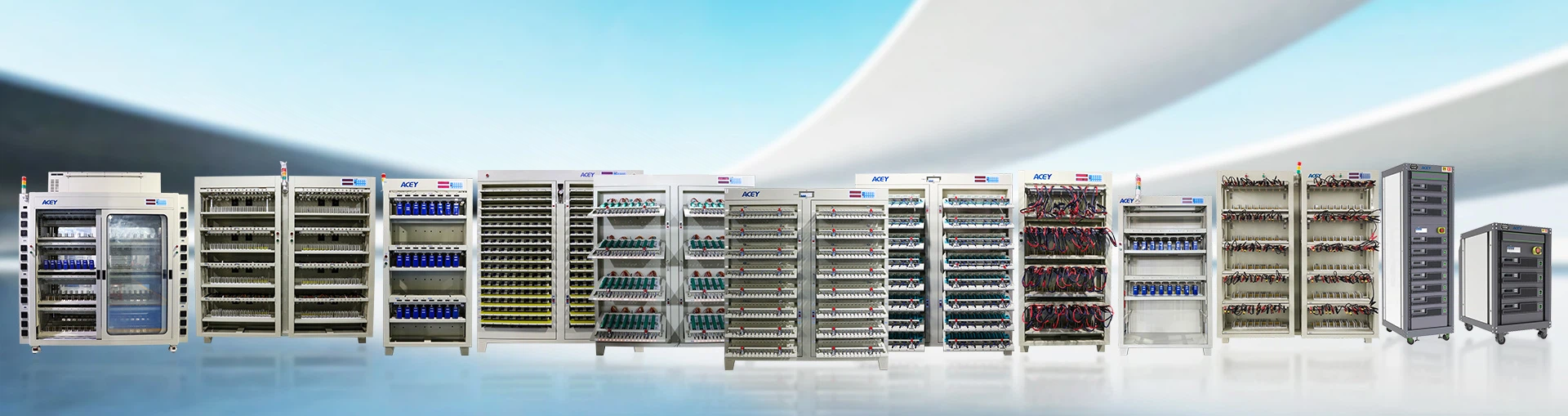
Spot Welding Machine
The Spot Welding Machine manufacture!
Our Lithium Battery Lab Fabrication Line is a modular, lab-scale production system designed for R&D, prototyping, and small-batch manufacturing of lithium-ion batteries. It replicates full-scale industrial processes, enabling seamless technology validation and scale-up.


After-sales service:
We have a professional after-sales engineer team to provide 24/7 all-weather service, and the product supports one-year warranty and lifetime maintenance. We provide complete after-sales services, including technical support, warranty repairs, spare parts supply, customer training, etc., to ensure that the equipment operates efficiently and meets your long-term needs.
Product market:
We have produced products that are well received by the market and are sold to more than 40 countries around the world.
Vision:
Our factory has advanced manufacturing equipment and our R&D team has more than 20 engineers to support customers' various customized needs.
OEM and ODM services:
Our products are rigorously tested and evaluated during the design and manufacturing process to ensure safety, reliability and environmental sustainability, and strictly comply with European regulatory requirements.
|
Output power |
10KVA |
|
Welding current |
00~99 |
|
Power supply |
AC220V±10% 50~60Hz |
|
Input air pressure |
0.1~0.7MPa |
|
Scope of application |
Suitable for various welding lugs from 0.03mm to 0.25mm |
|
Dimensions |
L400×W560×H400mm |
|
Weight |
40KG; |
Advantages of Spot Welding Machine
Efficiency:
Spot welding is a fast process, capable of joining metal sheets in a matter of seconds, making it ideal for mass production.
01
Strength:
The welds produced are strong and reliable, suitable for applications where structural integrity is critical.
02
Cost-Effective:
Spot welding requires minimal consumables and labor, reducing overall production costs.
03
Versatility:
This method can be used on various metals, including steel, aluminum, and nickel alloys, as well as different thicknesses and shapes.
04
Minimal Distortion:
Due to the localized heating, spot welding minimizes the warping and distortion of the workpieces.
05

Spot welding is used in various industries such as automotive, aerospace, metal furniture, electronics, building construction, etc.
Spot welding is used in high volume production applications.
It is applied for welding of thin sheets.
Spot welding is also used for fabricating all types of sheet metal structures where high mechanical strength is required.
Spot welding can also be applied to all types of boxes, cores and enclosing cases, etc.
Operation of Spot Welding Machines
Squeeze: At the point of welding, the electrodes hold the sheet at a specified force. This force depends on the sheet thickness. Right amount of force is crucial to ensure that the welding current is held at the weld point..
Welding current: After reaching the desired force in the squeeze cycle, the specified high welding current flows through the spot point of both the sheets. The welding current set depends on the sheet thickness and material to be weld. The welding current decides the fusion of the material resulting in final nugget size and weld quality
Welding time: This is the time for which the welding current flows through the spot. This time is typically in hundreds of milliseconds. The weld time is set as per the weld current and force applied to the spot point. Too high a time results in spatter creating a high heat affecting zone and too less a weld time will result in a bad spot quality. It is very essential to set a right weld tie.
Cooling Phase: Once the stipulated welding time elapses, the current ceases, and the welded joint undergoes a cooling process, thereby solidifying the bond. This time is essential to ensure a propoer fusion of spot.
Key Components of Spot Welding Machines
Types and Materials: Electrodes in spot welding machines are typically made from copper or copper alloys due to their excellent electrical conductivity and heat resistance. There are various types of electrodes, including flat, dome, pointed, and offset, each designed for specific welding applications and material thicknesses.
Maintenance: Regular maintenance of electrodes is crucial for consistent welding quality. This includes cleaning, reshaping, and occasionally replacing worn electrodes. Proper alignment and ensuring a clean contact surface are also essential for optimal performance.
Role: The transformer in a spot welding machine is responsible for converting the high-voltage, low-current power supply into a low-voltage, high-current output suitable for welding. This transformation is crucial for generating the heat needed to weld materials.
Types: There are several types of transformers used in spot welding machines, including single-phase AC, three-phase AC, and DC transformers. The choice depends on the specific requirements of the welding application, such as the material type and thickness.
Functionality: The controller is the brain of the spot welding machine. It regulates the welding current, time, and pressure, ensuring that each weld is consistent with the pre-set parameters. This is crucial for achieving uniform weld quality across multiple welds.
Types: Controllers range from simple timer-based systems to sophisticated microprocessor-based controls. Advanced controllers offer features like programmable welding cycles, feedback systems, and integration with automation systems for precise control over the welding process.
Importance: The cooling system in a spot welding machine is essential for dissipating the heat generated during the welding process. It prevents overheating of the electrodes and the transformer, which can lead to equipment damage and reduced weld quality.
Types: Cooling systems can be air-cooled or water-cooled. Air-cooled systems are typically used in lower-duty applications, while water-cooled systems are preferred for high-duty cycles and industrial applications due to their superior cooling efficiency.
Types of Spot Welding Machines
Pedestal Type Spot Welding Machine: Mounted on a pedestal, this stationary machine is ideal for heavy-duty applications, providing stability and precision.
Hand Spot Welding Machine: Portable and easy to carry, this machine is perfect for small-scale applications and on-site repairs.
Projection Spot Welding Machine: Utilizes a projection welding technique to join metal pieces, suitable for applications requiring precise welds.
Seam Welding Machine: Designed to weld along a seam, this machine is used for creating continuous, leak-proof joints.
Butt Welding Machine: Joins two metal pieces at a butt joint, commonly used in wire and rod welding.
Regulator Type ARC Welding Machine: Employs an ARC welding process, ideal for various metal fabrication tasks.
Stud Type ARC Welding Machine: Uses ARC welding to attach studs to metal surfaces, often used in construction and manufacturing.
Portable Welding Machine: Compact and mobile, this machine is suitable for small-scale and on-the-go welding tasks.
Inverter Mosfet ARC Welding Machine: Utilizes an inverter-based ARC welding process, offering efficiency and precision.
Inverter IGBT ARC Welding Machine: Another inverter-based ARC welding machine, known for its reliability and performance.
Mig(CO2) Welding Machine: Uses a MIG welding process with CO2 shielding gas, ideal for welding thicker materials.
Tig Welding Machine: Employs a TIG welding process, known for producing high-quality, precise welds.
Plasma Cut Machine: Uses plasma cutting technology to cut through metal with high precision and speed.
FAQ
Find professional spot welding machine manufacturers and suppliers in China here! Please feel free to buy high quality spot welding machine from our factory. For customized service, contact us now.
spot welding machine, Pulse Spot Welder