

Which Battery Cell Is Better? What Are the Real Differences Between Prismatic, Cylindrical, and Pouch Cells?
Choosing between prismatic, cylindrical, and pouch cells is an important decision for any battery project. Each format has its own strengths in energy density, cost, structural design, and manufacturing.
So, which one is right for your application? Let's compare their key differences to help you make a more informed choice.
Table of Contents
- What Are the Characteristics of the Three Main Battery Cell Formats?
- How Does Cell Format Affect Battery Pack Integration Efficiency?
- How Do Different Cell Formats Affect Charging and Discharging Performance?
- How Do Different Cell Formats Affect Battery Cooling and Heat Management?
- How Do Different Cell Formats Affect Battery Safety?
- Frequently Asked Questions
Prismatic Cell
- Structure: Features a rigid aluminum housing with an internal electrode assembly made through winding or stacking.
- Key Advantages: The sturdy casing offers mechanical protection and can serve as a load-bearing component within the battery module.
- Main Limitations: Dimensions and specifications differ across manufacturers, making cross-brand compatibility difficult.
- Design Challenges: Long-term cycling may cause cell swelling, so adequate clearance between the electrode assembly and outer casing must be maintained.
Cylindrical Cell
- Structure: Enclosed in a steel or aluminum cylindrical shell, with electrodes typically arranged in a wound configuration.
- Key Advantages: Provides good mechanical strength, strong resistance to internal pressure, standardized dimensions across common models, and well-established production processes.
- Main Limitations: Relatively low capacity per unit means that many individual cells are needed to meet the required pack capacity.
- Design Challenges: Large cell counts increase the number of holders, busbars, and voltage-sensing wires, adding to assembly complexity and component weight.
Pouch Cell
- Structure: Uses flexible aluminum-plastic film packaging rather than a rigid metal enclosure.
- Key Advantages: Lightweight and highly adaptable in shape, allowing thin or customized configurations. Its broad surfaces also provide ample area for heat transfer.
- Main Limitations: The flexible packaging offers limited mechanical protection and relies heavily on external reinforcement.
- Design Challenges: Proper protection against punctures and compression is essential. Clamping mechanisms must also accommodate thickness variations caused by repeated charge and discharge cycles.

Different cell formats also require different manufacturing processes and equipment configurations during battery pack production.
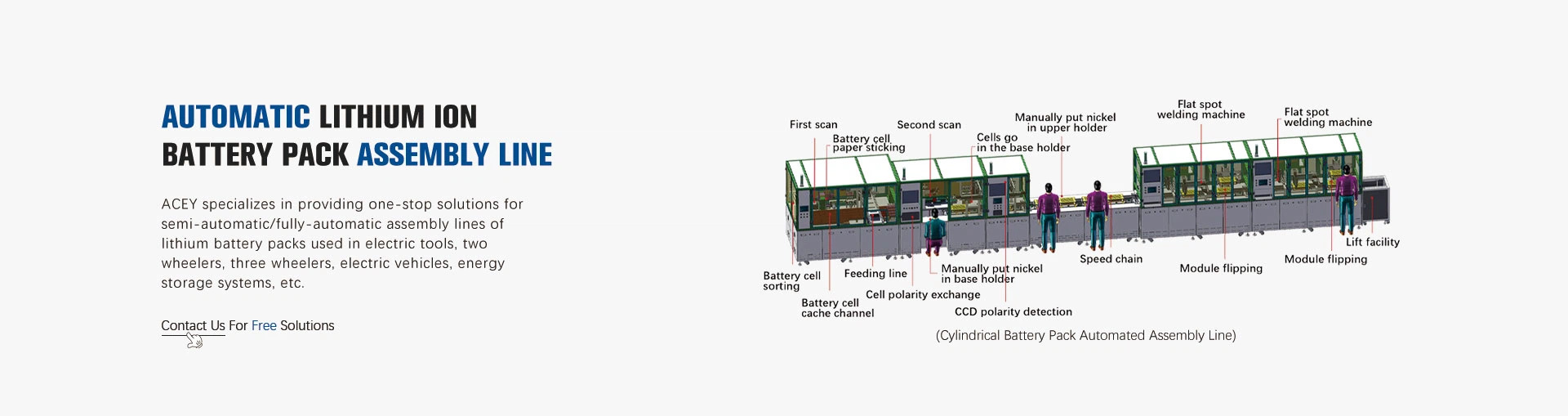
- Cylindrical Battery Pack Production: Typically involves cell sorting, cell arrangement, spot welding, insulation, and pack testing.

- Prismatic Battery Pack Production:Common processes include cell inspection, busbar welding, structural assembly, electrical insulation, and pack testing.

Pack integration efficiency refers to how much of a cell's energy density is retained after module and pack assembly.
Integration Efficiency Comparison
The differences are relatively small at the module level but become more noticeable in the finished battery pack.
|
Cell Format |
Module-Level |
Pack-Level |
|
Prismatic |
89% |
70% |
|
Cylindrical |
87% |
65% |
|
Pouch |
85% |
60% |
Note: These figures are typical reference values, not universal industry standards.
Why Do the Three Formats Differ?
Pouch Cells
- Require external frames and clamping structures for mechanical support.
- Need insulation, cooling components, and extra space for swelling.
- Film sealing and stacking processes can increase production costs.
Cylindrical Cells
- Require more individual cells to reach the target pack capacity.
- Additional holders, busbars, wires, and weld points increase weight and assembly complexity.
Prismatic Cells
- Rigid aluminum casings simplify pack integration.
- Fewer cells and connection points can reduce supporting components.
How Do CTP and CTC Technologies Help?
CTP (Cell-to-Pack): Integrates cells directly into the pack, reducing intermediate module components.
CTC (Cell-to-Chassis): Integrates the battery structure with the vehicle chassis to improve space utilization.
CTP (Cell-to-Pack) technology reduces the need for intermediate module structures, potentially improving space utilization and pack-level integration efficiency. The actual results depend on cell dimensions and overall pack architecture.
Key Takeaway: Don't focus on cell-level energy density alone. Pack-level energy density provides a more practical basis for comparing different cell formats.
Rate capability determines how well a battery cell handles high-current charging and discharging. Electrode design and current collection methods play an important role in this performance.
How Do Different Cell Formats Perform?
Cylindrical Cells
- Traditional designs use a single tab, resulting in longer current paths, higher resistance, and localized heat buildup.
- Multi-tab designs shorten the current path by adding multiple current collection points.
- Tabless technology uses the entire electrode edge for current collection, significantly reducing resistance and heat generation.
For example, 4680 tabless cells have been reported to offer:
- Approximately 90% shorter current paths.
- Around one-fifth the internal resistance of conventional cylindrical designs.
- Significantly higher peak power output compared with standard 2170 cells.
- A 15–20°C reduction in temperature rise during fast charging, under reported test conditions.
Prismatic Cells
- Stacked electrodes or multi-tab winding help reduce internal resistance.
- More uniform current distribution supports high-rate performance.
Pouch Cells
- Tabs are typically positioned on the same side, which can result in longer current paths.
- Rate performance is generally moderate, while large-format cells may experience uneven current distribution.
Which Cell Format Is Better for High-Power Applications?
For applications requiring sustained high power or ultra-fast charging, stacked prismatic cells and large tabless cylindrical cells are worth considering.
Cylindrical Cells
- A high surface-area-to-volume ratio and natural gaps between cells facilitate air cooling and channel-based liquid cooling.
- Thermal uniformity depends on cell spacing: narrow gaps restrict airflow, while wider gaps reduce packing density.
Prismatic Cells
- Large, flat surfaces enable close contact with liquid cooling plates or heat sinks, making thermal management integration relatively straightforward.
- The main challenge is maintaining temperature uniformity between the cell core and outer casing, particularly during fast charging.
Pouch Cells
- Large, flat surfaces on both sides provide extensive heat transfer areas, supporting double-sided liquid cooling and immersion cooling.
- Large-format cells may experience uneven current density and aging, making thermal simulation and uniform compression design important for effective heat management.

Cylindrical Cells
- Lower energy per cell (e.g., 2170: 4–5Ah; 4680: 20–30Ah) helps limit individual cell heat release during thermal runaway.
- Natural gaps, thermal barriers, CID/PTC devices, and safety vents help reduce propagation risks.
- However, numerous cells and connections increase potential failure points.
Prismatic Cells
- Large-capacity cells (e.g., 314Ah) can release substantial heat during thermal runaway.
- Mica barriers, insulation pads, pressure-relief vents, and system-level fire protection help contain risks.
Pouch Cells
- Under thermal abuse, pouch cells may experience swelling, gas generation, and pouch deformation. Their flexible packaging also requires appropriate mechanical protection and system-level venting design.
- Their aluminum-plastic film requires protection against punctures and compression.
Key Takeaway: Safety Goes Beyond Packaging
Cell chemistry, consistency, welding quality, thermal management, BMS protection, and manufacturing inspection all affect safety. LFP generally offers better thermal stability than high-nickel NMC, highlighting the importance of chemistry alongside cell format.
Ultimately, prismatic, cylindrical, and pouch cells each have distinct strengths and trade-offs in energy density, performance, safety, and pack integration. The best choice is not the most advanced cell format, but the one that best fits your application and manufacturing requirements.
Q1: What are the main differences between prismatic, cylindrical, and pouch cells?
Prismatic cells feature rigid casings and high individual capacity. Cylindrical cells offer standardized sizes and mature production processes, while pouch cells are lightweight and flexible in design.
Q2: Which is better for battery packs, prismatic or cylindrical cells?
Prismatic cells are suitable for large-capacity packs with fewer connections, while cylindrical cells offer greater flexibility in modular pack designs. The choice depends on capacity, power requirements, and pack architecture.
Q3: What applications are pouch cells best suited for?
Pouch cells are suitable for lightweight, space-constrained battery designs that require flexible form factors. They are commonly considered for applications where weight and packaging flexibility are key priorities.
ACEY provides cylindrical and prismatic battery pack production line solutions, with equipment configurations tailored to different cell formats, production requirements, and project needs. Whether you are planning a new production line or upgrading an existing facility, contact our team to discuss a suitable manufacturing solution.
Request Battery Cell Testing Equipment For Your Project
Xiamen Acey New Energy Technology Co., Ltd. supplies equipment for lithium-ion battery research and manufacturing, including battery cell fabrication systems, battery testing equipment, and battery pack assembly machinery.
If your project involves swelling analysis, cell aging, dimensional consistency, or production-quality evaluation, provide the following information to help define the equipment requirements:
- Cell format and chemistry
- Nominal and maximum voltage
- Charge/discharge current range
- Required test protocols
- Number of test channels
- Temperature-control requirements
- Dimensional measurement objectives
- Laboratory or production application
Contact Acey Intelligent to discuss a suitable equipment configuration for your lithium-ion battery testing and manufacturing project.
Website: https://www.aceyintelligent.com/