

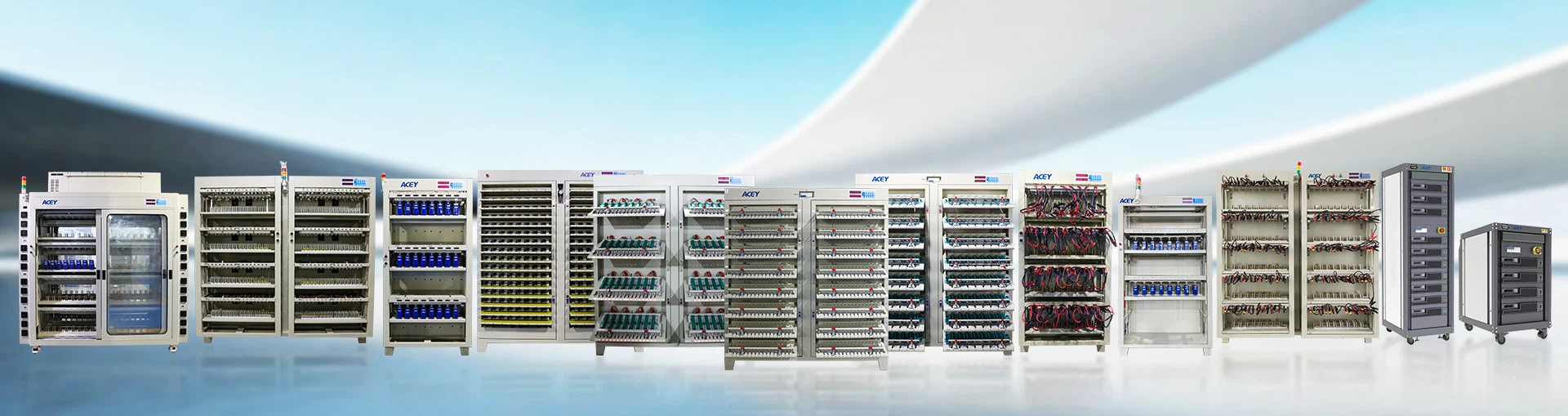
Lab Battery Cell Tester
The Lab Battery Cell Tester manufacture!
Our Lithium Battery Lab Fabrication Line is a modular, lab-scale production system designed for R&D, prototyping, and small-batch manufacturing of lithium-ion batteries. It replicates full-scale industrial processes, enabling seamless technology validation and scale-up.


After-sales service:
We have a professional after-sales engineer team to provide 24/7 all-weather service, and the product supports one-year warranty and lifetime maintenance. We provide complete after-sales services, including technical support, warranty repairs, spare parts supply, customer training, etc., to ensure that the equipment operates efficiently and meets your long-term needs.
Product market:
We have produced products that are well received by the market and are sold to more than 40 countries around the world.
Vision:
Our factory has advanced manufacturing equipment and our R&D team has more than 20 engineers to support customers' various customized needs.
OEM and ODM services:
Our products are rigorously tested and evaluated during the design and manufacturing process to ensure safety, reliability and environmental sustainability, and strictly comply with European regulatory requirements.
|
Product Name: |
Battery Testing Equipment 5V50MA |
|
|
Model No.: |
ACEY-BT-5V50MA |
|
|
Input power |
AC 220V ±10% / 50Hz |
|
|
Input active power |
25W |
|
|
Input Resistance |
≥1MΩ |
|
|
Resolution |
AD:16bit;DA:16bit |
|
|
Voltage |
Per Channel Voltage Range |
25mV~5V |
|
Discharge Min Voltage |
0V |
|
|
Accuracy |
± 0.05% of FS |
|
|
Stability |
± 0.05% of FS |
|
|
Current |
Per Channel Current Range |
Range one:5uA~1mA; |
|
Accuracy |
± 0.05% of FS |
|
|
Constant Voltage Cut-off Current |
2uA;0.05mA;0.1mA |
|
|
Stability |
± 0.05% of FS |
|
|
Power |
Per Channel Output Power |
0.05W |
|
Stability |
±0.1% of FS |
|
|
Time |
Current Response Time |
(0~Full Range)<1ms |
|
Step Time Range |
≤(365*24)Hour/Step |
|
|
Data Recording |
Recording Condition |
The minimum time interval:100ms |
|
Record Frequency |
10Hz |
|
|
Charge |
Charge Mode |
Constant Current Charge,Constant Voltage Charge,Constant Current and Constant Voltage Charge,CPC |
|
End Condition |
Voltage,Current,Relative Time,Capacity,-△V |
|
|
Discharge |
Discharge Mode |
CCD,CPD,CRD |
|
End Condition |
Voltage,Current,Relative Time,Capacity |
|
|
Pulse |
Charge |
CCC |
|
Discharge |
CCD |
|
|
Min Pulse Width |
500ms |
|
|
Pulse Number |
Each pulse step supports 32 different pulses |
|
|
Automated Switch |
Automated switch from charge to discharge for each pulse |
|
|
End Condition |
Voltage, Test Time |
|
|
Cycle |
Loop Measure Range |
1~65535 times |
|
Max Steps Per Loop |
254 |
|
|
Nested Loop |
Nested loop Function,Max Support 3 Layers |
|
|
Protection |
Software Protection |
Power-down Data Protection |
|
Off-line Testing Function |
||
|
Setting Protection Condition,Setting Parameter:Low Voltage limit,Upper Voltage limit,Low Current limit,Upper Current limit,Delay Time |
||
|
Noise |
<85dB |
|
|
Channel Features |
Constant Current Source and Constant Voltage Source with Independent pairs of Closed-loop Structure |
|
|
Channel Control Mode |
Independent Control |
|
|
Voltage and Current Testing Sample |
4-wire connecting |
|
|
Database |
MySQL Database |
|
|
A Means of Communication of Upper Machine |
TCP/IP Protocol |
|
|
Data Output |
EXCEL,TXT,Graph |
|
|
Communication Interface |
Ethernet Port |
|
|
Per Unit Main Channels No. |
8 |
|
|
Working Temperature Range |
0℃~40℃ |
|
|
Storage Temperature Range |
-10℃~50℃ |
|
|
Working Environment Relative Humidity Range |
30% ~ 80% RH |
|
|
Storage Environment Relative Humidity Range |
30% ~ 90% RH |
|
|
Dimensions |
1U,W*D*H:480*330*45(mm) |
|
Benefits of using battery Capacity Tester
Enhanced reliability: Explain how regular battery testing contributes to the reliability of power systems and prevents unexpected failures. Battery testing equipment also plays a crucial role in assessing the condition and performance of battery packs, used in various applications such as electric vehicles and energy storage systems. The ability to accurately evaluate the state of charge, capacity, and overall health of battery packs is essential for ensuring their reliability and safety.
Cost savings: Discuss how proactive battery testing can help avoid costly downtime and premature battery replacements. Battery testing equipment is indispensable for assessing the condition and performance of battery packs, which are utilized in applications such as electric vehicles and energy storage systems. proactive battery testing can help avoid costly downtime and premature battery replacements, leading to significant cost savings. By incorporating battery testing equipment into regular maintenance practices, industries can enhance the reliability of power systems and prevent unexpected failures, ultimately optimizing the performance and longevity of battery-powered devices across diverse applications.
Improved safety: Highlight the role of battery testing in identifying potential safety hazards and preventing battery-related incidents. When it comes to battery testing equipment, one of the key features to consider is its compatibility with different battery types. This is crucial because various industries rely on a wide range of battery chemistries and sizes. The ability to test and evaluate these diverse batteries accurately is essential for ensuring reliable power supply across different applications.

- Software control direct to cell channel hardware
- Software UI to embedded computer to cell channel hardware
- Software UI to internal hardware sequencer to cell channel hardware
Industries That Conduct Battery Testing
Automotive
Battery testing is crucial in the automotive industry, where batteries are used to power EVs. For instance, manufacturers are focused on extending the range EVs have on a single charge, alleviating some of the so-called “range anxiety” many consumers experience. Labs will employ high-density battery test chambers and fixtures to conduct research and development on EV batteries
Aerospace
The aerospace industry tests batteries used in spacecraft and satellites, verifying whether cells can withstand the extreme conditions of space and perform reliably over long periods.
Electronics
Battery testing is essential for companies that manufacture electronic devices, such as smartphones, laptops, medical equipment, and tablets. Rigorous testing ensures batteries are safe, reliable, and long-lasting before products end up in the hands of consumers.
Energy Storage
Battery testing is critical in the energy storage industry. While EVs utilize energy storage, there are many other applications for energy storage beyond transportation.
FAQ
Find professional lab battery cell tester manufacturers and suppliers in China here! Please feel free to buy high quality lab battery cell tester from our factory. For customized service, contact us now.
Coin Cell Battery Tester, lab battery cell tester