

When we mention "battery", most people first think of "Battery" - this word is the general term for all batteries. In essence, a battery is an energy storage device that converts chemical energy into electrical energy. Its core component is the electrochemical cell, which is often referred to as "Cell" in daily life and "battery core" in industrial scenarios.

It should be noted here that the definition of "solar cell" is different from that of traditional batteries: it is not an energy storage device, but an energy conversion device that directly converts light energy into electrical energy through the photoelectric effect. From the perspective of etymology, the original meaning of "Solar cell" is closer to "solar unit", which also confirms its essential attribute of energy conversion.
Lithium iron phosphate battery
Compared with traditional lead-acid batteries, lithium iron phosphate has many advantages. Its theoretical specific capacity is 170mAh/g (more than 140mAh/g in actual applications), which is much higher than the 40mAh/g of lead-acid batteries, and its energy density advantage is significant. As the safest lithium-ion battery positive electrode material, it does not contain metal elements that are harmful to the human body, and its safety is outstanding. In addition, lithium iron phosphate has good lattice stability, and lithium ion insertion and extraction have little effect on the lattice, so that the battery can be charged and discharged more than 2,000 times at 100% DOD, with a long cycle life. At the same time, it also has the characteristics of good charging performance, low price, and environmental protection. However, it has the disadvantage of poor electrode ion conductivity, which is not suitable for large current charging and discharging. At present, this problem is solved by coating the electrode surface with conductive materials and modifying the electrode by doping.
LFP batteries and lithium batteries are both green and environmentally friendly batteries. The biggest difference is that LFP batteries have no safety concerns such as overheating or explosion. Their cycle life is about 4-5 times that of lithium batteries, and their discharge power is 8-10 times higher than that of lithium batteries. At the same energy density, their overall weight can be reduced by 30-50% compared to lithium batteries. These characteristics make LFP batteries widely used. In the field of new energy vehicles, they are especially suitable for commercial vehicles and buses that have high requirements for safety and cycle life. In energy storage systems, they can be used for grid peak regulation and photovoltaic and wind power storage, reducing the full cycle cost with their long life and low cost advantages. In addition, they are also suitable for low-speed transportation vehicles such as electric bicycles and electric forklifts, as well as backup power supplies for communication base stations and data centers.
Resistance
Resistance is the resistance to the flow of current through the lithium battery when it is working. It can usually be divided into ohmic internal resistance and polarization internal resistance. Among them, the ohmic internal resistance is determined by the total conductivity of the battery, and the polarization internal resistance depends on the solid phase diffusion coefficient of lithium ions in the electrode active material.
Ohmic internal resistance specifically includes three parts: ionic impedance, electronic impedance and contact impedance. Polarization internal resistance is the internal resistance caused by polarization when electrochemical reactions occur at the positive and negative electrodes of the battery. Although it can reflect the internal consistency of the battery, it is greatly affected by the operation method and is not suitable for production scenarios. Polarization internal resistance is not a constant value and will change with time during the charging and discharging process. This is because factors such as active material composition, electrolyte concentration and temperature are always in dynamic change. It is worth noting that the ohmic internal resistance follows Ohm's law, while the relationship between the increase of polarization internal resistance and the increase of current density is not linear, and usually increases linearly with the logarithm of current density.
DC internal resistance and AC internal resistance
Battery internal resistance is a key indicator for measuring battery performance, which is generally divided into two categories: DC internal resistance (DCR) and AC internal resistance (ACR). In judging the aging state of lithium-ion batteries, battery impedance has an important reference value: during the use of lithium-ion batteries, the growth of ohmic internal resistance is relatively limited, but as the SEI film gradually thickens and irreversible substances are continuously deposited on the surface of the electrode active material, the charge transfer impedance and diffusion impedance will continue to rise. This change can be used to qualitatively evaluate the degree of battery aging.
Battery rate
C (battery discharge C rate) is an important indicator to measure the battery's charge and discharge capabilities. It is defined as the ratio of the charge and discharge current to the rated capacity, and is used to indicate how fast the battery discharges. The battery capacity can be detected by different discharge currents. For example, when a battery with a capacity of 100A·h is discharged at a current of 15A, the discharge rate is 0.15C. Currently, lithium-ion batteries used in daily electronic products such as mobile phones and laptops are often referred to as "high-rate batteries", but strictly speaking, high-rate batteries are rarely used in such devices due to their high safety risks. Generally speaking, the larger the rate, the larger the discharge current, and the higher the requirements for battery performance and safety.
Battery cycle life
Battery cycle life Lithium batteries used in electric vehicles are usually expected to have a cycle life of more than 2,000 times. Considering that electric vehicles are mostly used for short distances, if they are charged once every 2 days, a cycle life of 2,000 times can support pure electric vehicles on the road for nearly 11 years. As smartphones become increasingly powerful, the size of the display screen continues to increase, and the body tends to be thinner and lighter, higher requirements are placed on the energy density of the battery. At the same time, a cycle life of more than 500 times must be met to ensure that the phone can be used for more than 2 years. The cycle life of the positive electrode material is closely related to its crystal structure, charge and discharge depth, preparation process and other factors. Taking lithium iron phosphate as an example, it has a stable olivine structure, which theoretically allows all lithium in the structure to be removed, and has good reversibility during the charge and discharge process, which makes it show excellent cycle performance and become a typical positive electrode material system that takes into account both safety and long life.
ACEY-BT10020-7 battery pack tester is mainly used for lithium battery charging and discharging cycle test. The test items include battery charging protection voltage, discharging protection voltage, capacity, etc. The equipment has four test steps: charging, discharging, shelving and cycling. By editing the corresponding step, the battery can be tested according to the set process.

Secondary use of lithium batteries
With the rise of electric vehicles, the use of lithium batteries has greatly increased. The retired batteries on electric vehicles have 70%\80% of their power. The retired lithium iron phosphate power batteries can be used as energy storage batteries for 35 years.
If they are directly scrapped and dismantled for recycling, the economic benefits of recycling 1 ton of lithium iron phosphate are about 10,000 yuan;
If they are used for secondary use, such as energy storage power stations, communication base stations, etc., the benefits can reach 30,000 to 40,000 yuan. Great commercial prospects!
ESS
ESS is the abbreviation of Energy Storage System, which literally means "energy storage system". The core function of the energy storage system is to store electric energy, but what is behind it is the operation logic of the entire power system - the essential requirement of the power system is that the power generation and power consumption must be strictly balanced every second. This instantaneous balance is not only difficult to control accurately but also related to the survival of the system. Once it is unbalanced, it will cause the power grid to collapse.
The value of energy storage power stations lies in solving this problem: by storing excess electric energy, the rigid supply and demand relationship of the power system is transformed into flexible regulation, thereby improving the stability of the power grid. This "peak shaving and valley filling" mechanism allows the power system to achieve continuous and reliable operation in dynamic balance.
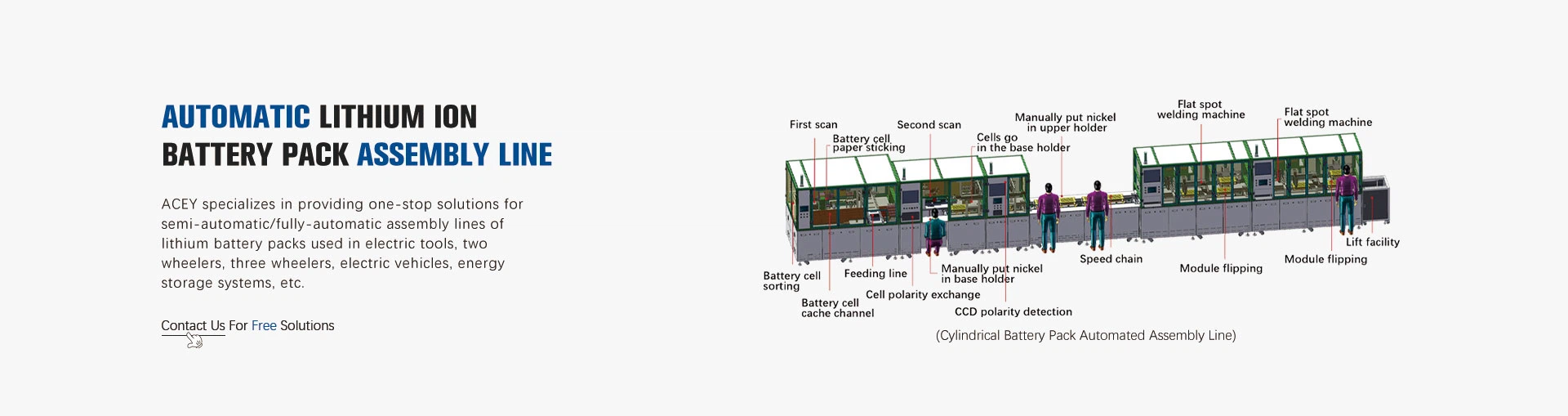
Acey Intelligent specializes in providing one-stop solutions for semi-automatic/fully-automatic assembly lines of lithium battery packs used in ESS, UAV, E-Bike, E-Scooter, Power Tools, Two/Three Wheelers, Etc.

The difference between power batteries and 3C batteries
Lithium-ion batteries can be divided into two categories: consumer and power batteries due to different application scenarios. Consumer lithium-ion batteries focus on "3C products" such as mobile phones, portable computers, digital cameras, as well as mobile power supplies, electric toys and other fields, mainly providing energy support for equipment. Its battery cells and modules are rich in form, covering three types: cylindrical, square and soft pack.
Power lithium-ion batteries serve scenarios such as electric vehicles and power tools. As the core energy source for driving equipment, they are also called lithium-ion power batteries and power lithium batteries. In terms of form, they also include three types: cylindrical, square and soft pack. Due to differences in application fields, there are significant differences between consumer and power lithium-ion batteries in terms of performance requirements, design standards, etc., which will be elaborated in detail below.
Power lithium-ion batteries need to consider reliability and consistency more. After all, they need to be used for a long time (at least 5 to 10 years), in harsh environments (low temperatures in winter, exposure to the sun in summer, rain and snow), and in series and parallel groups of a large number of batteries. Ideally, the probability of power battery problems (safety, storage, circulation, etc.) should be less than one in 100 million (of course, for the highest-end consumer batteries, Apple also requires suppliers to reach this level). Considering reliability, power batteries are generally designed with more redundancy, using thicker diaphragms, foils and shells, so the energy density is about half of that of consumer batteries.
The use conditions of consumer lithium-ion batteries are relatively less stringent, and there is no need for long-term reliability (the cycle does not need to be too good, because it will be replaced in one or two years anyway). It is usually used alone and generally does not require grouping, so there is not much requirement for consistency. However, since consumer mobile phones and tablets have limited space and are very precious, consumer lithium-ion batteries have strict requirements on size, capacity, energy density, etc. High-end consumer batteries use the most advanced technology and materials, while power batteries require more advanced process control, consistency control and quality management.