

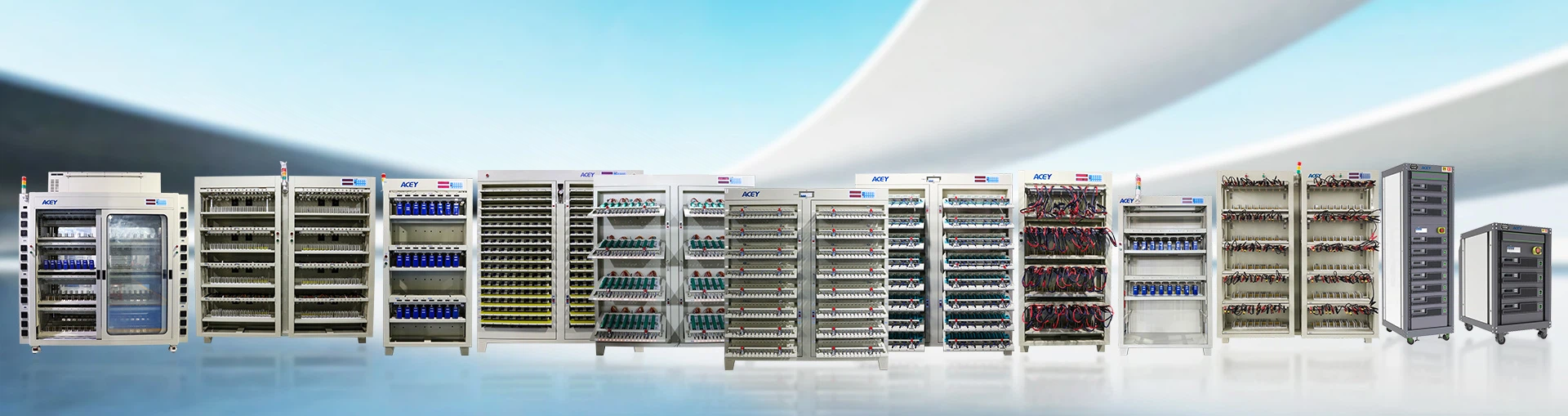
Internal Resistance Tester
The Internal Resistance Tester manufacture!
Our Lithium Battery Lab Fabrication Line is a modular, lab-scale production system designed for R&D, prototyping, and small-batch manufacturing of lithium-ion batteries. It replicates full-scale industrial processes, enabling seamless technology validation and scale-up.


After-sales service:
We have a professional after-sales engineer team to provide 24/7 all-weather service, and the product supports one-year warranty and lifetime maintenance. We provide complete after-sales services, including technical support, warranty repairs, spare parts supply, customer training, etc., to ensure that the equipment operates efficiently and meets your long-term needs.
Product market:
We have produced products that are well received by the market and are sold to more than 40 countries around the world.
Vision:
Our factory has advanced manufacturing equipment and our R&D team has more than 20 engineers to support customers' various customized needs.
OEM and ODM services:
Our products are rigorously tested and evaluated during the design and manufacturing process to ensure safety, reliability and environmental sustainability, and strictly comply with European regulatory requirements.
|
Model HK3561 |
|
|
Measurement parameters |
ESR, DCV |
|
Basic accuracy |
Internal resistance: 0.5% voltage V: 0.1% |
|
Test Range |
Internal resistance : 10U / 3.2K/V: 1mV~60V |
|
Screen |
Four-color VFD display |
|
Maximum display value |
Internal resistance : 32000; The voltage V: 60000 |
|
Calibration |
Full range short circuit zero clearance; REl function |
|
Comparator |
30 sets of data recording, ng-lo, gd-in, ng-hi display and output buzzer volume adjustable |
|
Trigger mode |
Internal/manual |
|
Interface |
RS-232C/RS-485 |
|
Power supply |
Voltage :198VAC ~ 240VAC; Frequency: 47Hz ~ 63Hz; Power: Max 15VA |
|
Dimension & weight |
Size: 385 mm (L) x249mm x102mm (W) (D); Weight: 3.5 kg |
|
Accessories |
HK3500-A Kelvin test line,HK3800 RS232C interface cable |
|
Options |
HK3500-B test probe |
|
Others |
Internal resistance : 10U / 3.2K/V: 1mV~60V |
Advantages of Internal Resistance Tester
Battery Health Assessment
Internal resistance is a key indicator of a battery's health and condition. As a battery ages or undergoes wear and tear, its internal resistance tends to increase. By regularly testing the internal resistance, you can assess the overall health of the battery. This is crucial for batteries used in critical applications like emergency backup power systems, electric vehicles, and renewable energy systems.
Predictive Maintenance
Monitoring internal resistance can help you predict when a battery is nearing the end of its useful life. As internal resistance increases, a battery's capacity and performance can degrade. By identifying this trend early, you can schedule battery replacement or maintenance before the battery fails completely, minimizing the risk of unexpected downtime.
Performance Optimization
In applications where batteries are essential for performance, such as electric vehicles or renewable energy storage systems, monitoring and managing internal resistance can help optimize battery performance. High internal resistance can lead to energy losses, reduced power output, and shorter operating times. By identifying and addressing high resistance, you can maintain or improve the battery's performance.
Troubleshooting
When a battery-related problem arises, an internal resistance test can help diagnose the issue. For example, if a battery fails to deliver its rated capacity, the internal resistance may be too high, indicating a problem within the battery. Identifying the root cause allows for targeted troubleshooting and maintenance.
Quality Control
Manufacturers and suppliers of batteries often use internal resistance testing as part of their quality control processes. Ensuring that batteries meet specified internal resistance thresholds helps maintain product quality and reliability, particularly for applications like consumer electronics and medical devices.
Safety
High internal resistance in batteries can lead to safety concerns, including overheating and, in extreme cases, thermal runaway or cell rupture. By monitoring and managing internal resistance, you can reduce the risk of safety incidents, which is crucial for applications like aerospace, medical devices, and industrial equipment.
Cost Savings
Identifying and replacing batteries with high internal resistance before they fail can save you money in the long run. It's more cost-effective to replace or maintain batteries proactively than to deal with emergency replacements and potential damage or downtime.
Data Logging and Analysis
Battery internal resistance testers often provide data logging and analysis capabilities, allowing you to track the historical performance of batteries over time. This data can be valuable for trend analysis, optimization, and decision-making.

• Deficiency of alkaline batteries and lead battery measurement and life assessment
• UPS detection
• Factory inspection of batteries
• High -precision lithium battery internal resistance and voltage detection
• High -speed mass production random inspection of buttons
• Measurement of fuel cell group
• Test of high -voltage battery packs such as electric vehicle lithium batteries
• Multi -section series high -voltage lithium battery internal resistance and voltage measurement
• Measurement of hydrogen fuel cell resistance and voltage
• The supporting automatic sorting machine performs battery internal resistance+voltage automatic test
• The deterioration state and life evaluation of the battery
• ESR test of super capacitance (low internal resistance capacitor)
Usage battery internal resistance tester
Before testing, it is necessary to prepare a battery resistance tester, the tested battery, wires, and other necessary tools. At the same time, to ensure the accuracy of testing, the testing environment should be kept quiet and undisturbed, and the testing ground should be flat and hard to avoid unexpected situations during the testing process.
Connect the battery resistance tester and the tested battery through wires. During the connection process, it is necessary to pay attention to the correctness of the positive and negative poles to avoid reverse connections. At the same time, it is necessary to place the tested battery in the center of the testing ground to ensure its stability.
After connecting the wires, the testing can begin. During the testing process, it is necessary to fully charge the tested battery and wait for a period of time to ensure that it is in a stable state. At the same time, it is necessary to set testing parameters according to the actual situation, such as testing time, testing items, etc.
After setting the testing parameters, you can start testing. During the testing process, it is necessary to maintain silence to avoid interfering with the test results. At the same time, it is also necessary to pay attention to the changes in the test data, and if any abnormal situations occur, they should be dealt with in a timely manner.
After the testing is completed, it is necessary to analyze the test results. Based on the test results, the health status and performance of the tested battery can be determined. If there is any abnormal situation in the test results, it is necessary to handle it in a timely manner or replace the battery.
Package
Standard exported package: Internal anticollision protection, external export wooden box packaging.
Shipping by express, by air, by sea according to customers' requirements to find the most suitable way.
Responsible for the damage during the shipping process, will change the damaged part for you for free.

FAQ
Find professional internal resistance tester manufacturers and suppliers in China here! Please feel free to buy high quality internal resistance tester from our factory. For customized service, contact us now.
Battery Ir Tester, internal resistance tester