

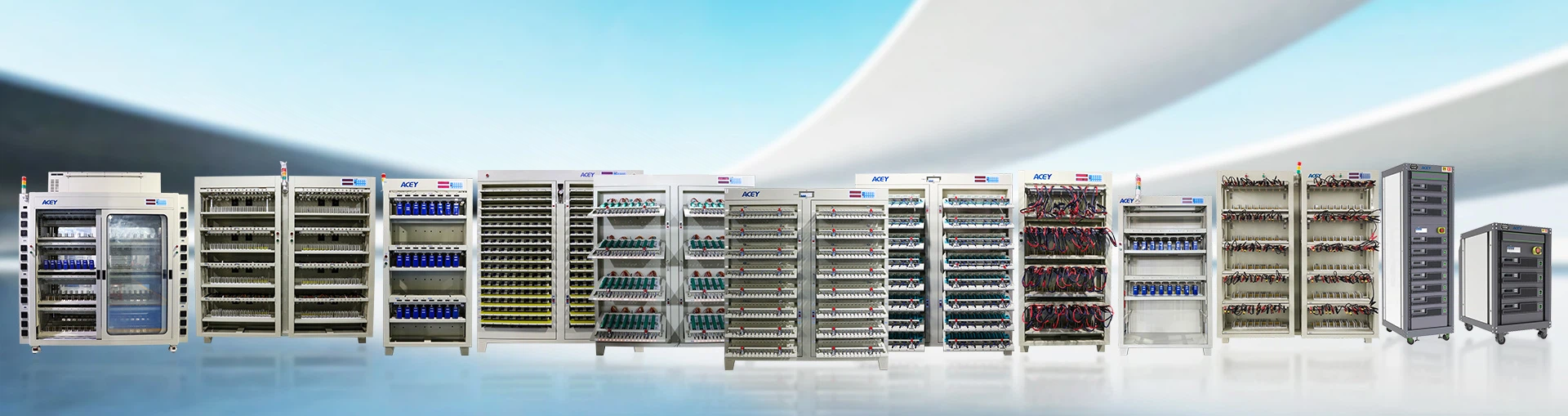
Cylindrical Cell Tester
The Cylindrical Cell Tester manufacture!
Our Lithium Battery Lab Fabrication Line is a modular, lab-scale production system designed for R&D, prototyping, and small-batch manufacturing of lithium-ion batteries. It replicates full-scale industrial processes, enabling seamless technology validation and scale-up.


After-sales service:
We have a professional after-sales engineer team to provide 24/7 all-weather service, and the product supports one-year warranty and lifetime maintenance. We provide complete after-sales services, including technical support, warranty repairs, spare parts supply, customer training, etc., to ensure that the equipment operates efficiently and meets your long-term needs.
Product market:
We have produced products that are well received by the market and are sold to more than 40 countries around the world.
Vision:
Our factory has advanced manufacturing equipment and our R&D team has more than 20 engineers to support customers' various customized needs.
OEM and ODM services:
Our products are rigorously tested and evaluated during the design and manufacturing process to ensure safety, reliability and environmental sustainability, and strictly comply with European regulatory requirements.
|
Device channel number |
The whole machine has a total of 512 channels |
|
Chassis color |
Standard gray and black (customizable) |
|
Fixture form |
Flat head fixture |
|
Fixture spacing |
35MM |
|
Battery Model |
Battery model 18650, 21700, 26650, 32650, 32700, |
|
Channel control mode |
Each battery has an independent constant current and constant voltage source, which is stable and without impact. Able to start, stop, pause, continue and protect |
|
Each channel has an independent constant voltage and constant current hardware control circuit |
|
|
Each channel charge current, discharge current precision fine-tuning calibration |
|
|
Power supply |
Three-phase five-wire system AC380V±10%, 50HZ |
|
Power factor |
≥0.99 |
|
AC current distortion rate |
≤2% |
|
Overall charging efficiency |
≥75% |
|
Feeder conversion efficiency |
≥70% |
|
Working power consumption |
≤18KW |
|
Equipment failure rate |
<1% |
|
Working environment |
Temperature -10~40, relative humidity 80% |
|
Cooling method |
Natural intake, upward exhaust |
|
Channel parameters |
|
|
Voltage measurement range |
DC 0~5V |
|
Battery voltage range |
Charging DC 0~4.5V; Discharging DC 4.5~2V |
|
Constant voltage range |
DC 2~4.5V |
|
Voltage accuracy |
±(1‰ reading+1‰ full scale), resolution 1mV |
|
Voltage stability |
≤(±1mV) |
|
Current range |
Charging DC 60mA~6A; Discharging DC 60mA~6A |
|
Current accuracy |
±(1‰ reading+1‰ full scale), resolution 1mA |
|
Current stability |
≤(±1mA) |
|
Software function |
|
|
Way to control |
Computer control equipment work, whole cabinet control, with scanning system |
|
Communication method |
485 serial port communication (baud rate 57600) |
|
Process settings |
Up to 32 steps and 256 cycles can be set |
|
Charging mode |
Constant current, constant voltage, constant current and constant voltage |
|
Charging cut-off conditions |
Voltage, current, time, capacity, -△V |
|
Discharge mode |
Constant current |
|
Discharge cut-off condition |
Voltage, time, capacity |
|
Protective function |
Overvoltage, undervoltage, overcurrent, undercurrent, overcapacity protection, power failure protection, data breakpoint recovery |
|
Time limit |
0~900 minutes/step, the time unit is min |
|
Time accuracy |
≤±1‰ |
|
Sampling inspection cycle |
≤8 seconds |
|
Battery sorting |
Sort by (capacity, time, open circuit voltage, discharge platform, etc.) |
|
Data processing |
It can record voltage, current, time, and capacity data, and automatically calculate constant current charging ratio, capacity loss, discharge efficiency, average voltage, median voltage and other data, and provideData curve graph and cycle graph; can be output to generate text, EXCEL, WORD or MDB database format files |

1. By dividing the battery capacity, the capacity and performance of the battery can be quickly and accurately evaluated, helping users make choices and improving battery efficiency and lifespan.
2. Volume separation is not only beneficial to the stability of the SEI film, but also shortens the time consumed in the volume separation process, reduces energy consumption and increases production capacity.
3. Divide the cells that will be used for lithium battery assembly into mechanical parts again. Through this process, you can always pick out some cells that do not meet the requirements and return them to the cell factory. After passing the lithium battery detection mechanical test, it can be seen that the battery core has been charged and discharged and is "charged". So when you get the battery, it has two bars of electricity, which is normal.
4. Capacity classification can classify and group batteries, and select monomers with the same internal resistance and capacity for combination. When combined, only those with very similar performance can form a battery pack.
Types of Lithium-Ion Cell Testing Machines
Battery Cycle Testers
These machines test the charge and discharge cycles of a battery to assess its longevity and efficiency. Cycle testing is essential for understanding how a battery will perform over time.
01
Cell Sorting Machines
Lithium-ion cell sorting machines are used to categorize cells based on their voltage, capacity, and internal resistance. Accurate sorting ensures that only high-quality cells are used in battery packs.
02
Battery Pack Testers
These devices evaluate the performance of a complete battery pack. They simulate real-world conditions to ensure the pack's durability and reliability.
03
Environmental Test Chambers
These chambers simulate extreme conditions, such as high temperatures, humidity, or vibrations, to assess a battery's resilience and safety under various scenarios.
04
Impedance Testers
Impedance testers measure the internal resistance of a cell, which is a key indicator of its health and performance.
05
The Basics of Battery Cell Quality Testing
Human visual inspection is a simple test to check for physical defects or abnormalities, although it's prone to subjectivity and human error. An inspector may check electrode coating, weld integrity, and the cell structure.
As automation becomes more prevalent in battery cell manufacturing, robotic systems with cameras and computer vision algorithms can perform visual inspections with speed, consistency, and precision. Automated visual inspection is a valuable tool for streamlining quality control processes, enhancing inspection capabilities, and boosting manufacturing efficiency.
Direct current internal resistance (DCIR) tests measure resistance to direct current flow. The battery is injected with a relatively high intensity current pulse to measure the ohmic response of the cell. Pulses are applied when the battery is at different states of charge to map the response across the cell range, both charging and discharging. This process provides insights into the internal condition of the cell and its functionality.
While DCIR doesn't provide the most comprehensive analysis, it's a quick and simple approach to get a baseline measurement of internal resistance. Alternating current internal resistance (ACIR) and electrochemical impedance spectroscopy (EIS) tests provide more information about battery impedance, but they are more time-consuming and require specialized equipment.
Unlike DCIR, which measures resistance to direct current, ACIR evaluates the impedance of the battery under alternating current flows. A sinusoidal current is applied to the cell, and the voltage reaction is measured at specific frequencies (typically 1 kHz).
By analyzing the voltage response, engineers can characterize the AC dynamic of the cell and detect critical defects. The results reveal information about various electrochemical processes, aging effects, and internal resistance variations across different frequencies.
EIS tests are the most advanced type of impedance test. Instead of applying the sinusoid at one frequency and amplitude like an ACIR test, the stimuli are applied at many frequencies, typically from 0.1 Hz to 10 kHz or more.
Defects that would otherwise go undetected by ACIR and DCIR tests are captured with EIS because these tests evaluate performance across a larger spectrum and wider frequency range. This method can help identify issues like premature aging. These insights improve the lab's diagnostic capabilities and provide deeper insights into battery behavior.
Open circuit voltage (OCV) tests measure the cell voltage when no load is applied to it and no current is flowing outside the battery. This simple, non-intrusive test indicates whether a cell was correctly activated and characterizes how the cell degrades over time. However, this test provides limited insights into the cell's internal condition. A cell with an OCV that is too low or too high indicates a cell quality concern.
OCV tests are often used to estimate the leakage current of a cell in the formation, pack assembly, and throughout the battery's lifecycle, rating its performance and checking its health. For example, OCV tests are used to sort and match cells during pack assembly.
Leakage tests are helpful for the early detection of leaks, cell damage, or deterioration. These tests are performed in numerous ways to assess the quality of battery cells and packs. Most commonly, periodic OCV tests are performed to detect leakage when the cell is left to age in a climatically controlled environment.
The industry is researching advanced methods. For example, a voltage can be imposed on a cell, and an additional current is supplied to stabilize that voltage. The additional current required to stabilize the voltage is an estimate of the internal leakage current. Unfortunately, this technique is time-consuming and does not produce repeatable results.
FAQ
Find professional cylindrical cell tester manufacturers and suppliers in China here! Please feel free to buy high quality cylindrical cell tester from our factory. For customized service, contact us now.
battery cell tester, cylindrical cell tester, Cell Grading Machine