

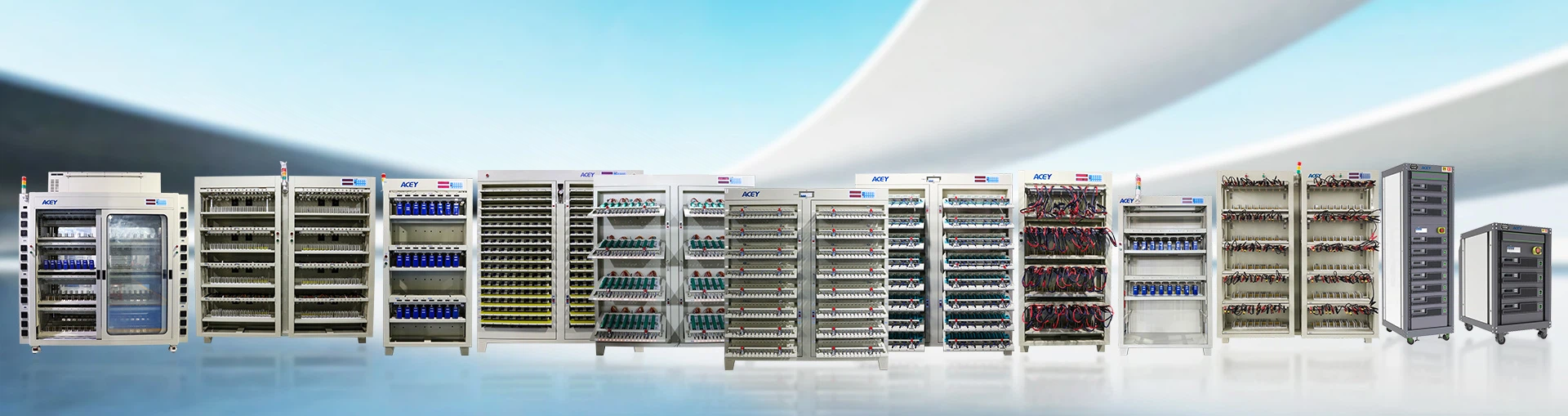
Aging Machine
The Aging Machine manufacture!
Our Lithium Battery Lab Fabrication Line is a modular, lab-scale production system designed for R&D, prototyping, and small-batch manufacturing of lithium-ion batteries. It replicates full-scale industrial processes, enabling seamless technology validation and scale-up.


After-sales service:
We have a professional after-sales engineer team to provide 24/7 all-weather service, and the product supports one-year warranty and lifetime maintenance. We provide complete after-sales services, including technical support, warranty repairs, spare parts supply, customer training, etc., to ensure that the equipment operates efficiently and meets your long-term needs.
Product market:
We have produced products that are well received by the market and are sold to more than 40 countries around the world.
Vision:
Our factory has advanced manufacturing equipment and our R&D team has more than 20 engineers to support customers' various customized needs.
OEM and ODM services:
Our products are rigorously tested and evaluated during the design and manufacturing process to ensure safety, reliability and environmental sustainability, and strictly comply with European regulatory requirements.
|
Charging function |
With constant current and constant voltage charging function |
|
Discharge function |
With constant current and current limiting discharge function |
|
Charge and discharge interface |
Fully meet the requirements of charging and discharging the same port and separate charging and discharging of the battery pack, that is, 2 wires (P+ P-) and 3 wires (P+ P- C-) |
|
Equipped with a usb interface |
It is used for scanning gun to collect the ID number of the battery pack, which is convenient for data query after battery aging |
|
Security protection |
Anti-reverse protection function |
|
Voltage upper and lower limit setting protection |
|
|
Safe discharge current protection (maximum current 10A) |
|
|
Charging |
Charging voltage 0-70V, continuously adjustable, accuracy ±1mV(high precision dedicated) |
|
Charging current 0-5000mA, continuously adjustable, accuracy ±1mA (high precision dedicated) |
|
|
Discharge |
Discharge voltage 0-70V, accuracy ±1mV (high precision dedicated) |
|
Discharge current 0-10A, accuracy ±1mA (high precision dedicated) |
|
|
Discharge capacity error 1‰ (high precision dedicated) |
- Automatic network connection eliminates the need for manual setup in online mode.
- Data is securely stored in an MYSQL database, preventing loss and enabling historical measurement review.
- A small number of instruments can communicate with PC software through the serial port.
- Multiple instruments can use the network to communicate with PC software, which reduces the computer interface. Only one network port is needed to control all instruments, ensuring the real-time and complete communication data.
- The instrument number is displayed through LED lights, and the position of the corresponding instrument can be queried intuitively. The number can be modified by software, which reflects the flexibility of the instrument.
- In addition to the P+ and P- interfaces, the instrument also provides CH+ and CH-, which can test special finished batteries and charge and discharge them on one instrument.
- The battery can be charged as long as the battery is in the test range, avoiding the problem that the charger can only charge a specific type of battery.

Structure and Appearance of the Equipment

(1) One CPU board, centrally controlling the entire cabinet.
(2) 64 constant current boards for eight channels, evenly arranged in four sections.
(3) 32 charging switch power supplies for two groups of outputs, each supplying power to 2 constant current boards.
(4) Two keyboard boards, allowing dual-sided operation.
(5) 32 sets of quick clamps, each set with 16 channels, equipped with 32 plastic battery trays. Each battery tray can simultaneously accommodate batteries of sizes such as 18650, 21700, 26650, 32650, and 32700.
Applications of Battery Discharge Testers
Battery manufacturing: Battery manufacturers use discharge testers to test the performance of their products before they are shipped to customers.
Battery maintenance: Battery discharge testers are used to test the performance of batteries during routine maintenance and to determine when batteries need to be replaced.
Battery research and development: Battery discharge testers are used in the research and development of new battery technologies to measure their performance and identify areas for improvement.
UPS systems: Uninterruptible power supply (UPS) systems use batteries to provide backup power during a power outage. Discharge testers are used to test the performance of these batteries to ensure that they will function properly during a power outage.
Telecommunications power systems: Telecommunications companies use battery backup systems to provide power in the event of a power outage. Discharge testers are used to test the performance of these batteries to ensure that they will function properly during an outage.
There are several factors that can affect the accuracy and reliability of a battery discharge tester. These include the load bank resistance, the power supply stability, and the accuracy of the voltage and current measurements.
Load bank resistance is an important factor because it determines the discharge current that is applied to the battery. A lower resistance will result in a higher discharge current, which can cause the battery to heat up and reduce its capacity. A higher resistance will result in a lower discharge current, which can extend the test time and increase the measurement error.
Power supply stability is also an important factor because it determines the accuracy of the discharge current. If the power supply voltage fluctuates during the test, the discharge current will also fluctuate, which can cause measurement errors. To ensure accurate measurements, it is important to use a power supply that provides a stable voltage and current output.
The accuracy of the voltage and current measurements is also critical for reliable battery discharge testing. The voltmeter and ammeter must be calibrated to ensure accurate readings, and they must also be able to measure the battery voltage and current accurately during the discharge test. In addition, the measurement interval must be appropriate for the battery being tested. For example, a high-capacity battery may require longer measurement intervals to accurately capture its discharge curve.

Packaging & Shipping

FAQ
Find professional aging machine manufacturers and suppliers in China here! Please feel free to buy high quality aging machine from our factory. For customized service, contact us now.
aging machine, Battery Charge Discharge Tester