

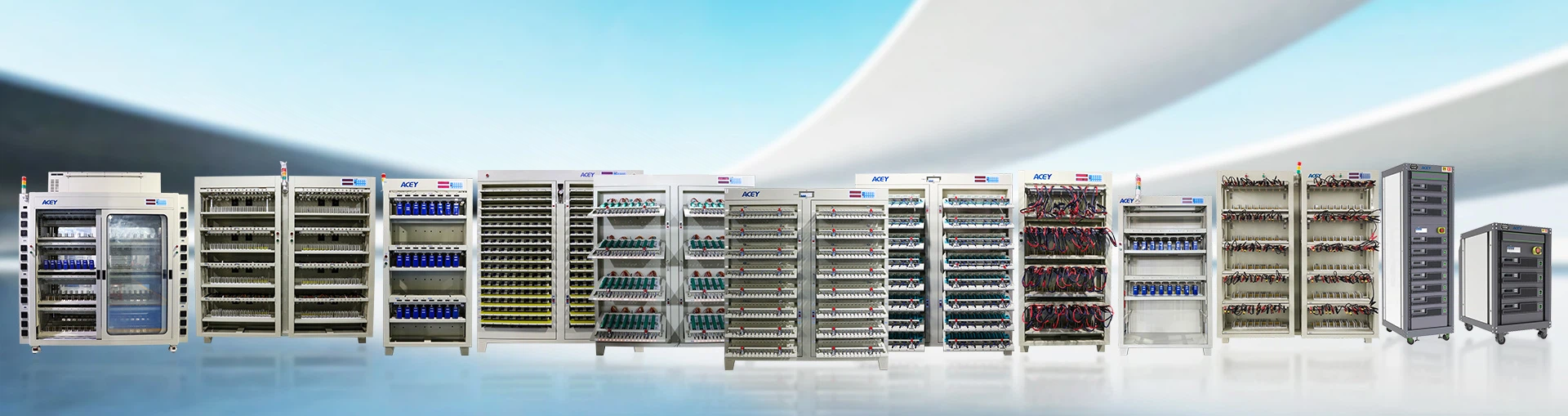
Stacking Machine
Our goal is to become your true partner in the field of battery cell tester in China. Acey Intelligent Equipment is a high-tech enterprise and specializes in the development of high-end equipment for lithium-ion batteries. We providing enormous production capacity, as well as a professional R&D and after-sales service team with over 15 years of experience in this field. Our company is committed to applying advanced manufacturing technology and strict quality control standards to every product. The price is competitive and the product is quality-assured, which is a good choice for your long-term cooperation.


Why Choose Us
Product market:
We have produced products that are well received by the market and are sold to more than 40 countries around the world.
OEM and ODM services:
Our factory has advanced manufacturing equipment and our R&D team has more than 20 engineers to support customers' various customized needs.
Our certification:
Our products are rigorously tested and evaluated during the design and manufacturing process to ensure safety, reliability and environmental sustainability, and strictly comply with European regulatory requirements.
After-sales service:
We have a professional after-sales engineer team to provide 24/7 all-weather service, and the product supports one-year warranty and lifetime maintenance. We provide complete after-sales services, including technical support, warranty repairs, spare parts supply, customer training, etc., to ensure that the equipment operates efficiently and meets your long-term needs.
Advantages of Stacking Machine

High energy density:
The stacking process can effectively utilize space, increase battery capacity and energy density by stacking small cell units.
Good safety:
The existence of separators can avoid short circuits between the positive and negative electrodes, reducing the risk of battery short circuits.
Long cycle life:
The small cell units of the stacking process have a long cycle life, providing more stable battery performance.
Specification of Stacking Machine
|
Lamination method |
Z-shaped lamination |
|
Diaphragm material roll |
Roll material diaphragm, 3 inch core, diameter φ200mm; |
|
Applicable pole piece specifications |
Length (20~200) mm, width (20~200) mm, thickness within 16mm; |
|
Swing roller travel stroke |
300mm; |
|
Power supply |
AC220V/50Hz; |
|
Power |
200W; |
|
Air pressure source |
0.4MPa~0.7MPa; |
|
Equipment size |
L650mmW400mmH700mm; |
|
Control box size |
L200mmW300mmH380mm; |
|
Weight |
30Kg; |
Types of Electrode Stacking Machine
Manual stacking machine: Manual stacking machines are vehicles that facilitate the loading, unloading, and transportation of products stacked on pallets. These machines, operated by human strength, use hydraulic pumps for horizontal and vertical movements. Manual stacking machines, which are fundamental tools in warehouse operations, find extensive use across various industries.
Semi-electric stacking machine: A semi-electric stacking machine is a vehicle used for transporting loads from one place to another in factory and storage areas through an operator's control, and lifting and lowering operations are powered by hydraulic pumps using electrical energy.
Semi-powered stacking machine: Stacking machines, also known as "stacker machines," are used across a wide range of applications, from industrial facilities to warehouses, to lift, lower, and perform horizontal-vertical movements for various loads. These machines are developed with the aim of making work processes more efficient.
Fully electric stacking machine: Machines designed to effectively meet transportation and stacking needs are referred to as fully electric stacking machines. These specialized machines are used for purposes such as transporting, stacking, and placing loads on high shelves, thus optimizing work processes.
Coil stacking machine: Coil stacking machines are specially designed machines for effectively transporting and stacking coils. In the manual model, forward-backward and up-down movements are carried out manually.
Features of Stacking Machine
The adjustment, operation and maintenance of the machine are simple and easy. Applicable to a wide range of cell stack sizes.
High working efficiency, with digital display counter. Adopt foot switch to control cylinder movement. The machine is small in size, exquisite and beautiful in appearance.


Application of Stacking Machine
An electrode stacking device is used to manufacture the electrodes of secondary batteries. It cuts electrode materials, which have been pressed with roll press equipment, into specific lengths and alternately stacks the positive electrode, negative electrode and separator in layers.
Precautions for Use Stacking Machine
A specialized machine that fixes boxed positive and negative electrode sheets and rolled separator material in designated positions. It automatically alternates positive and negative electrode sheets to a reciprocating stacking platform. The separator is unrolled in a Z-shaped path to separate the positive and negative electrode sheets, wrap around the exterior, cut the separator, and apply adhesive, thus completing the production of lithium-ion battery core.
Packaging and Shipping of Stacking Machine
|
Packing |
Plywood Case |
|
Shipping |
Shipped by road, sea, rail or air |
Other Service of Stacking Machine
|
Order(Moq) |
1 set |
|
Compliance |
CE Certified |
|
Product Origin |
China |
|
Warranty |
One-year warranty with lifetime support |
|
Payment |
T/T, Western Union, PayPal, Ali Trade Assurance |
FAQ
Find professional stacking machine manufacturers and suppliers in China here! Please feel free to buy high quality stacking machine from our factory. For customized service, contact us now.
stacking machine, Electrode Stacking Machine