

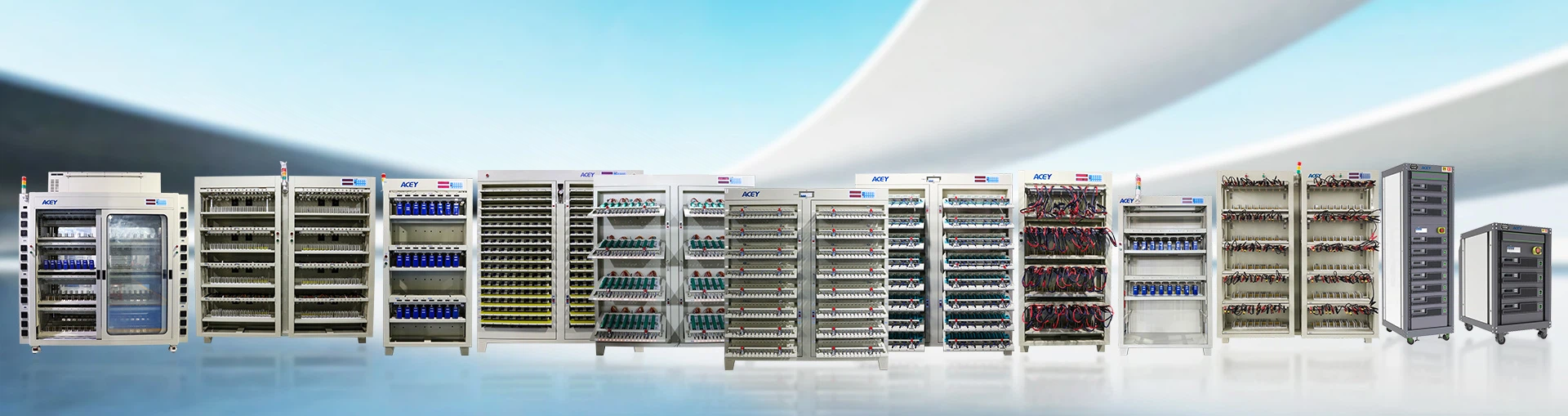
Battery Pack Assembly Line
The Battery Pack Assembly Line manufacture!
Our Lithium Battery Lab Fabrication Line is a modular, lab-scale production system designed for R&D, prototyping, and small-batch manufacturing of lithium-ion batteries. It replicates full-scale industrial processes, enabling seamless technology validation and scale-up.


After-sales service:
We have a professional after-sales engineer team to provide 24/7 all-weather service, and the product supports one-year warranty and lifetime maintenance. We provide complete after-sales services, including technical support, warranty repairs, spare parts supply, customer training, etc., to ensure that the equipment operates efficiently and meets your long-term needs.
Product market:
We have produced products that are well received by the market and are sold to more than 40 countries around the world.
Vision:
Our factory has advanced manufacturing equipment and our R&D team has more than 20 engineers to support customers' various customized needs.
OEM and ODM services:
Our products are rigorously tested and evaluated during the design and manufacturing process to ensure safety, reliability and environmental sustainability, and strictly comply with European regulatory requirements.
|
Electric Bike Battery Pack Assembly Equipment |
|
|
Product Name |
Description |
|
256/512 Channels Battery Tester |
5V 3A/5A/6A Battery Tester optional |
|
Battery Insulation Paper Sticking Machine |
Sticker Matrials: Barley paper or PVC |
|
Barley paper Maxium 350mm;Scroll Internal Diameter 72-75MM |
|
|
Battery Sorting Machine |
11 Channels Battery Sorter(Data record function is selectable) |
|
CCD Visual Inspection Machine |
Cylindrical battery positive and negative detection |
|
Manual Spot Welding Machine |
Pneumatic AC Spot Welding Machine |
|
(Single Welding Point or Double Welding Point) |
|
|
AC Pedal Manual Spot Welding Machine |
|
|
Automatic Spot Welding Machine |
Single Side Automatic Spot Welding Machine |
|
Double Sides Spot Welding Machine |
|
|
1-24 series/1-32 series BMS Tester |
Over-discharge Protection Current:0-120A |
|
Overcharge Protection Current:0-50A |
|
|
Overcharge/Overdischarge Voltage:0.5-5V |
|
|
Battery Pack Comprehensive Tester |
100V 120A Battery Pack Comprehensive Tester |
|
Automatic Cylindrical Battery PVC Heat Shrink Wrapping Machine |
Film speed:50~70PCS/MIN |
|
Film precision:±0.1MM |
|
|
Battery Aging Machine |
30 V 10A Charging 20 A Discharging Aging Machine |
|
70 V 5A Charging 10 A Discharging Aging Machine |
|
|
100 V 10A Charging 20 A Discharging Aging Machine |
|
Advantages of Battery Pack Assembly Line
Efficiency Gains and Reduced Human Error:
Automated assembly processes are meticulously programmed and executed by machines, eliminating the variability and inconsistencies that can arise from human involvement. This precision minimizes the risk of errors in cell placement, welding, and other critical tasks. The result is a streamlined production process with higher throughput and reduced rework, leading to improved overall efficiency.
Consistency in Assembly and Quality Control:
Automation ensures a consistent and uniform approach to assembling battery packs. Machines follow predefined patterns and parameters, ensuring that each module is assembled according to the exact specifications. This level of consistency directly translates to higher product quality and reliability, reducing the chances of defects or deviations.
Faster Production Turnaround:
Automated assembly lines are designed for high-speed, continuous production. Tasks that would be time-consuming for humans are executed swiftly by machines. This accelerated production pace translates to shorter lead times and increased output capacity, meeting market demands effectively.
Improved Safety for Workers and End-Users:
Automated assembly minimizes the exposure of workers to potentially hazardous processes, such as welding and handling of volatile materials. This enhanced safety extends to the end-users of the battery packs, as the automation process ensures precise and secure connections that reduce the risk of malfunction or accidents during usage.
Data-Driven Decision Making:
Automated assembly lines often include data collection and monitoring systems that track various aspects of the process. This data can be analyzed to identify bottlenecks, optimize workflows, and enhance overall performance. It enables manufacturers to make informed decisions for continuous process improvement.
Scalability and Adaptability:
Automated systems are designed to be scalable, allowing manufacturers to increase production volumes without significantly altering the process.automated systems can be adapted to accommodate changes in battery pack designs, allowing for flexibility in product offerings.
Cost Savings and Resource Efficiency:
While the initial investment in automated assembly equipment may be higher, the long-term benefits include reduced labor costs, minimized rework, and optimized resource utilization. As automation decreases the likelihood of errors and rejections, manufacturers save on material costs and improve overall resource efficiency.
Enhanced Product Customization:
Automated systems can be easily reprogrammed to accommodate various battery pack configurations, facilitating the production of customized solutions to meet specific customer requirements. This flexibility allows manufacturers to cater to diverse market needs.

Battery Pack Assembly Line The Process
Component Assembly:
The first stage involves the assembly of individual battery components such as electrodes and separators. These components are carefully aligned and integrated to form the basic structure of the battery.
Cell Formation:
In this stage, the assembled components are combined with electrolytes to create cells. These cells serve as the building blocks of the battery and are where the chemical reactions occur to generate electrical energy.
Battery Pack Assembly:
Once the cells are formed, they are grouped together and connected to form a battery pack. This involves the arrangement of cells in a specific configuration and the installation of protective casing and terminals.
Testing and Quality Control:
Throughout the assembly process, batteries undergo rigorous testing to ensure they meet safety and performance standards. Various parameters such as voltage, capacity, and temperature are monitored to identify any defects or irregularities.
Packaging and Shipping:
Once the batteries pass quality control checks, they are packaged and prepared for shipping to customers or distribution centers.
Uses of Battery Assembly Lines
Mass Production: They facilitate the large-scale production of batteries, meeting the high demand for various consumer electronics, electric vehicles, and renewable energy storage solutions.
Quality Control: Automated assembly lines integrate advanced quality control mechanisms to ensure each battery meets stringent industry standards, minimizing defects and enhancing product reliability.
Efficiency and Cost Reduction: Automation significantly reduces labor costs and increases production speed, leading to lower overall manufacturing costs and making batteries more affordable for end-users.
Customization: Modern assembly lines are flexible, allowing manufacturers to customize battery specifications based on different applications, such as varying voltage, capacity, and form factors.
Safety: Advanced safety protocols are embedded within the assembly line processes to handle hazardous materials safely and ensure worker and product safety.
FAQ
Find professional battery pack assembly line manufacturers and suppliers in China here! Please feel free to buy high quality battery pack assembly line from our factory. For customized service, contact us now.
battery assembly line workflow, battery pack production process deburring, battery manufacturing equipment updating