

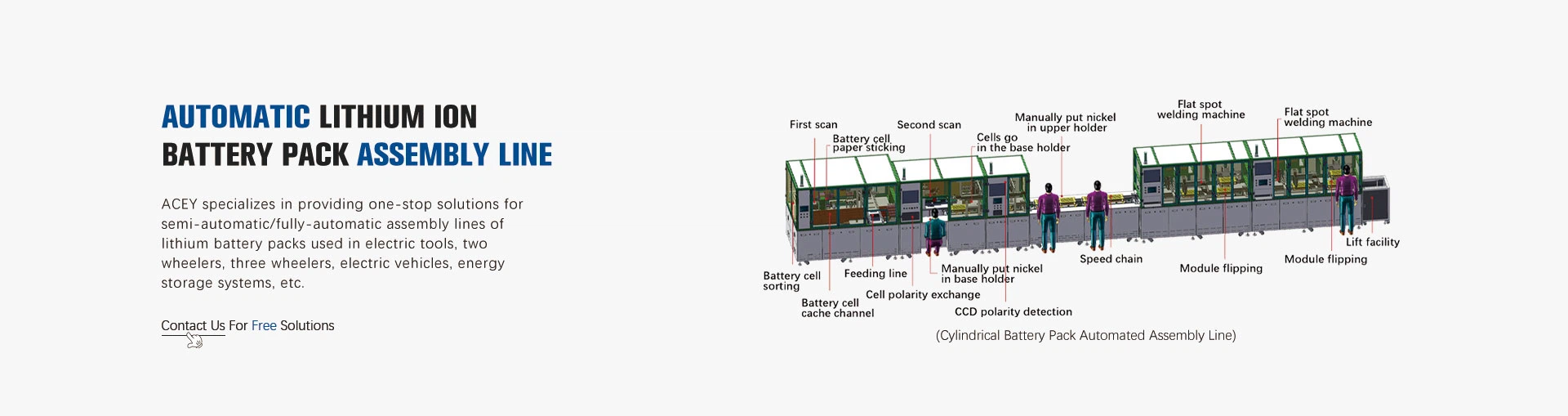
In the field of lithium battery manufacturing, winding and lamination are the two mainstream electrode assembly processes. Both processes have their own advantages and disadvantages, and there are significant differences in the requirements for production equipment. In order to better understand the characteristics of these two processes and their specific equipment requirements, this article will explore the differences in equipment requirements between the winding and lamination processes.

1. Winding process and equipment requirements
1.1 Overview of the winding process
The winding process is to wind the positive electrode sheet, separator and negative electrode piece into a cylindrical or prismatic cell structure. The advantages of this process include high production efficiency, small equipment footprint, and suitability for large-scale production. The winding process is widely used in the production of cylindrical batteries (such as 18650, 21700, etc.) and some prismatic batteries.
ACEY-SWM-C automatic cylindrical winding machine is an equipment that can be applied to the winding process of cylindrical lithium-ion battery pole pieces. Compared with the , this equipment has high manual winding machine winding efficiency, good winding neatness, and a wide range of applicable battery sizes. It is more suitable for various cylindrical battery winding needs in lithium battery laboratories.

1.2 Key requirements for winding equipment
- High-precision tension control
Tension control of the pole piece and diaphragm is crucial during the winding process. Excessive tension may lead to tensile deformation of the pole piece, affecting the performance of the battery; If the tension is too small, it may cause the pole piece to loosen and affect the winding quality. Therefore, the winding equipment needs to be equipped with a high-precision tension control system, which can monitor and adjust the tension in real time. For example, the use of magnetic levitation tension control technology, combined with multi-stage closed-loop adjustment, can control the tension fluctuation to a very small range.
- High-precision alignment
During the winding process, the positive electrode sheet, separator and negative electrode piece need to be precisely aligned to ensure the consistency and stability of the battery's internal structure. Some high-end winding equipment will be equipped with a high-precision visual alignment system, which can monitor the position deviation of the pole piece in real time and automatically adjust the alignment accuracy through a closed-loop control algorithm.
- High-speed winding
In order to improve production efficiency, winding equipment needs to have high-speed winding capabilities. High-speed winding not only requires the mechanical structure of the equipment to withstand the stress caused by high speeds, but also needs to be equipped with high-performance servo motors and drives to ensure the smoothness and consistency of the winding process.
- Environmental adaptability
The winding process has relatively high requirements for the production environment, and needs to be carried out in a clean, constant temperature and humidity environment to reduce the impact of impurities on the performance of the battery. Therefore, winding equipment often needs to be equipped with an environmental control system to ensure the stability of the production environment.
2. The lamination process and its equipment requirements
2.1 Overview of the stacking process
The lamination process is to superimpose the positive electrode sheet, separator and negative electrode sheet in turn to form the electrode structure of the battery. The advantages of the lamination process include a more compact internal structure of the battery, higher energy density, and the ability to produce large-capacity batteries. The lamination process is more widely used in the production of pouch cells and some prismatic cells.
2.2 Key requirements for stacking equipment
- High-precision positioning
In the lamination process, the positioning accuracy of the pole piece and the diaphragm is extremely high. Due to the more complex structure of laminated cells, the alignment accuracy between the pole pieces directly affects the performance and safety of the battery. The lamination equipment needs to be equipped with a high-precision positioning system, such as laser positioning or visual recognition system, to achieve positioning accuracy.
- Multi-layer lamination capability
The lamination process usually requires the processing of multi-layer pole pieces and separators, and the equipment needs to have the ability to multi-layer lamination to ensure the structural stability and consistency of the cell.
- Precise pressure control
In the lamination process, pressure control between the poles is crucial. Excessive pressure may cause deformation of the pole piece and affect the performance of the battery; If the pressure is too low, it may lead to poor contact between the pole pieces and affect the conductivity of the battery. The lamination equipment needs to be equipped with a precise pressure control system that can monitor and adjust the pressure in real time.
ACEY-SSM-C electrode stacking machine is a device that can be applied to the stacking process of lithium-ion battery pole pieces. The process of manual film loading, subsequent pole piece position correction and lamination is completed automatically, which has the characteristics of high lamination efficiency and high accuracy. The equipment design can stack 200*200mm cells, and different sizes can be realized by adjusting the fixture, which is very suitable for the research and development and sample production of laminated lithium-ion batteries. The equipment adopts a single cantilever structure design, automatic constant tension control of the coil isolation film, and automatic correction control.

- Environmental adaptability
Similar to the winding process, the lamination process also needs to be carried out in a clean, constant temperature and humidity environment to reduce the impact of impurities on battery performance. It is often necessary to be equipped with an environmental control system to ensure the stability of the production environment.
3. Comparison of equipment requirements for winding and lamination processes
|
Equipment Requirements |
Winding Process |
Stacking Process |
|
Tension Control |
High-precision tension control, real-time monitoring and adjustment of tension |
Relatively relaxed, but precise control of the flatness of electrodes and separators is required |
|
Alignment Precision |
High-precision vision alignment system, real-time adjustment of alignment accuracy |
High-precision laser or vision positioning system, micron-level positioning accuracy |
|
Production Efficiency |
High-speed winding, suitable for mass production |
Relatively lower, suitable for producing high-capacity batteries |
|
Pressure Control |
Relatively relaxed, but ensuring the stability of the winding process is required |
Precise pressure control, real-time monitoring and adjustment of pressure |
|
Environmental Adaptability |
Clean, temperature-controlled, and humidity-controlled environment |
Clean, temperature-controlled, and humidity-controlled environment |
|
Equipment Complexity |
Relatively low |
Higher, requiring multi-layer stacking capabilities and precise control |
|
Equipment Cost |
Relatively low |
Higher |
4.Conclusions
The winding and lamination processes have their own advantages and disadvantages, and are suitable for different battery types and application scenarios. The winding process is suitable for large-scale production, the equipment requirements are relatively low, and the cost is relatively controllable; The lamination process is more suitable for the production of large-capacity batteries, which requires higher precision and complexity of the equipment. As the lithium battery market continues to grow, both processes will play an important role in the future. Buyers need to purchase different equipment according to their specific needs.
(Note: The above content is for reference only. The actual equipment requirements may vary due to specific processes and application scenarios.)