

When it comes to lithium battery PACK, many people simply equate it with "battery assembly". But in fact, this process is far from as simple as piecing together multiple battery cells - it is a highly integrated system engineering integrating electrochemistry, mechanical design, electronic technology, and thermal management, and every link is related to the performance, safety and longevity of the battery system. Today, we will take you to dismantle the core links of the lithium battery PACK process in depth and see how a qualified battery pack is "refined".

1. Cell selection: The "foundation" of the PACK process, consistency is the key
To build a reliable battery system, the first step must start with "core selection", which is not just a few battery cells, the core must meet the two major requirements of performance consistency screening and on-demand selection. If the capacity of a battery cell is 10% lower than others, it will be fully charged and discharged first in the long-term charging and discharging cycle, and accelerating its own aging may also cause the entire battery pack to be unbalanced charging and discharging, and even trigger safety risks. At the same time, the demand for battery cells in different application scenarios varies significantly, and power batteries such as new energy vehicles pay more attention to energy density and fast charging performance, and ternary lithium (NCM/NCA) cells are often selected; Energy storage batteries such as home energy storage and power station energy storage prioritize safety and long cycle life, and lithium iron phosphate (LFP) cells are the mainstream; Consumer electronics such as mobile phones and notebooks need to take into account volume, weight and energy density, and small ternary lithium cells are more suitable.

2. Structural design: "game" in space, balancing safety and practicality
The battery pack needs to be adapted to the end product, but also to withstand the test of complex environment, and the structural design needs to find the optimal solution between "space, weight, and strength". Taking the battery pack of new energy vehicles as an example, it should be designed to strictly fit the space layout of the vehicle body, and at the same time have a high-strength structure to resist vibration, bumps and even collisions during driving, and protect the battery cells from being squeezed; For energy storage battery packs, the cabinet installation size needs to be considered to ensure stacking stability. In order to reduce energy consumption, especially for automobiles, the battery pack will use lightweight materials such as aluminum alloy and carbon fiber, but lightweight does not mean "cutting corners", engineers use topology optimization design to strengthen the structure at the key points of stress, so that the battery pack can reduce weight and be more rigid, so as to avoid damage to the battery cell due to vibration and impact. Nowadays, mainstream battery packs will be divided into multiple independent modules, which can be assembled in sections during production to improve efficiency, and any module will be replaced during later maintenance, without the need for overall replacement, greatly reducing costs.
3. Electrical Connection: The "Precise Channel" for Current and Signals, No Room for Error
After the battery cells are combined, reliable electrical connection is the key to the "power-on" of the battery pack and is also a high-risk area. The connection of the cell tabs does not use ordinary wires but adopts laser welding, ultrasonic welding or resistance welding. The laser welding points are small, have high precision and extremely low resistance, which can reduce heat generation during current transmission; the ultrasonic welding does not require high temperatures and is suitable for heat-sensitive battery cells, avoiding damage to the cells due to high temperatures. The shape of the connection piece (Busbar) will also be optimized, designed as "U-shaped" or "L-shaped" to shorten the current path and further reduce heat generation. The high-voltage wiring harness in the battery pack is responsible for transmitting large currents and must be thickened and kept away from heat sources; the low-voltage signal lines are responsible for transmitting data and should not be parallelly arranged with the high-voltage wiring harness to prevent electromagnetic interference (EMI) from causing the BMS to receive incorrect data and make wrong judgments. All connection parts will be wrapped with insulating materials to prevent "leakage" and breakdown, and the entire battery pack must also meet protection standards such as IP67/IP6K9K to ensure safety in rainy and water-related scenarios.
4. Thermal Management: The "Thermal Regulator" of Batteries, Temperature Determines Lifespan
Lithium batteries are "afraid of heat and cold". Excessive temperature accelerates aging and even causes thermal runaway, while low temperature leads to a sudden drop in capacity and slower charging. The thermal management system is the "thermal regulator" of the battery pack, maintaining the temperature within the optimal range of 25-40°C at all times. In terms of cooling, the battery packs of new energy vehicles commonly use liquid cooling methods. The cooling liquid circulates through the liquid cooling plates embedded in the battery pack to remove heat, ensuring more uniform temperature control; air cooling has low cost and a simple structure, suitable for scenarios with relatively smaller heat generation such as energy storage batteries; phase change materials (PCM) are like "ice packs", absorbing heat when the temperature rises and releasing heat when it drops, suitable for short-term heat dissipation needs. In northern winters, the battery pack will activate the heating function, using PTC heating elements or electric heating films to preheat the cells to avoid the problem of reduced range and inability to charge in winter. Engineers will also use CAE software to simulate the temperature distribution under different working conditions, identify "hotspots" in advance, optimize the cooling structure, and ensure uniform temperature throughout the battery pack.
5. BMS: The "Brain" of the Battery Pack, the Core of Intelligence
If the cells are the "heart" of the battery pack, then BMS (Battery Management System) is the "brain", responsible for monitoring, protecting and optimizing the battery performance. BMS collects the voltage, temperature and current of each cell in real time through sensors, and then estimates the SOC (Remaining Capacity) and SOH (Health Status) through algorithms, allowing users and the vehicle control system to always know the battery status. Even if the initial parameters of the cells are the same, differences will occur after long-term use. BMS will "balance" them through passive balancing (discharging the voltage-high cells through a resistor to level the voltage) or active balancing (through energy transfer, which is more efficient and power-saving) to avoid excessive charging and discharging of a single cell, and extend the lifespan of the entire battery pack. There are also a series of "safety red lines" preset in BMS. As soon as any of the voltage, temperature, current, etc. parameters trigger one of the safety thresholds, the circuit will be immediately cut off to prevent the accident from escalating, which is the "last line of defense" for the battery pack.

ACEY-BP32-200A300A bms tester machine features a high level of automation, rapid testing capabilities, and exceptional accuracy. It is designed to evaluate the functionality of Battery Management Systems (BMS) for MCN batteries, LiFePO4 batteries, and lithium cobalt oxide batteries. The system provides real-time monitoring of key parameters such as battery voltage, temperature, operating current, and remaining charge.
6. Testing and Verification: Strict Quality Control, No Pass, "Re-do from Scratch"
A battery pack that has not undergone testing is merely "paper talk" in terms of its design. Before leaving the factory, the battery pack must undergo three types of tests: electrical performance, safety, and environmental adaptability. The electrical performance tests include 500 or 1000 cycles of charge and discharge to check if the capacity decline is within the allowable range, internal resistance tests of the battery cells and connection parts, and capacity tests by discharging after being fully charged to see if the actual capacity reaches the designed value. Safety tests simulate extreme dangerous scenarios such as needle puncture (using a steel needle to puncture the battery cell to check if it catches fire or explodes), compression (using a hydraulic machine to squeeze the battery pack to simulate a collision to check for leakage and combustion), and overcharging (charging at 1.5 times the rated voltage to check if it can trigger BMS protection). Environmental adaptability tests are conducted in high temperatures (60°C), low temperatures (-30°C), high humidity (90% humidity), and high altitudes (5000 meters) to test the charging and discharging performance and lifespan changes of the battery pack, ensuring its normal use in different regions and seasons.
7. Trends: More Intelligent, More Integrated - The Future of PACK Technology
With the explosive growth of the new energy vehicle and energy storage markets, the PACK technology is constantly upgrading and moving towards a more intelligent and integrated direction. The traditional BMS requires a large number of signal lines to connect the cells, which increases weight, costs, and is prone to failure. The wireless BMS replaces the wiring harness with wireless communication (such as Bluetooth, LoRa), which can reduce weight by 10%-15%, lower costs by 5%-8%, and make maintenance more convenient. The CTP (Cell to Pack) technology skips the steps of "cell → module → battery pack" and integrates the cells directly into the battery pack, increasing the space utilization by 10%-15% and improving the energy density. The CTC (Cell to Chassis) technology is even more radical, integrating the cells directly into the vehicle chassis. The battery pack is not only an energy source but also a part of the vehicle structure, further reducing weight and improving space. Currently, BMS is also beginning to incorporate machine learning algorithms. By analyzing the trends of cell voltage and temperature changes, it can predict potential failures in advance, proactively alert for maintenance, and dynamically adjust the balancing strategy based on user usage habits, thus extending the battery life.
Summary: Reviewing the development history of lithium battery PACK technology, from the initial "simple assembly" to the current "multidisciplinary precise collaboration", each technological breakthrough stems from the pursuit of "greater safety, higher efficiency, and greater reliability". It is not the result of a single aspect's efforts alone, but rather the deep integration of knowledge from multiple fields such as electrochemistry, mechanical engineering, electronics technology, thermal management, and intelligent control.
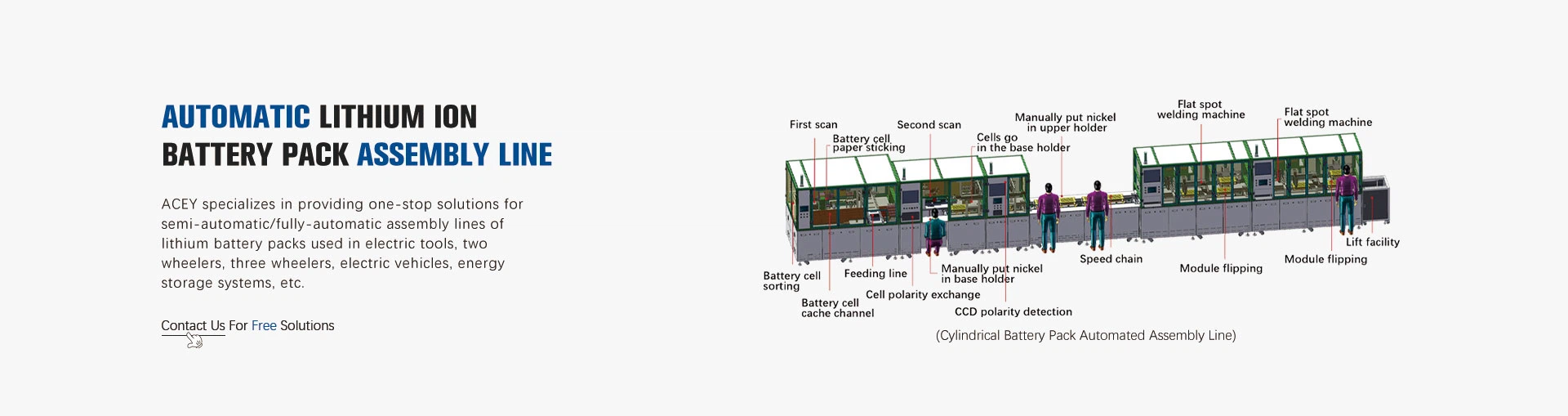
Acey Intelligent specializes in providing one-stop solutions for semi-automatic/fully-automatic assembly lines of lithium battery packs used in ESS, UAV, E-Bike, E-Scooter, Power Tools, Two/Three Wheelers, Etc. In Addition, we provide a complete set of battery pack assembly equipment, such as Cell Grading Machine, Battery Sorting Machine, Insulation Paper Sticking Machine, CCD tester, Manual/Automatic Spot Welding Machine, BMS Tester, Battery Comprehensive Tester and Battery Pack Test System, etc.
