

1. Current Status of Power Battery Thermal Runaway
According to news media reports on new energy vehicle safety accidents, there have been far more related news reports in recent years than in previous years. On the one hand, the market inventory of new energy vehicles has increased significantly, and with it, a corresponding increase in failures and accidents. On the other hand, related companies have weak technical capabilities, blindly launching projects, and engaging in speculative behavior to rush deadlines and gain market share and subsidies. This has objectively exacerbated the incidence of safety accidents.
New energy vehicle safety accidents have inherent and unique causes. Because the batteries that power them are highly active, high-energy carriers, they can experience thermal runaway at relatively low temperatures. The causes of thermal runaway are numerous and complex, making them difficult to prevent. Therefore, power batteries are often the primary cause of safety accidents that escalate to higher severity and higher risk, making them difficult to prevent, control, and address.

2. Concepts of Battery Thermal Runaway and Thermal Safety Issues
2.1 Concept of Battery Thermal Runaway
Battery thermal runaway refers to a violent reaction in a battery, triggered by certain external conditions (such as puncture, overheating, short circuit, overcharging, etc.), characterized by rapid and massive heat release, which may be accompanied by other physical or chemical changes (such as short-circuit discharge, combustion, and explosion). In a power battery system, when a single cell experiences thermal runaway, the violent reaction generates a large amount of heat, potentially leading to violent reactions such as combustion or explosion. The resulting high temperature or mechanical shock often triggers thermal runaway in adjacent cells. Consequently, thermal runaway in a single cell can easily spread throughout the battery system, causing a rapid release of large amounts of energy, posing a significant threat.
2.2 Battery Thermal Safety Issues
Battery thermal safety issues, to a certain extent, refer to thermal runaway. Accidents of power batteries under conditions such as mechanical damage, thermal abuse, electrical abuse, and extreme application environments ultimately manifest as thermal runaway problems. These problems are characterized by complex mechanisms and numerous influencing factors, which are mainly manifested in the following aspects:
A. The thermal safety of power battery cells is directly related to the type of electrochemical system, material composition, structural form, packaging form, capacity, structure, shape, size form, and process conditions within the battery;
B. Considering the triggering conditions for thermal runaway, battery overheating, overcharging, external impact, extrusion, puncture, and battery short circuit can all trigger thermal runaway;
C. In terms of the expansion of thermal runaway in the battery system, environmental conditions, thermal runaway triggering methods and loading status, battery group connection methods, battery thermal management methods, and the location of the thermal runaway-initiating battery in the power battery system directly affect the thermal runaway expansion process.
Therefore, the thermal runaway mechanism of batteries is complex, and multiple factors are mutually dependent. The research on thermal runaway of power batteries is highly systematic and difficult, and has become one of the key and difficult issues in the research of power battery systems. Due to these characteristics, battery thermal safety management is particularly important, especially for improving the safety of electric vehicles. The design of a battery thermal safety management system generally focuses on providing early warning before thermal runaway, delaying its expansion and spread, and minimizing losses after thermal runaway. This involves developing safety protection control strategies and designing high-safety power battery materials, internal structures, battery packing methods, and battery box structures. This ensures timely detection of thermal runaway risks and prevents or delays their spread.
3. Lithium-ion Battery Thermal Runaway Mechanisms
Due to the excellent performance of lithium-ion batteries, an increasing number of electric vehicles are using them as their power source. Therefore, research into the thermal runaway mechanisms of lithium-ion batteries is essential. The main factors causing thermal runaway in power lithium-ion batteries include external short circuits, external high temperatures, and internal short circuits.
External short circuits: The probability of a dangerous event occurring during actual vehicle operation is relatively low. Firstly, the vehicle system is equipped with fuses, fuses, and a battery management system (BMS); secondly, the battery itself can withstand short-term, high-current surges. In extreme cases, the short circuit point bypasses the vehicle fuse. A prolonged external short circuit generally burns out weak connections in the circuit and rarely causes thermal runaway. Currently, many power battery system companies are implementing integrated fuses in the circuit to more effectively mitigate the hazards caused by external short circuits.
External High Temperature: Due to the structural characteristics of lithium-ion batteries, high temperatures cause decomposition reactions in the SEI film, electrolyte, and EC. The electrolyte decomposition products also react with the positive and negative electrodes, melting and decomposing the cell separator. These multiple reactions generate significant heat. Separator melting leads to internal short circuits, and the release of electrical energy further increases heat generation. This cumulative, mutually reinforcing destructive effect can lead to rupture of the cell's explosion-proof membrane, electrolyte ejection, and combustion. It's worth noting that, compared to lithium iron phosphate batteries, the positive electrode material of ternary lithium batteries is more susceptible to oxygen decomposition reactions, resulting in a more rapid onset of thermal runaway. For example, in lithium cobalt oxide (LCO), upon reaching a certain temperature, the positive electrode instantly releases oxygen. This oxygen reacts with the solvent to produce large amounts of gas and heat, leading to rapid thermal runaway and high flammability. Lithium iron phosphate's olivine structure provides high-temperature stability. In the chemical reaction that leads to thermal runaway, decomposition, not oxidation, occurs before the electrolyte is ejected. This results in low and slow gas production, resulting in bloating rather than violent combustion. This is the reason why lithium iron phosphate (LFP) is relatively safe. However, this does not mean it is immune to thermal runaway and combustion, as evidenced by recent electric bus fires. The primary cause of LFP combustion is thermal runaway-induced rupture of the explosion-proof membrane, leading to the ejection of electrolyte. In this high-temperature environment, the electrolyte quickly reaches its ignition point, causing combustion, which in turn ignites other combustible materials, such as the cell wrapping. This further intensifies heat dissipation and triggers a chain reaction of thermal runaway in other cells.
Internal short circuits: Battery misuse, such as dendrites caused by overcharging and over-discharging, impurities and dust during battery production, and thermal deformation caused by the operating environment, can lead to deteriorating growth, puncturing the separator and causing micro-short circuits. The release of electrical energy causes a temperature rise, and the resulting chemical reactions in the materials expand the short circuit path, generating a larger short-circuit current. This creates a cumulative, mutually reinforcing damage, leading to thermal runaway. It should be noted that most battery fires are initially triggered by internal short circuits. The resulting heat and temperature create an "external high temperature environment" for adjacent cells, triggering thermal runaway in those cells and causing a chain reaction throughout the battery system.

Thus, the mechanism suggests that thermal runaway is fundamentally caused by heat accumulation, exacerbated by the accumulation of heat. If heat dissipation can be effectively improved and measures are taken to prevent this accumulation, thereby controlling the battery temperature within a certain range, a safe battery can be achieved. This is the unremitting pursuit of battery industry professionals. The industry has made unremitting efforts to this end, and initial results have been achieved, such as through the use of effective thermal management designs and internal short circuit devices. Another viable approach is to innovate in module or pack technology to achieve "intrinsic safety" for battery cells. "Intrinsic safety" has two meanings: first, the energy limit of the smallest energy unit is such that even a combustion or explosion would be insufficient to cause damage, making it an acceptable risk; second, after grouping, if a combustion or explosion occurs in one energy unit, the energy would not trigger a chain reaction of combustion or explosion in other units, making it an isolated and acceptable event.
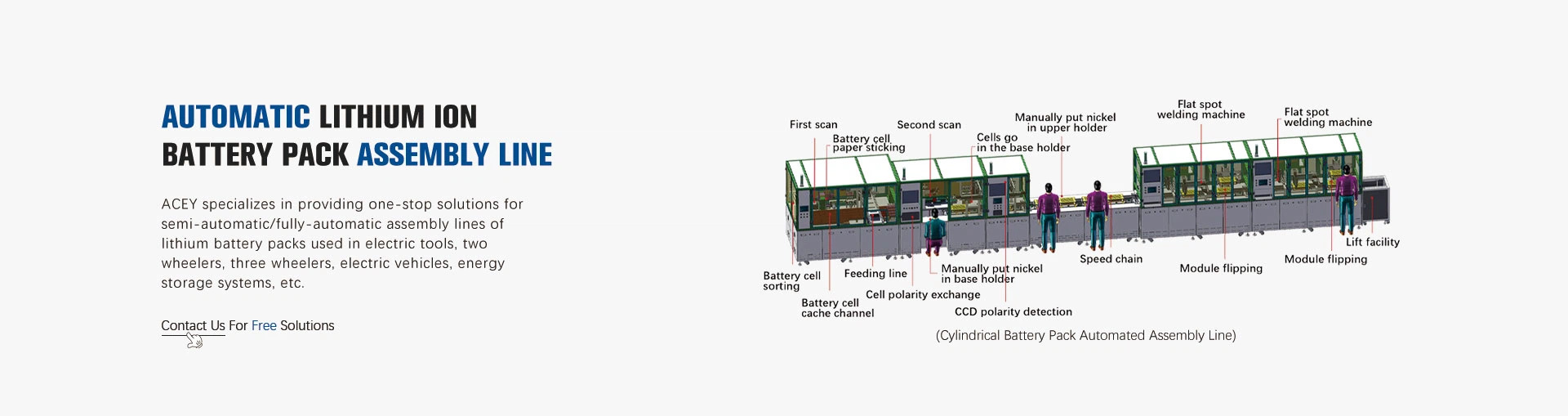
Acey Intelligent specializes in providing one-stop solutions for semi-automatic/fully-automatic assembly lines of lithium battery packs used in ESS, UAV, E-Bike, E-Scooter, Power Tools, Two/Three Wheelers, Etc. In Addition, we provide a complete set of battery pack assembly equipment, such as Cell Grading Machine, Battery Sorting Machine, Insulation Paper Sticking Machine, CCD tester, Manual/Automatic Spot Welding Machine, BMS Tester, Battery Comprehensive Tester and Battery Pack Test System, etc.