

1. Process introduction
In the manufacturing process of cylindrical cells, the gluing process is an extremely critical part, and it carries multiple important functions.
First of all, mechanical protection is one of the core functions of glue filling. During the use of cylindrical battery cells, they will inevitably be subjected to external forces such as vibration and shock. The potting compound is filled inside and around the battery cell, which can effectively buffer these external forces, avoid damage to the internal structure of the battery cell due to external force impact, and ensure the integrity and stability of the battery cell.
Secondly, heat dissipation is crucial for cylindrical cells. The battery cell will generate a lot of heat during the charging and discharging process, and if the heat cannot be dissipated in time, it will seriously affect the performance and life of the battery cell. The potting compound with good thermal conductivity can quickly conduct the heat generated by the battery cell and help the battery cell maintain the appropriate operating temperature range, thereby improving the charging and discharging efficiency and service life of the battery cell.
In addition, glue filling can also play a role in moisture prevention and corrosion prevention, prevent external moisture, corrosive gases from invading the battery cell, protect key components such as electrodes and electrolytes of the battery cell, and improve the environmental adaptability and reliability of the battery cell.

2. Commonly used glue filling materials
Epoxy Resin Potting Compound: Epoxy resin potting compound is widely used in the cylindrical cell filling process due to its excellent comprehensive properties. It has the characteristics of high strength and hardness, and can provide reliable mechanical protection for the battery cell against external force shock and vibration.
Silicone Rubber Potting Compound: Silicone rubber potting compound has unique performance advantages, making it also highly favored in cylindrical cell filling. It has good elasticity and can buffer the stress through its own elastic deformation when the battery cell is subjected to external force, which plays a good role in protecting the battery cell.
Polyurethane potting compound: Polyurethane potting compound has good wear resistance and water resistance, which can effectively protect the battery cell from external wear and moisture. It has good flexibility and can adapt to the slight deformation of the battery cell during use to a certain extent, avoiding cracking of the potting layer caused by deformation.
3. Glue filling process
(1)Pretreatment
Cell surface cleaning: Before gluing, the surface of the cylindrical battery cell must be thoroughly cleaned to remove dust, oil, impurities, etc. from the surface. These pollutants will affect the bonding effect between the potting compound and the surface of the battery cell, leading to bubbles, cracking and other problems in the potting layer. You can use a dust-free cloth dipped in alcohol, acetone and other detergents to wipe the surface of the battery cell to ensure that the surface is clean and dry.
Component assembly and fixation: Assemble the various components of the battery cell, such as electrodes, diaphragms, etc., according to the design requirements. During the assembly process, ensure that the components are accurately positioned and securely connected. For some parts that need to be fixed, auxiliary tools such as fixtures and tapes can be used to fix them to prevent the displacement of parts during the gluing process and affect the gluing effect.
(2)Glue filling operation
Glue blending: Accurately mix glue according to the type of potting compound selected and usage requirements. For two-component potting compounds, such as epoxy potting compounds, components A and B need to be mixed in the specified ratios. During the blending process, use precise measuring tools, such as electronic scales, to ensure accurate proportions of the two components. At the same time, it is necessary to use appropriate stirring methods, such as electric mixers, to fully stir the glue evenly to avoid uneven mixing, which will affect the curing effect and performance of potting adhesive.
(3)Curing treatment
After the glue filling is completed, the battery cell needs to be cured to fully cure the potting compound and form a potting layer with certain strength and performance. Different types of potting compounds have different curing conditions, and epoxy resin potting compounds generally need to cure at higher temperatures (such as 60°C - 120°C) for several hours or even longer; Silicone rubber potting compounds can cure at room temperature or accelerate the curing process by heating; Polyurethane potting compounds cure relatively quickly, typically initially curing within a few hours at room temperature, but full curing may take longer. During the curing process, the curing temperature and time should be strictly controlled to ensure that the potting compound is fully cured, and at the same time, the performance of the battery cell should be damaged due to excessive temperature or long time.

(4) Post-processing
Surface cleaning: After curing, clean up the excess potting adhesive on the surface of the battery cell to remove overflow, burrs, etc., so that the surface of the battery cell is flat and smooth. You can use knives, sandpaper and other tools to clean it, but be careful not to damage the surface of the battery.
Quality inspection: Conduct comprehensive quality inspection of the battery cells after gluing, including visual inspection, electrical performance testing, mechanical property testing, etc. The visual inspection mainly checks whether the potting layer is uniform, no bubbles, no cracking, etc.; The electrical performance test detects whether the voltage, internal resistance, capacity and other parameters of the battery cell meet the requirements; Mechanical properties test evaluates the strength, hardness and other performance indicators of the potting layer. Through quality inspection, ensure that the glued battery cells meet the production standards and usage requirements.
4. Control of key process parameters
Filling temperature: The filling temperature has a significant impact on the fluidity and curing speed of the potting compound. Increasing the pouring temperature can reduce the viscosity of the potting compound, making it more fluid and easier to fill the gaps and holes inside the battery cell. However, too high temperature will lead to faster curing speed and shorten the operation time, and may cause bubbles, decomposition and other problems of potting compound, affecting the quality of glue. Therefore, it is necessary to reasonably control the pouring temperature according to the type and characteristics of the potting compound, which is generally suitable between 20°C~40°C.
Filling pressure: The size of the filling pressure directly affects the filling effect of the potting compound. Proper filling pressure can ensure that the potting compound fills the inside of the battery cell quickly and evenly, avoiding cavities and lack of glue. However, excessive pressure may cause the potting compound to overflow, pollute the surface of the battery, and even damage the internal structure of the battery. If the pressure is too small, the potting compound will not be filled sufficiently, affecting the potting quality. In actual operation, it is necessary to adjust the filling pressure according to the structure of the battery cell and the characteristics of the potting compound, which is generally controlled between 0.1MPa~0.5MPa.
Filling speed: The filling speed is closely related to the quality and production efficiency of the glue. If the filling speed is too fast, the potting compound may not be able to fully fill the inside of the battery cell, and it is easy to produce bubbles and cavities. If the filling speed is too slow, it will reduce production efficiency and increase production costs. Therefore, it is necessary to reasonably adjust the filling speed according to the size of the battery cell, the viscosity of the potting compound and other factors to ensure that the potting compound can fill the inside of the battery cell evenly and quickly.
Curing temperature and time: The curing temperature and time are key factors affecting the curing effect and performance of potting compounds. Different types of potting compounds have different curing temperature and time requirements, which must be strictly controlled according to the instructions for using the potting compound. If the curing temperature is too low or the time is too short, the potting compound cannot be fully cured, resulting in insufficient strength and unstable performance of the potting layer. If the curing temperature is too high or the time is too long, it may cause the potting compound to age and deteriorate, affecting the performance and lifespan of the battery cell.
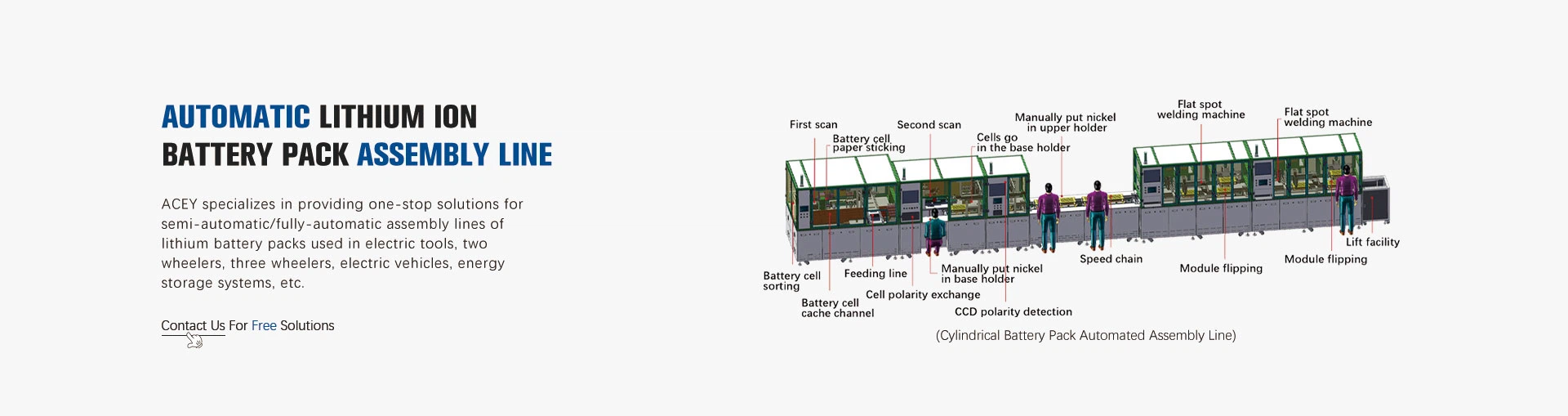
Acey Intelligent specializes in providing one-stop solutions for semi-automatic/fully-automatic assembly lines of lithium battery packs used in ESS, UAV, E-Bike, E-Scooter, Power Tools, Two/Three Wheelers, Etc. In Addition, we provide a complete set of battery pack assembly equipment, such as Cell Grading Machine, Battery Sorting Machine, Insulation Paper Sticking Machine, CCD tester, Manual/Automatic Spot Welding Machine, BMS Tester, Battery Comprehensive Tester and Battery Pack Test System, etc.
