

1. The "power watershed" in life: the difference in charging speed
When you hold an electric screwdriver to screw a screw, have you ever encountered a sudden freeze? When the drone prompts that the battery is low as soon as it takes off, have you ever wondered if it was clearly fully charged? The answers to these questions are often hidden in the "multiplier" of the battery. In today's digital product popularization, our requirements for batteries are no longer as simple as "large capacity". Ordinary mobile phone batteries need stable battery life, power tools need instant explosive power, and drones need sustained high power output - the performance of batteries varies greatly in different scenarios. The core of this difference is the "charge-discharge rate".
The essential difference between high-rate batteries and ordinary batteries can be summarized in two key words: speed and strength. Ordinary batteries are like joggers, which can output stably but lack explosive power; High-rate batteries are like sprinters, capable of sprinting instantaneously and maintaining their condition during high-intensity exercise.

2. Decryption of "multiplier": the "speed unit" of the battery world
(1) What is "C"? Understand the "speed code" of the battery
In the battery parameters, we often see logos such as "3C" and "10C". This "C" stands for charge-discharge ratio, which is a measure of the battery's ability to charge and discharge per unit time. 1C means that the battery can be fully charged and discharged within 1 hour, 3C can be completed in 20 minutes, and the high-rate battery used in drones can even reach 100C - which is equivalent to releasing 1 hour of power in 36 seconds.
Ordinary batteries typically have a discharge rate between 0.5C-2C and can often only withstand currents within 1C when charging. If you forcibly charge an ordinary battery with 3C current, it is like connecting a fire hydrant to a water pipe - the battery will precipitate lithium metal inside the battery because the lithium ions have not had time to embed the negative electrode, forming "lithium dendrites". These needle-like crystals can pierce the separator membrane, causing battery bulge attenuation at light or short circuit fires.
(2) The "superpower" of high-rate batteries: from parameters to experience
The core advantages of high-rate batteries are reflected in two aspects:
Discharge capacity: Ordinary batteries will quickly "drop voltage" when outputting high current, just like old mobile phones suddenly darken when playing games. High-rate batteries can maintain voltage stably, such as a 100C drone battery, which can instantly output more than 10 times the current of ordinary batteries, supporting the explosive force of propeller rotation from stationary to high-speed rotation.
Charging speed: Although the charge rate is usually lower than the discharge rate (generally 1/2-1/3 of the discharge rate), high-rate batteries can still achieve rapid energy replenishment. Batteries discharged at 3C support at least 1C fast charging, which is more than 3 times faster than the 5V/1A charging efficiency of ordinary batteries.
However, this "superpower" comes at a cost - the manufacturing cost of high-rate batteries is 30%-50% higher than that of ordinary batteries. The investment in special materials and precision craftsmanship makes it temporarily unable to replace ordinary batteries in low-cost devices such as mobile phones and remote controls.
Cost Structure Comparison: High-Rate Batteries VS. Standard Batteries
|
Cost Category |
High-Rate Battery(e.g., Power/Fast-Charging) |
Standard Battery(e.g., Consumer Electronics) |
Key Differences |
|
Cathode Material |
NCM622/811, Lithium Iron Phosphate (LFP) |
Lithium Cobalt Oxide (LCO), NCM523 |
High-rate batteries require high-nickel cathodes or LFP for better rate capability; LCO is expensive and less suitable for high rates. |
|
Anode Material |
Artificial graphite (surface-modified), Si-C composite |
Natural graphite, standard artificial graphite |
High-rate anodes need faster Li-ion intercalation/deintercalation, requiring more complex processing. |
|
Electrolyte |
High-purity Li-salts (LiPF6), additives (film-forming, conductivity enhancers) |
Conventional electrolyte |
High-rate batteries require more additives to stabilize SEI layers and reduce internal resistance. |
|
Separator |
Ceramic-coated separator, high-strength PP/PE base film |
Standard PE/PP separator |
High-rate separators need higher porosity and thermal stability to prevent thermal runaway. |
|
Current Collector |
Thinner Cu foil (6-8um), surface-treated Al foil |
Standard Cu foil (8-12um) |
Thinner current collectors reduce resistance but increase manufacturing difficulty. |
|
Manufacturing Process |
1. Multiple electrode compaction |
1. Single compaction |
High-rate batteries demand stricter process control, lower yield, and higher consistency. |
|
2. Precise capacity grading & pairing |
2. Basic capacity grading |
||
|
3. High-temperature aging |
|||
|
BMS (Battery Management System) |
Advanced BMS (voltage/temperature monitoring, balancing) |
Simple protection circuit |
High-rate batteries require additional thermal and charge/discharge management. |
|
Packaging |
Steel/aluminum casing (explosion-proof), modular integration |
Pouch cell (aluminum laminate film) |
High-rate batteries need stronger mechanical and thermal management. |
|
Total Cost Breakdown |
Materials: 60-70% |
Materials: 70-80% Process: 20-30% |
High-rate batteries have higher processing and auxiliary system costs. |
3. Scenarios determine the demand: Which devices must be high-rate batteries?
(1) Drones: Why do we have to use high-rate batteries?
When the drone's propellers rotate at 500 revolutions per second, its brushless motor requires more than 20 times the current of a regular toy car. Ordinary batteries will immediately "strike" under this load, while high-rate batteries can continuously output a stable current for three key reasons:
Explosive force at takeoff moment: The drone needs to overcome gravity when taking off vertically, and the motor current is 3 times that of cruising. The 100C battery boosts the current from 0 to 30A in just 0.1 seconds, ensuring a smooth take-off for the aircraft.
Current fluctuations in maneuvering actions: Hovering, accelerating, moving sideways and other actions will cause drastic changes in current, and ordinary batteries will "drop high" due to voltage instability. High-rate batteries have extremely low internal resistance (typically less than 20 milliohms) and can handle fluctuations like a regulated power supply.
Balance between weight and range: Drones are weight-sensitive and cannot be increased by increasing battery capacity. High-rate batteries can output more energy at the same weight, such as a 2000mAh 100C battery, which actually lasts longer than a 4000mAh battery.
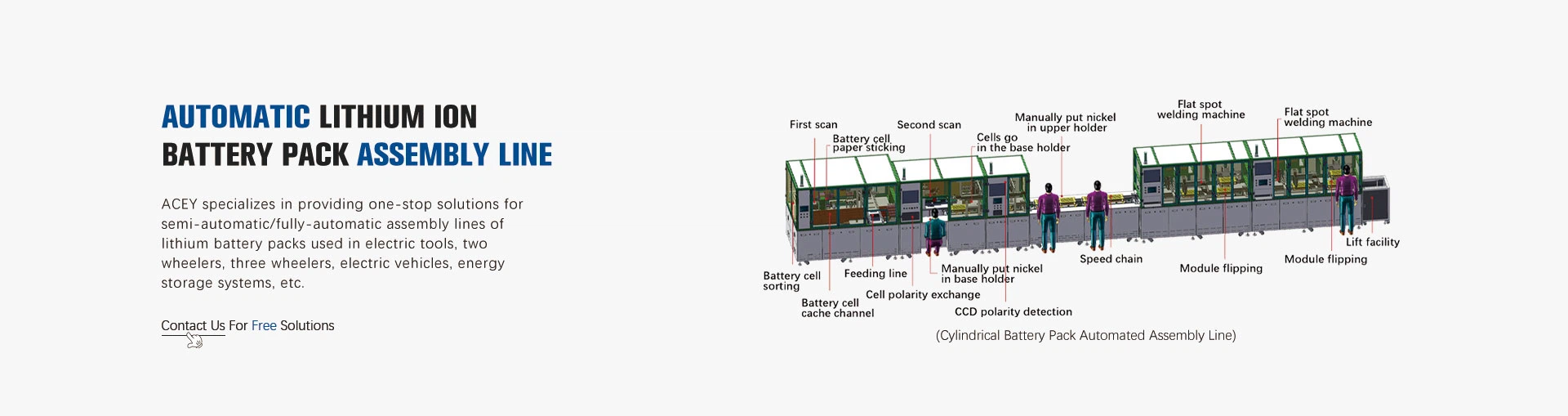
ACEY-CAL-UAV battery pack assembly line for UAV drone battery pack encompasses various stages and processes aimed at efficiently assembling and testing these battery packs to ensure they meet performance, safety, and quality standards.

(2) Other high-rate scenarios: From tools to transportation In addition to drones, these devices are also inseparable from high-rate batteries:
Power tools: electric drills and angle grinders can work up to 10A current, and ordinary batteries will stop due to overheating protection. The high-rate battery can withstand sustained high currents for 4 hours of continuous operation.

Emergency starting power: When the car loses power, it needs to instantly output 200A to start the engine, which can only be achieved by high-rate lithium iron phosphate batteries.
Electric Racing: The acceleration performance of RC racing cars depends on the battery discharge speed, with a 60C battery accelerating from 0-100km/h in just 2 seconds.
4. Technological breakthroughs: How to make batteries "fast and strong"?
The development of high-rate batteries is like walking a tightrope - both to allow lithium ions to move quickly (high rate) and to carry enough charge (high energy density). The two are often contradictory: increasing the thickness of the electrode increases capacity but hinders ion diffusion; Reducing particle size speeds up conduction but reduces energy density. Engineers find a balance through three dimensions of optimization:
(1)Material selection:
Improve performance from atomic structure Cathode materials prefer ternary materials (such as NCM811, NCA), whose layered structure allows lithium ions to diffuse 3 times faster than lithium iron phosphate. High-nickel ternary materials not only have high capacity, but also have electronic conductivity that is more than 10 times that of ordinary materials. The negative electrode uses small particle graphite (particle size 5-8μm), which shortens the lithium ion diffusion distance compared to traditional graphite. Lithium titanate material goes one step further - nanoscale particles shorten the diffusion path to 100nm, achieving 10-minute fast charging, but the energy density will be reduced by 20%, which is more suitable for scenarios with extremely high charging speeds.
(2)Formulation optimization:
find a balance between density and conduction The compaction density of the electrode is a key parameter: too high will squeeze the pores (ion channels), and too low will increase the contact resistance. The compaction density of high-rate batteries is usually controlled at 3.2-3.6g/cm³, which not only ensures more than 70% porosity, but also reduces electronic transport resistance. The addition of conductive agents is also particular - the composite use of carbon nanotubes and graphene can form an "electronic highway" inside the electrode, and the conductive efficiency is 5 times higher than that of traditional carbon black, while not occupying too much volume.
(3)Structural design:
Solve the heat dissipation problem When discharging at high current, the internal temperature of the battery will soar above 60°C. High-rate batteries are designed to cool down:
Lug Optimization: The multi-pole lug structure distributes the current and avoids local overheating. A 100C battery has 4 times more lugs than a regular battery.
Shell material: The aluminum alloy shell has a 30% higher heat dissipation efficiency than plastic, and with a honeycomb internal structure, it can quickly export heat.
Separator Improvement: Ceramic-coated separators are not only resistant to high temperatures, but also automatically close pores when the temperature is too high, preventing thermal runaway.
5. Future trends:
When high rate meets long battery life, the current energy density ceiling of high-rate batteries is 300Wh/kg, while ordinary power batteries can reach 350Wh/kg. The next generation of technologies will focus on two directions:
Silicon carbon anode: The theoretical capacity of silicon is 10 times that of graphite, and nanosilicon particles can not only increase the capacity but also maintain good rate performance after compounding with graphite.
Solid Electrolyte: Replacing liquid electrolyte increases lithium ion conduction speed by 10 times while eliminating the risk of leakage, laying the foundation for ultra-high rate batteries (above 200C). Once these technologies mature, we may see drones with a range of more than 1 hour, power tools for 8 hours of continuous operation, and even electric vehicles to achieve "5 minutes of charging and driving 200 kilometers".
From the free soaring of drones to the continued efficiency of power tools, high-rate batteries are reshaping our perception of "electricity." It is not only a breakthrough in technology, but also an accurate response to the needs of the scene - when technology can find the perfect balance between speed and capacity, every charge will be a leap in efficiency.
Acey Intelligent specializes in providing one-stop solutions for semi-automatic/fully-automatic assembly lines of lithium battery packs used in ESS, UAV, E-Bike, E-Scooter, Power Tools, Two/Three Wheelers, Etc. In Addition, we provide a complete set of battery pack assembly equipment, such as Cell Grading Machine, Battery Sorting Machine, Insulation Paper Sticking Machine, CCD tester, Manual/Automatic Spot Welding Machine, BMS Tester, Battery Comprehensive Tester and Battery Pack Test System, etc.