

With the continued rise of the new energy industry, lithium battery packs, as a core component of battery systems, have permeated many aspects of production and daily life. In 2026, the Chinese lithium battery pack market formed a distinct "three-way split": power batteries accounted for over 50%, energy storage for 30%, and small-power applications for approximately 20%. These three scenarios have different demands and complementary technologies, jointly driving the steady growth of the market. Riding the wave of increasing new energy vehicle penetration, explosive growth in the energy storage industry, and full coverage of small-power applications in people's lives, the application boundaries of lithium battery packs are constantly expanding, becoming an important engine driving the high-quality development of the new energy industry.

I. New Energy Vehicles
Power battery packs, as the "heart" of new energy vehicles, are currently the largest and fastest-growing battleground in the pack market. Their development directly relies on the upgrading of the new energy vehicle industry. Passenger vehicles and commercial vehicles have different technological focuses, but the core remains focused on breakthroughs in four core indicators: safety, range, lifespan, and fast charging.
In the passenger vehicle sector, high-voltage fast charging and high integration have become industry standards. The widespread adoption of 800V high-voltage platforms, with some flagship models upgrading to 900V high-voltage architecture, supports 4C-6C ultra-fast charging, enabling the convenient experience of "adding 300-400 kilometers of range with just 5 minutes of charging," completely alleviating users' range anxiety. The large-scale application of CTP/CTC deep integration technology has eliminated traditional module designs, increasing battery pack volume utilization to over 80% and system energy density to over 250Wh/kg. Some lithium iron phosphate battery packs have achieved a range exceeding 1,000 kilometers. Simultaneously, the widespread adoption of BMS active balancing technology can control the voltage difference of individual cells to within 20mV, not only increasing vehicle range by 10%-15% but also extending battery cycle life by 30%, balancing performance and durability. Currently, leading companies such as CATL and BYD Battery have become core suppliers for mainstream passenger vehicle manufacturers, supporting the continuous upgrading of passenger vehicle battery technology.

In the commercial vehicle sector, lithium iron phosphate batteries dominate, with long cycle life becoming a core requirement. Lithium iron phosphate (LFP) batteries, due to their outstanding advantages of high safety and long lifespan, have become the preferred choice for commercial vehicle battery packs. With a cycle life exceeding 6000 cycles, they are perfectly suited for heavy-duty, high-frequency usage scenarios such as heavy trucks, buses, and cold chain logistics. As the penetration rate of new energy commercial vehicles continues to increase, domestic sales of new energy heavy trucks are expected to exceed 350,000 units in 2026, with mainstream models carrying 400-600 kWh of battery capacity, becoming a significant growth driver in the power battery pack market and further boosting overall demand for power batteries.
II. Energy Storage
Energy storage packs are currently the fastest-growing segment in the lithium battery pack market, with an annual growth rate of 48%, becoming the second growth curve driving the industry. Benefiting from the implementation of independent energy storage policies in China and the explosive growth in overseas industrial, commercial, and residential energy storage demand, the core requirements for energy storage packs are concentrated in three areas: long cycle life, high safety, and intelligence, adapting to multiple energy storage applications.

In terms of performance requirements, energy storage packs have extremely stringent stability requirements, needing a cycle life of over 8000 cycles and a design life of up to 15 years of usable capacity. In terms of form factor, containerized energy storage PACKs have become mainstream, pre-installed with a complete system including BMS, liquid cooling, and fire protection. Liquid cooling systems, with their high-efficiency heat exchange advantages, are gradually replacing traditional air cooling. In some scenarios, direct carbon dioxide immersion liquid cooling technology has been adopted, achieving higher temperature control accuracy. On-site installation takes only 3 days, significantly improving deployment efficiency and reducing operation and maintenance costs. It can flexibly adapt to the energy storage needs of various scenarios, including grid-side, industrial and commercial, and residential applications. Meanwhile, intelligent scheduling capabilities are continuously upgraded, integrating AI technology to achieve precise intelligent scheduling, supporting primary grid frequency regulation, with a response time of less than 100ms. This perfectly adapts to the grid connection needs of new energy sources, becoming core equipment for grid peak shaving, photovoltaic energy storage, and data center backup power.

III. Small-Power Pack Equipment
Small-power PACKs achieve full coverage of public service scenarios, characterized by strong customization, cost-effectiveness, and strict safety and compliance. They cover multiple fields such as electric two-wheelers, three-wheelers, industrial vehicles, portable energy storage, drones, and medical equipment, with stable market demand growth.

In the electric two-wheeler sector, with the implementation of the new national battery standard in 2026, lithium iron phosphate (LFP) batteries are clearly replacing lead-acid batteries. Compared to traditional lead-acid batteries, LFP batteries are lighter, safer, and have a longer lifespan. Combined with an active balancing BMS, they can effectively solve the problem of reduced range in winter, and have lower long-term operating costs, gradually becoming the mainstream in the market. In the industrial vehicle sector, forklifts, AGVs, and other equipment require high-current discharge and 24-hour continuous operation, placing high demands on the high power and long-range capabilities of the batteries. They rely on efficient thermal management systems and overcurrent protection technology to ensure stable operation under high-intensity conditions. In the high-end portable device sector, drones, medical equipment, and military applications have extremely high requirements for battery miniaturization, low-temperature rise, and high reliability, driving the iterative upgrade of battery technology towards miniaturization and precision to meet the needs of high-end consumer and special-purpose scenarios.

IV. Conclusion
Currently, the three major application scenarios of lithium battery batteries are developing synergistically, each with its own focus. Power batteries are solidifying their market foundation, opening up new growth paths in the energy storage field, and small-scale power applications are filling gaps in consumer needs. With continuous technological iteration and the expansion of application scenarios, lithium battery packs are gradually breaking application boundaries, injecting lasting momentum into the comprehensive development of the new energy industry.
V. about Us
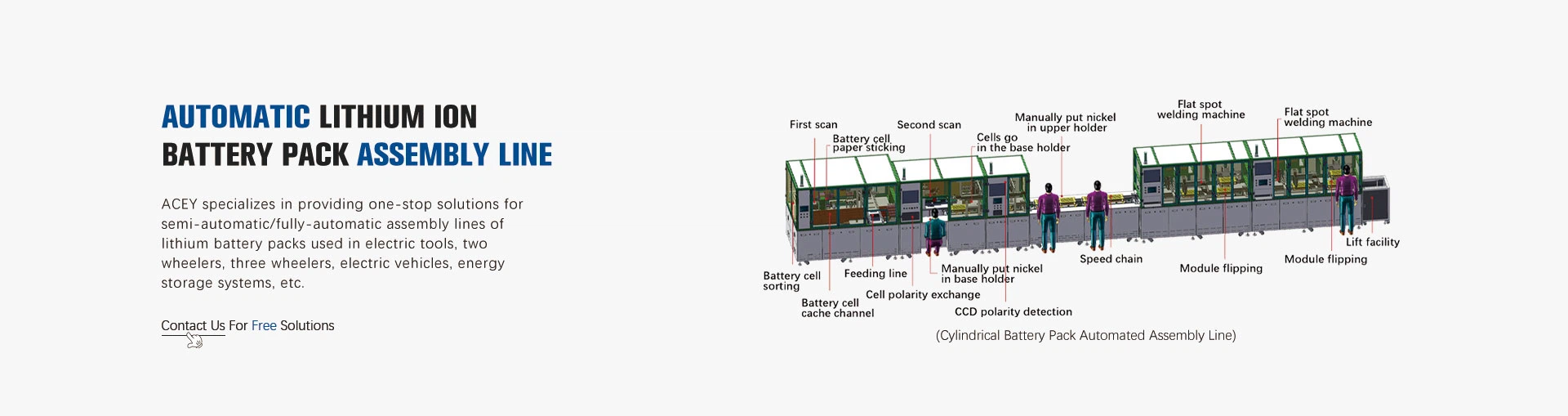
Acey Intelligent specializes in providing one-stop solutions for semi-automatic/fully-automatic assembly lines of lithium battery packs used in ESS, UAV, E-Bike, E-Scooter, Power Tools, Two/Three Wheelers, Etc. In Addition, we provide a complete set of battery pack assembly equipment, such as Cell Grading Machine, Battery Sorting Machine, Insulation Paper Sticking Machine, CCD tester, Manual/Automatic Spot Welding Machine, BMS Tester, Battery Comprehensive Tester and Battery Pack Test System, etc.