

The root cause of gas production in lithium-ion batteries is essentially the result of a series of undesirable chemical and electrochemical side reactions within the battery. These reactions consume the active components in the battery, disrupt the stability of the internal structure, and generate gaseous products. This not only leads to performance degradation issues such as battery bulging, capacity decay, and shortened cycle life, but in severe cases, it can also cause safety hazards such as battery leakage, fire, and even explosion. Based on the internal structure and working principle of lithium-ion batteries, gas production mainly originates from the following five core aspects, each interconnected and often mutually inducing and exacerbating the gas production phenomenon.

First, electrolyte decomposition
The electrolyte, as the core medium for ion transport within a lithium-ion battery, is composed of organic solvents, lithium salts, and additives. Its stability directly affects battery safety. In high-temperature environments (above 60°C) or when improper voltage is used (such as overcharging or charging voltage exceeding the safe range), the organic solvents in the electrolyte undergo oxidation or reduction reactions and decompose, breaking down the original molecular structure. This process generates a variety of gases, primarily carbon dioxide (CO₂), carbon monoxide (CO), methane (CH₄), and ethylene (C₂H₄). Among these, CO and other gases are toxic, further increasing safety risks.
Secondly, there is the damage and rebuilding of the SEI film
The SEI (solid electrolyte interface) film on the negative electrode surface is a protective film that naturally forms during the first charge and discharge of a lithium battery. It prevents the electrolyte from directly reacting with the negative electrode material, ensuring normal battery operation. However, when the battery is subjected to overcharging, over-discharging, high temperatures, or severe vibration, the SEI film can rupture. At this time, the electrolyte will react with the negative electrode material again, attempting to repair the damaged SEI film. This repeated damage and repair process continuously generates gases, mainly including hydrogen (H₂), ethylene (C₂H₄), and ethane (C₂H₆). Over time, this can lead to the SEI film losing its protective function.
Thirdly, there is excessive moisture content
Lithium-ion batteries have extremely high requirements for internal moisture content. Even trace amounts of water (ppm level, i.e., one part per million) can trigger serious side reactions. Moisture reacts with the core lithium salt in the electrolyte (such as lithium hexafluorophosphate LiPF₆) to produce highly corrosive hydrofluoric acid (HF). HF not only damages the SEI film but also further triggers a chain reaction of side reactions, including electrolyte decomposition and electrode material corrosion, producing gases such as hydrogen (H₂), hydrogen fluoride (HF), carbon monoxide (CO), and carbon dioxide (CO₂), while simultaneously corroding internal battery components.
Fourthly, there are side reactions related to the cathode material
The cathode material is crucial for the energy storage and release of lithium-ion batteries, especially high-nickel ternary cathode materials, which have relatively poor structural stability. Under overcharge or high-temperature conditions, the crystal structure of the cathode material collapses, releasing oxygen. This oxygen reacts violently with the electrolyte, further intensifying electrolyte decomposition and producing large amounts of gas, mainly oxygen (O₂) and carbon dioxide (CO₂). Oxygen accelerates combustion reactions, increasing the risk of battery fire.
Fifth, side reactions of the anode material
Different anode materials exhibit different gas generation characteristics. Newer anode materials, such as silicon anodes, experience significant volume changes during charge and discharge (expansion rates can exceed 300%). This repeated volume expansion and contraction continuously damages the SEI film, leading to ongoing side reactions and continuous gas generation. Traditional graphite anodes, under over-discharge or high-temperature conditions, also react with the electrolyte to generate gases such as hydrogen (H₂), ethylene (C₂H₄), and ethane (C₂H₆), affecting battery performance and safety.
about us
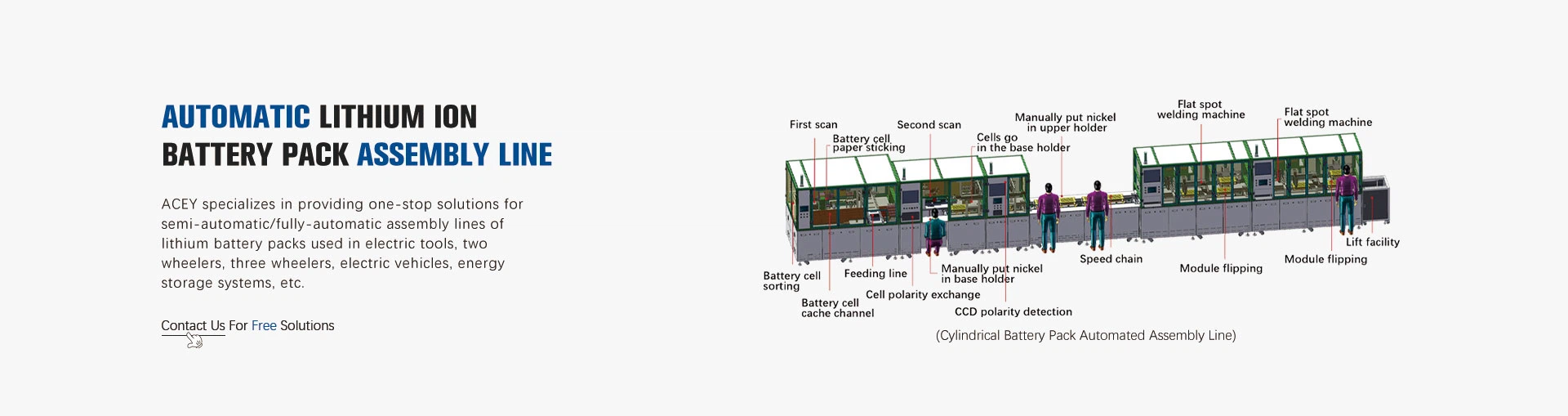
Acey Intelligent is dedicated to delivering integrated one‑stop solutions for both semi‑automatic and fully‑automatic lithium battery pack assembly lines, serving applications such as energy storage systems (ESS), unmanned aerial vehicles (UAVs), e‑bikes, e‑scooters, power tools, and two‑/three‑wheelers. Additionally, the company offers a comprehensive range of battery pack assembly equipment, including cell grading machines, battery sorters, insulation paper applicators, CCD inspection systems, manual and automatic spot welders, BMS testers, battery comprehensive testers, and battery pack test systems.
