

Battery Cell Packaging: A Small Desiccant, a Big Role
In lithium battery manufacturing, battery cell packaging is a crucial step. It acts like a solid "armor" for the battery cells, protecting them during subsequent transportation and storage, and directly impacting their performance and lifespan. A closer look at the battery cell packaging reveals a seemingly unassuming yet essential component: the desiccant. What role does this small desiccant play in battery cell packaging? Why is this seemingly unassuming desiccant so essential to the packaging process? Let's delve deeper into the secrets of desiccant placement in battery cell packaging.
Desiccant
When you pick up a packaged battery cell, you might not notice the desiccant quietly nestling inside. It lacks the complex, sophisticated structure of the battery cell, nor its elegant appearance. It's often just a small bag filled with granular, powdered, or bulky substances. Yet, this often overlooked small item is the "loyal guardian" of battery cells in the packaging world, shouldering the crucial mission of ensuring their quality. In the entire battery cell packaging system, desiccant may seem unnoticeable, but like air to life, its absence can cripple the entire system. Its importance cannot be underestimated. Let's uncover its crucial role.

Battery Cell's "Enemy": The Threat of Humid Air
In the "life" of a battery cell, humid air is like a hidden "enemy," constantly poised to attack, negatively impacting its performance and lifespan. When exposed to humidity, moisture acts like a "little assassin," silently invading the cell's interior. Once the electrode materials within a battery cell come into contact with moisture, they are susceptible to oxidation and corrosion reactions, much like iron rusting in humid air. This damages the electrode material's structure and reduces its electrochemical activity, significantly impairing the battery cell's charge and discharge performance. A cell that previously charged and discharged efficiently will experience slower charging and significantly shortened discharge times under the influence of moisture.

Furthermore, the electrolyte within the battery cell is also vulnerable to moisture and decomposes, producing gases and acidic substances. These gases and acids act like disruptors, reducing the electrolyte's conductivity and impairing ion transport within the cell. They can also corrode the battery casing. Corrosion of the battery cell casing is like a damaged wall, allowing electrolyte to leak out, further compromising the safety and performance of the battery cell. Furthermore, moisture-damaged battery cells can also lead to increased polarization between the positive and negative electrodes, increasing their internal resistance. Increased internal resistance is like a rougher road, hindering the flow of current, naturally reducing charging and discharging efficiency and impairing the cell's energy conversion capacity.
In extreme cases, the damage caused by humid air to battery cells can even pose a more serious safety hazard. When internal pressure in a battery cell continues to rise due to the inability to dissipate gases generated by electrolyte decomposition, the cell may overheat or even explode. This is no exaggeration; real-world safety incidents caused by moisture-damaged battery cells have served as a warning. Therefore, to protect battery cells from moisture, it is crucial to place desiccant in the packaging of the battery cells. Desiccant acts as a solid defense, blocking this "enemy" of moisture and safeguarding the safety and performance of the battery cells.
Desiccant's Hygroscopic Effect
The key to desiccant's status as the "guardian" of battery cells lies in its powerful moisture absorption capacity, which is supported by scientific principles. Common desiccants include silica gel, calcium chloride, and montmorillonite. Their moisture absorption mechanisms are primarily physical and chemical adsorption. Silica gel desiccant is like a "sponge castle" with countless tiny pores. Its main component, silicon dioxide, has an open, porous structure. These pores create a large specific surface area, allowing it to firmly adsorb water molecules from the air through physical adsorption. When humid air comes into contact with the silica gel desiccant, the water molecules are captured by the pores, much like a small water droplet being absorbed by a sponge, thereby reducing the humidity inside the package. This physical adsorption is reversible; under certain conditions, the adsorbed water molecules can be released again. However, within the battery cell packaging, it can continuously absorb moisture for a long time, maintaining a dry environment for the cells.
The moisture absorption mechanism of calcium chloride desiccant is more like a "magic show" of chemical reactions. Calcium chloride is highly hygroscopic and deliquescent. When it encounters water molecules, it undergoes a rapid chemical reaction, absorbing the water molecules and converting them into hydrates. Calcium chloride reacts with water to form calcium chloride hydrate. As the reaction proceeds, the calcium chloride gradually transforms from a solid into a gel-like substance. During this process, calcium chloride acts like a voracious "water-absorbing monster," continuously absorbing water, significantly reducing the humidity inside the package. Furthermore, the gel-like substance it forms locks in moisture, preventing it from easily releasing it back into the air, thereby maintaining a continuously dry environment.
Montmorillonite desiccant, derived from a natural mineral, also has an interesting moisture absorption process. Montmorillonite is a layered clay mineral with numerous cavities and channels within its crystal structure. These microscopic structures provide ample storage space for water molecules. When water molecules from the surrounding environment approach the montmorillonite desiccant, they are attracted to these cavities and channels and adsorbed into them, like finding a warm "home" where they are securely "settled," effectively removing moisture from the package.
Due to their unique moisture absorption mechanism, these desiccants play a crucial role in the packaging of battery cells. Like loyal guardians, they constantly monitor and control the humidity within the packaging, ensuring the cells maintain a dry, stable environment and protecting them from the harmful effects of humid air, thus safeguarding their performance and safety during transportation and storage.
Types of Desiccant
In the small "world" of battery cell packaging, the desiccant family boasts a wealth of talent. Different types of desiccant, each with its own unique capabilities, safeguard the quality of the cells.
Silica gel desiccant is a star performer within the desiccant family. It typically appears as transparent or translucent granules with a sleek, round appearance. Its primary component, silicon dioxide, gives it exceptional physical adsorption capacity. Its numerous tiny pores, like densely packed chambers, provide ample storage space for water molecules. Silica gel desiccant is chemically stable, non-toxic, and odorless. Even prolonged contact with battery cells does not contaminate them, making it a popular choice for packaging battery cells. Silica gel desiccant is often found in electronic product packaging, effectively preventing moisture-induced short circuits on circuit boards. It also provides excellent moisture protection for battery cells, ensuring stable performance during transportation and storage.
Montmorillonite desiccant, a natural "guardian," is made from pure natural montmorillonite through a drying and activation process. This desiccant's greatest strength is its environmental friendliness. It contains no additives or soluble substances, is non-toxic, and is non-corrosive. Even in direct contact with metal battery cells, it remains non-corrosive, fully complying with environmental and safety standards. Montmorillonite desiccant also boasts excellent moisture absorption properties, maintaining a stable moisture absorption capacity across a wide range of temperatures. Its saturated moisture absorption rate can reach over 50% of its weight, 1.5 times that of traditional desiccants. Like a tireless "hygroscopic expert," it can quickly and effectively reduce humidity within the packaging, creating a dry environment for the battery cells. Montmorillonite desiccant is widely used in battery cell production, where environmentally sensitive materials are crucial. It not only protects the battery cells but also minimizes environmental impact.
Calcium chloride desiccant is a powerful desiccant. Its exceptionally strong moisture absorption capacity stems from its chemical reaction with water. Calcium chloride quickly combines with water molecules to form a stable hydrate, absorbing significant amounts of moisture from the packaging. Furthermore, after absorbing moisture, calcium chloride desiccant transforms into a gel-like state. This property allows it to securely lock in absorbed moisture, preventing it from easily releasing it back into the air and ensuring a consistently dry environment within the packaging. However, calcium chloride desiccant is somewhat corrosive, so when using it, ensure that the packaging is sealed tightly to avoid direct contact with the battery cells. In battery cell storage environments with extremely high humidity requirements, calcium chloride desiccant, with its powerful moisture absorption capacity, plays a crucial role.
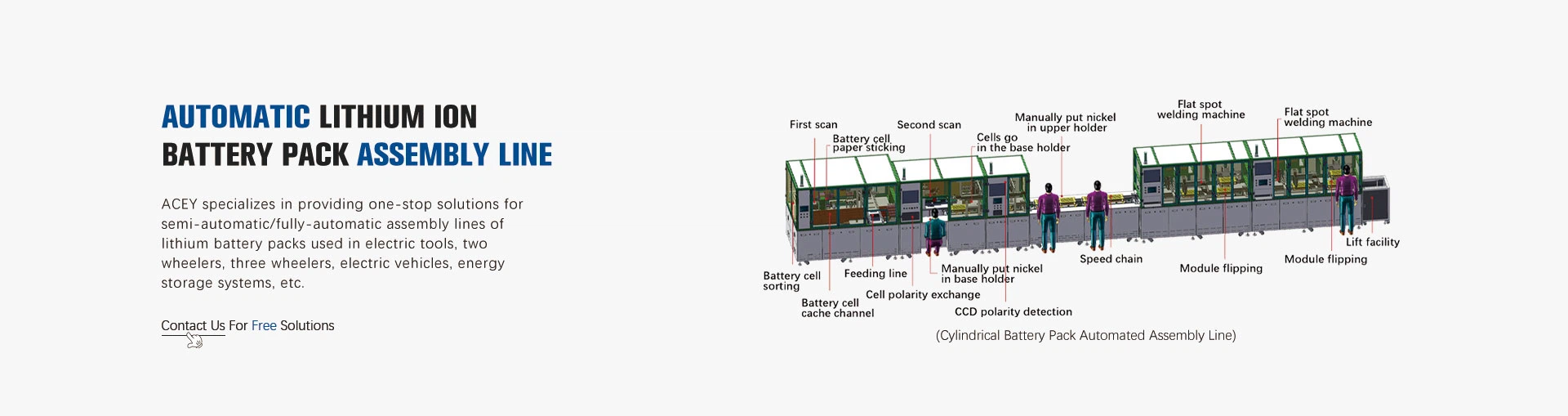
Acey Intelligent specializes in providing one-stop solutions for semi-automatic/fully-automatic assembly lines of lithium battery packs used in ESS, UAV, E-Bike, E-Scooter, Power Tools, Two/Three Wheelers, Etc. In Addition, we provide a complete set of battery pack assembly equipment, such as Cell Grading Machine, Battery Sorting Machine, Insulation Paper Sticking Machine, CCD tester, Manual/Automatic Spot Welding Machine, BMS Tester, Battery Comprehensive Tester and Battery Pack Test System, etc.