

Overview
In the precision arena of modern industry, laser welding technology is undoubtedly a shining star. From seamlessly connecting car bodies and components in automotive manufacturing to precisely connecting critical aircraft structures in the aerospace industry; from delicately welding tiny chip pins in electronic devices to manufacturing precision components critical to life and health in medical devices, laser welding technology is ubiquitous. With its numerous advantages, such as high precision, high efficiency, and low heat-affected zone, it has become a key force driving the development of various industries, significantly improving product quality and performance and transforming once complex welding processes into efficient and precise ones.
However, in this seemingly magical laser welding process, there is an often overlooked yet crucial "unsung hero": shielding gas. Just as actors on stage require a suitable stage environment, laser welding also requires the "protection" of shielding gas. Let's unveil the crucial role of shielding gas in laser welding.
The Critical Mission of Shielding Gas
(I) Potential Dangers in Welding
In the microscopic world of laser welding machine, without the participation of shielding gas, welds face numerous potential hazards. When a laser beam instantly releases high energy, rapidly melting the metal and forming a molten pool, oxygen in the surrounding air acts like a waiting "invader." For example, in carbon steel welding, a common process in automotive manufacturing, without a shielding gas, the high-temperature molten pool, upon contact with oxygen, rapidly reacts with the oxygen, producing oxides such as iron oxide. These oxides not only alter the chemical composition of the weld but also increase its hardness and decrease its toughness. This makes the weld susceptible to cracking during subsequent use, reducing the structural strength and safety of automotive components.
At the same time, nitrogen in the air can also react with the metal at high temperatures. For example, when welding aluminum alloys, nitrogen reacts with aluminum to form aluminum nitride, which is hard and brittle, severely impacting the mechanical properties of the weld. Furthermore, without the stabilizing effect of a shielding gas during the cooling and solidification process, the flow of the liquid metal becomes turbulent, easily leading to the formation of pores. These pores, like hidden dangers buried within a fortress, significantly weaken the strength and sealing of the weld. For welding critical aircraft components in the aerospace industry, pore defects can have catastrophic consequences. Moreover, without shielding gas to disperse it, metal vapor will gather in the weld area, forming a plasma cloud. This plasma cloud strongly absorbs, scatters, and reflects the laser beam, acting like a "veil" over the laser beam, preventing the laser energy from effectively transmitting to the workpiece. This results in shallow weld depth and unstable weld quality.
ACEY-LWM Gantry continuous metal laser welding machine is used for metal welding, especially for prismatic and pouch pack assembly.Using the internationally advanced fiber laser source, combined with our company's independently developed design, it has excellent rigidity and stability.

(II) The Powerful Effects of Shielding Gas
Shielding gas plays multiple key roles in laser welding and possesses powerful effects. First, it acts as a "loyal guardian" that isolates the weld from the air. Through a specially designed nozzle, shielding gas is injected into the weld area at an appropriate flow rate and velocity, forming a tight "air curtain" around the molten pool, blocking out harmful atmospheric elements such as oxygen, nitrogen, and water vapor. This acts like a solid "protective suit" for the molten pool, fundamentally preventing chemical reactions between the metal and these harmful elements, ensuring the purity and chemical stability of the weld.
Shielding gas also plays an important role in stabilizing the molten pool. It exerts a certain pressure on the molten pool surface, suppressing violent fluctuations in the liquid metal. Like a guardian of a calm lake, it keeps the molten pool relatively stable. This allows for a more even distribution of liquid metal during solidification, significantly reducing spatter caused by an unstable molten pool. Spatter not only wastes material but can also contaminate welding equipment, impacting subsequent welding operations. The presence of a shielding gas effectively addresses this issue, resulting in a more aesthetically pleasing and regular weld, improving welding quality and efficiency.
Shielding gas also optimizes weld microstructure. During welding, it assists in heat dissipation and controls the cooling rate of the weld. For example, in stainless steel welding, a suitable cooling rate helps form a uniform, fine-grained structure, enhancing the weld's strength, toughness, and corrosion resistance. Too rapid a cooling rate will coarsen the grains, reducing weld performance; too slow a cooling rate can lead to excessive weld distortion. The shielding gas acts as a precise "temperature regulator," removing some heat to cool the weld within the appropriate temperature range, thereby achieving the desired microstructure and properties.

Furthermore, in high-power laser welding, shielding gas plays a critical role in maintaining stable beam transmission. It effectively dissipates the metal vapor and plasma cloud generated during the welding process, allowing the laser beam to reach the workpiece surface unimpeded, ensuring efficient laser energy transfer, a stable welding process, and consistent and reliable weld quality.
The Unique Performance of Nitrogen in Laser Welding
(I) Basic Characteristics of Nitrogen
Nitrogen, a gas that accounts for approximately 78% of air, plays a vital role in laser welding due to its unique physical and chemical properties. Chemically, a nitrogen molecule consists of two nitrogen atoms bound together by a strong nitrogen-nitrogen triple bond (N≡N), with a bond energy of 948.9 kJ/mol. This makes nitrogen extremely stable at room temperature and pressure, making it difficult to react with other substances. Like a calm "guardian," it maintains its stability even in the high-temperature environment of welding.
In terms of physical properties, nitrogen has a density of 1.25 g/L (0°C, 1 atm), which is similar to but slightly lower than the density of air. This property enables it to form a stable gas layer above the weld area when used as a shielding gas, preventing it from being easily dispersed by air. Its moderate ionization energy produces less plasma under laser action, which is crucial for maintaining stable laser energy transmission during laser welding. This reduces the absorption, scattering, and reflection of laser energy by the plasma, ensuring efficient laser energy delivery to the weld. At standard atmospheric pressure, nitrogen liquefies to liquid nitrogen when cooled to -195.8°C and solidifies into a snow-like solid at -209.9°C. However, in laser welding, its primary use is in its gaseous form for shielding and auxiliary functions. These fundamental properties provide a solid foundation for nitrogen's diverse applications in laser welding.
(II) The Specific Role of Nitrogen
Preventing Oxidation: During laser welding, a high-energy laser beam is focused onto the metal surface, rapidly melting the metal to form a molten pool. This molten pool is hot and active, making it highly reactive to oxygen in the air. Nitrogen, acting as a shielding gas, is injected into the weld area through a specially designed nozzle at an appropriate flow rate and velocity, creating a tight, protective airflow around the molten pool. This airflow acts as a solid "barrier," isolating the oxygen in the air and preventing the hot molten pool and the newly solidified weld from coming into contact with oxygen, thus eliminating oxidation at its root. For example, when welding stainless steel, without nitrogen protection, oxidation will form a black oxide scale on the weld surface, which not only affects the appearance but also reduces the weld's corrosion resistance and strength. With nitrogen protection, the weld maintains a bright metallic color, maintains a stable internal chemical composition, and effectively safeguards both corrosion resistance and mechanical properties.
Reducing Spatter: During the welding process, the liquid metal on the surface of the molten pool is susceptible to spatter due to factors such as the impact of laser energy, the escape of metal vapor, and gas expansion. A nitrogen flow effectively controls the atmosphere at the surface of the molten pool, acting like a gentle "hand" to stabilize the surface. By suppressing violent fluctuations in the liquid metal, it reduces spatter caused by gas expansion or metal evaporation, resulting in a smoother weld during solidification and a more aesthetically pleasing and uniform finish. In laser welding of automotive parts, reducing spatter not only improves weld quality but also reduces the need for subsequent cleaning and polishing of the weld surface, increasing production efficiency and reducing costs.
Assisting Heat Dissipation: Although nitrogen's thermal conductivity is not as good as helium's, it can still dissipate some heat during laser welding, assisting in weld cooling. When the hot weld comes into contact with nitrogen, heat is transferred to the nitrogen molecules and carried away by the nitrogen flow. A suitable cooling rate is crucial for the formation of weld microstructure, contributing to a finer and more uniform grain structure. For example, when welding aluminum alloys, nitrogen-assisted heat dissipation can prevent cracks in the weld caused by rapid cooling. It also refines the grain size, improving the weld's strength and toughness, enabling the welded aluminum alloy component to meet higher performance requirements.
Maintaining beam stability: In some high-power laser welding systems, the welding process generates large amounts of metal vapor, dust, and smoke.
These substances can accumulate in the optical path and severely impact laser beam transmission. Nitrogen purges the optical path to promptly dissipate these vapors, dust, and smoke, ensuring unimpeded laser beam transmission to the workpiece surface and maintaining a stable welding process. This creates a "green channel" for the laser beam, ensuring that laser energy is accurately and efficiently delivered to the weld site, thereby ensuring consistent and stable weld quality. Maintaining beam stability is particularly important for welding precision electronic components, effectively avoiding problems such as cold welds and insufficient weld strength caused by beam instability.
About Us
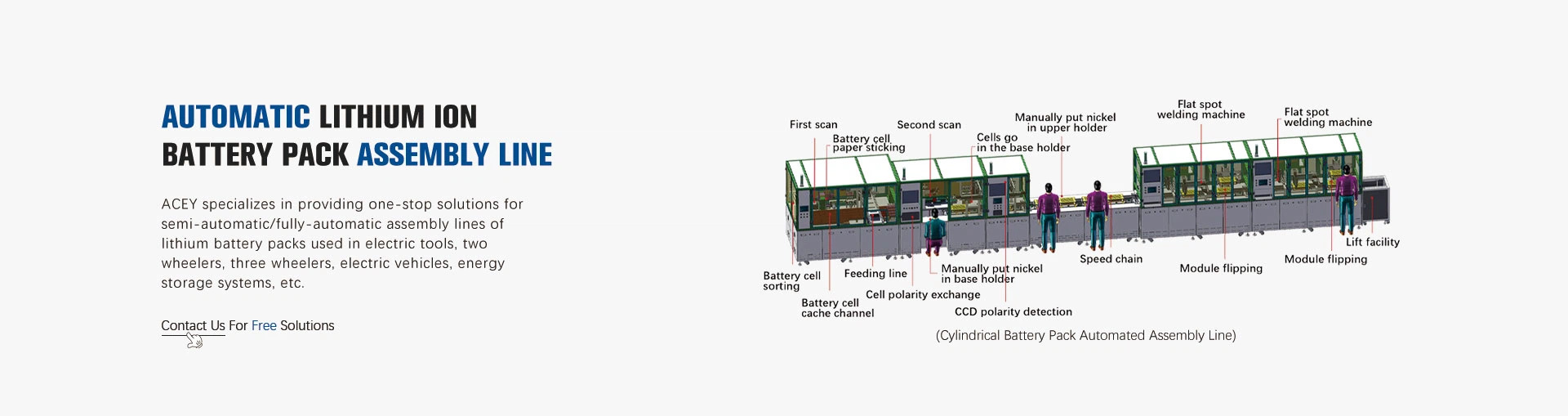
Acey Intelligent specializes in providing one-stop solutions for semi-automatic/fully-automatic assembly lines of lithium battery packs used in ESS, UAV, E-Bike, E-Scooter, Power Tools, Two/Three Wheelers, Etc. In Addition, we provide a complete set of battery pack assembly equipment, such as Cell Grading Machine, Battery Sorting Machine, Insulation Paper Sticking Machine, CCD tester, Manual/Automatic Spot Welding Machine, BMS Tester, Battery Comprehensive Tester and Battery Pack Test System, etc.