

Amid the global boom in the new energy industry, battery production line equipment is rapidly expanding into the international market, leveraging its cost-effectiveness and technological advantages. However, market access and certification systems vary significantly across countries and regions. Ignoring compliance can not only result in product import bans, but also lead to significant fines and a loss of market trust. This article systematically outlines the core certification requirements for exporting to the European and American markets, helping companies avoid certification pitfalls and successfully enter overseas markets.
European and American Certification Requirements
As the core region of the global new energy industry, the European and American markets have extremely stringent requirements for the safety, environmental friendliness, and electromagnetic compatibility of battery production line equipment. With mature certification systems and standardized processes, they represent the first hurdle companies must overcome before expanding overseas.
EU: Multi-dimensional Certification Creates a "Green Barrier"
The EU's layered certification standards not only ensure consumer and environmental safety, but also establish a certain market entry barrier. For battery production line equipment, the following five certifications are essential:

CE Certification: A "Mandatory Pass" for the EU Market
CE certification is a mandatory safety certification established by the EU for products entering its market. It covers core areas such as electrical safety (EN 61010 series standards), electromagnetic compatibility (EMC, EN 61326 standard), and mechanical safety (EN ISO 12100 standard).
Key Requirements: Battery cell assembly machines and testing equipment in the battery production line must pass electrical safety tests such as voltage withstand, ground resistance, and leakage protection. Furthermore, they must ensure that electromagnetic radiation emitted by the equipment during operation does not interfere with surrounding equipment and is resistant to external electromagnetic interference.
Practical Tips: Companies must entrust testing to an EU Notified Body (such as SGS or TÜV Rheinland). Upon passing certification, the CE mark must be prominently affixed to the product and a Technical File (TCF) must be prepared for customs inspection. Products without the CE mark or that do not meet the standards will be detained by EU customs and may even face notification and recall by the European Commission.
RoHS Certification: The "Red Line" of Environmental Protection Requirements
RoHS certification, short for the "Restriction of the Use of Certain Hazardous Substances in Electrical and Electronic Equipment," has been updated to RoHS version 3.0, increasing the number of controlled substances from six to ten (including newly added phthalates).
Specific to equipment: Components such as circuit boards, cables, and plastic casings in battery production lines must strictly limit the content of hazardous substances such as lead, mercury, and cadmium (e.g., lead content ≤ 1000 ppm).
Companies should sign environmental protection agreements with upstream suppliers in advance and require them to provide RoHS testing reports for raw materials. At the same time, they should conduct sampling tests on finished products to prevent the entire batch from failing due to a single component exceeding the standard. For example, a domestic equipment company had 200 units of equipment stranded at a German port due to excessive phthalates in its cables, resulting in losses exceeding one million euros.
REACH Certification: A Comprehensive Network for Chemical Substance Control.
REACH (Registration, Evaluation, Authorization and Restriction of Chemicals) covers all chemical substances, including coatings, adhesives, and lubricants used in battery production equipment.
Core Obligations: If the annual export volume of a chemical substance in equipment exceeds 1 ton, the company must submit a registration application to the European Chemicals Agency (ECHA). If a "Substance of Very High Concern (SVHC)" is present at a concentration exceeding 0.1%, this must be stated in the product instructions.
Latest Developments: In 2024, ECHA added 12 new SVHCs, including flame retardants commonly used in battery equipment. Companies must promptly update their bills of materials (BOMs) to identify risk substances.
WEEE Certification: A "Closed Loop of Responsibility" for Waste Disposal
WEEE (Waste Electrical and Electronic Equipment) Directive requires companies to assume responsibility for the recycling and disposal of end-of-life products, aiming to reduce the environmental impact of e-waste.
Specific requirements: Companies must designate an authorized representative within the EU to coordinate product recycling; they must also pay a recycling fee based on the type of equipment (for example, the recycling fee for industrial equipment is approximately €50-200 per unit) and label their products with recycling labels.
Case Study: A battery equipment company was banned from selling its products in France due to failure to promptly register for a WEEE recycling account. It subsequently took three months to complete the necessary paperwork before market access was restored.
EU New Battery Regulation: "New Thresholds" to Be Implemented in 2024
On July 1, 2024, the EU's new battery regulation officially came into effect, imposing stricter sustainability and safety requirements for batteries and related production equipment, directly impacting the export of battery production equipment.
Key Changes: Equipment is required to include a "carbon footprint declaration," accounting for carbon emissions throughout its lifecycle, from raw material extraction to shipment. Furthermore, equipment must be compatible with a traceability system that can track the source of raw materials used in battery production in real time (for example, key metals such as cobalt and lithium must meet due diligence requirements). Recommendations: Companies should establish carbon emissions accounting systems in advance and collaborate with third-party organizations to produce carbon footprint reports. Furthermore, they should upgrade their equipment's IoT modules to meet traceability requirements and avoid losing orders due to delayed implementation of new regulations.
United States: Dual-Core Certification for Safety and Electromagnetic Compatibility
Certification for battery production line equipment in the US market focuses on safety and electromagnetic compatibility, primarily relying on the FCC and UL certification systems. While the process is relatively flexible, the auditing is no less rigorous than that of the EU.
FCC Certification: The "Mandatory Threshold" for Electromagnetic Compatibility
FCC (Federal Communications Commission) certification applies to all electronic and electrical products entering the US market, regulating their electromagnetic radiation levels to prevent interference with US communication networks.
Certification Category: Battery production line equipment generally falls under the "Industrial, Scientific, and Medical (ISM) Equipment" standard and must comply with FCC Part 18. This certification is available in two modes: Self-Certification (SDoC) and Certification. Self-certification (SDoC): Applicable to low-risk devices (such as small testing instruments). Companies conduct their own testing and issue reports without the need for review by an FCC-approved agency. Certification: Applicable to high-power devices (such as battery cell laser welders). Testing must be conducted by an FCC-approved laboratory (such as UL or Intertek). Passing the test results in an FCC ID number before the device can be marketed.
Note: Product labels must include the FCC ID number and a warning (such as "Complies with Part 18 of the FCC Rules"). Otherwise, customs will refuse clearance.
UL Certification: A "Market Passport" for Safety Performance.
While not mandatory by the US government, UL (Underwriters Laboratories) certification is the most widely recognized safety certification in the market, particularly in the industrial equipment sector. Over 90% of buyers require UL certification as a prerequisite for cooperation.

Certification Standards: Battery production line equipment must comply with UL 508A (Safety Standard for Industrial Control Equipment). Testing covers electrical insulation, overload protection, and fire resistance. For example, the device's wiring terminals must withstand a 1000V voltage test, and the housing must pass a V0 flame retardancy test.
Value Advantage: UL-certified products not only quickly gain the trust of American customers but also offer lower insurance premiums (some insurance companies offer a 10%-20% reduction in premiums for UL-certified products). A domestic company once lost out on a contract with Tesla's US factory because its products lacked UL certification. Only after obtaining UL certification did they successfully enter the supply chain.
About Us
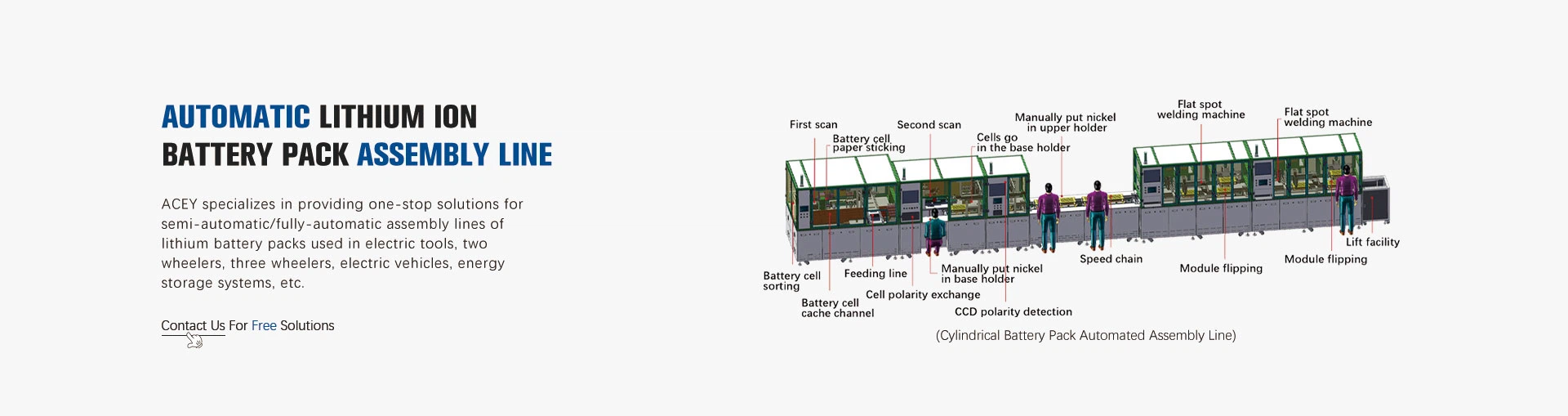
Acey Intelligent specializes in providing one-stop solutions for semi-automatic/fully-automatic assembly lines of lithium battery packs used in ESS, UAV, E-Bike, E-Scooter, Power Tools, Two/Three Wheelers, Etc. In Addition, we provide a complete set of battery pack assembly equipment, such as Cell Grading Machine, Battery Sorting Machine, Insulation Paper Sticking Machine, CCD tester, Manual/Automatic Spot Welding Machine, BMS Tester, Battery Comprehensive Tester and Battery Pack Test System, etc. If you have any needs, please contact us.