

Dry electrode technology is an emerging manufacturing process for lithium battery electrodes, which has attracted extensive attention in recent years. The following is a detailed explanation of its principles, preparation process, advantages, challenges and future prospects:
1. The principle of dry electrode technology
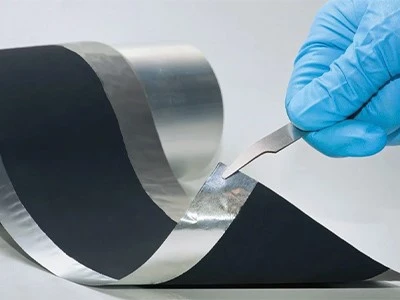
Dry cell electrode (DBE) technology is a breakthrough solvent-free method for manufacturing batteries. Unlike traditional wet coating methods, the dry electrode coating process uses a precision dispensing system to apply a dry mixture of active materials and conductive additives to the electrode substrate. The core of the binder is to use the fibrillation action of the binder to mix powder materials such as active substances, conductive agents and binders under solvent-free conditions to form a self-supporting film with a certain strength and conductivity. This self-supporting membrane can be combined directly with the current collector to form an electrode.
2. Preparation process of dry electrode
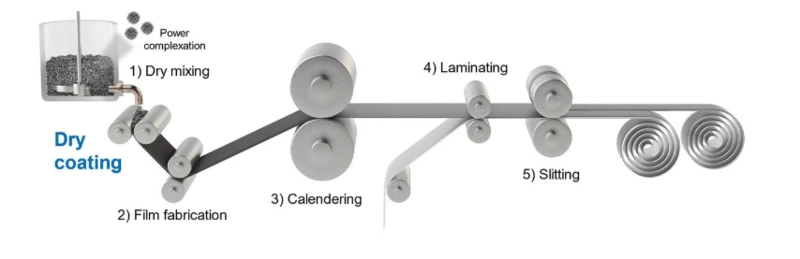
The preparation process of dry electrode mainly includes the following steps:
- Powder mixing: Powder materials such as active substances, conductive agents and binders are evenly mixed.
- Fibrosis: The binder is fibrillated by high-shear equipment to form a fibrous structure and enhance the mechanical strength and conductivity of the electrode.
- Film formation: The fibrous mixture is formed by rolling or extrusion to form a self-supporting film.
- Roller lamination: The self-supporting film is combined with the current collector and made to adhere firmly by rolling.
3. Advantages of dry electrode technology
- Higher energy density: no solvent residue, improved utilization rate of active substances, greater electrode compaction density, and higher capacity design.
- Stronger cycle stability: The fibrotic structure inhibits the volume expansion of the active substance, reduces particle shedding, and prolongs the cycle life.
- Rate performance optimization: The conductive network is more uniform, and the ion transmission efficiency is improved, which is suitable for fast charging scenarios.
- Environmental protection and cost advantage: eliminate solvent use and recycling, reduce material costs and equipment energy consumption, and shorten the production cycle.
- Adaptable to future batteries: Compatible with solid-state battery technology to avoid corrosion of electrode materials by liquid electrolytes.
4. The challenges of dry electrode technology
- Adhesive limitations: Mainstream PTFE adhesives need to be modified (such as carbon coating) to improve conductivity and stability, and the process complexity is high.
- Strict equipment requirements: fibrosis equipment needs to withstand high shear forces, and rolling equipment needs high-precision control to avoid material damage.
- Large-scale problem: the uniformity of the electrostatic spraying method is insufficient, and it is currently only suitable for laboratories; The problem of particle agglomeration in the dry mixing process needs to be further optimized.
- Material system adaptability: It is necessary to develop new binders and solve the problem of long-term cycling stability under high-pressure compaction density.
5. Future prospects
With the growing demand for solid-state batteries and new energy sources, dry electrode technology is expected to become mainstream. In the future, the development of dry electrode technology will rely on equipment and process optimization, such as the development of high-precision spraying equipment and intelligent control systems to improve coating uniformity and thickness control. At the same time, it will also be an important development direction to explore new binder materials to enhance the adhesion and conductivity of coatings.
Acey Intelligent is a high-tech enterprise. Our R&D team specializes in researching and manufacturing high-end equipment for lithium-ion batteries. Our business covers semi-automatic & fully automatic assembly machines for cylindrical, prismatic, and pouch battery packs; lab-scale fabrication machines for coin cells, cylindrical cells, and pouch cells; battery environmental safety testing equipment; battery materials; and supercapacitor production equipment, etc.