

Traditional liquid lithium-ion batteries are facing performance bottlenecks in the material system: first, the energy density is difficult to break through 350Wh/kg, which limits the improvement of electric vehicle range and electronic equipment standby time; second, the organic liquid electrolyte has active chemical properties, which is easy to cause safety hazards such as thermal runaway, combustion and even explosion; third, the electrolyte has volatilization, drying, leakage and other problems during the battery service process, which significantly shortens the battery life. Liquid electrolytes have become the core obstacle restricting the advancement of lithium-ion battery technology.
Solid-state batteries have opened up a new path for industry development by replacing liquid electrolytes with solid electrolytes. This technological innovation can not only adapt to high-capacity materials such as silicon-based negative electrodes and lithium-rich positive electrodes, breaking through the upper limit of energy density, but also avoid electrolyte leakage and thermal runaway risks from the root, significantly improving battery safety. In addition, the stable characteristics of solid-state electrolytes can effectively inhibit battery aging and extend cycle life. Therefore, all-solid-state lithium batteries are regarded as the inevitable direction of lithium-ion battery technology upgrades, and are expected to bring revolutionary breakthroughs to the new energy industry.

Process Differences
In the evolution of battery technology, the core difference between solid-state batteries and traditional liquid batteries is reflected in the innovation of the electrolyte system: the composition of traditional liquid lithium batteries relies on four key components - positive electrode, negative electrode, electrolyte and diaphragm, among which the liquid electrolyte needs to be matched with the diaphragm to block the risk of short circuit between the positive and negative electrodes.
Solid-state batteries completely replace the electrolyte and diaphragm in the traditional system with solid electrolytes: this solid material not only undertakes the function of ion conduction (replacing the electrolyte), but also can directly block the contact between the positive and negative electrodes (replacing the diaphragm) by virtue of its non-liquid properties, fundamentally changing the internal structure and working mechanism of the battery. Compared with the liquid system, the introduction of solid electrolytes not only saves the complex processes such as electrolyte filling and diaphragm laying, but also breaks through the bottlenecks of traditional batteries in terms of safety and energy density through the change of material form, becoming an important direction for battery technology iteration.
All-solid-state batteries break through the boundaries of traditional technology with a new material system and battery structure. The existing liquid lithium battery manufacturing process and equipment are difficult to meet its industrialization needs. Limited by the current situation of incomplete mass production, the production process of all-solid-state batteries has not yet been finalized. Different products have different process paths due to differences in design and application scenarios. However, compared with traditional liquid batteries, there are significant differences in the core production process between the two, which are specifically reflected in the following three links:
1. Front-end pole piece production: technological transition from wet slurry to dry electrode
The production of traditional liquid lithium battery pole pieces relies on wet process, which requires the active material, conductive agent, binder and solvent to be mixed into slurry, coated on the current collector, dried and rolled to shape, and the preparation and impurity removal processes brought by the use of solvents increase the complexity. All-solid-state batteries use dry electrode technology, which can directly mix slurry and apply without solvents. It not only simplifies the process and reduces pollution, but also adds the coating and rolling of solid electrolyte membranes. By preparing the electrode-electrolyte composite layer, structural innovation is achieved.

2. Mid-stage battery cell assembly: lamination process dominates, and the injection process is completely innovated
In the battery cell assembly stage, traditional liquid batteries can be formed by winding or lamination process. After forming, electrolyte needs to be injected, and the positive and negative electrodes are isolated by diaphragms to ensure safety. All-solid-state batteries are mainly based on lamination process, with pole piece glue frame printing and isostatic pressing technology to strengthen the contact tightness between solid electrolyte and electrode. Because solid electrolyte has both ion conduction and physical isolation functions, all-solid-state batteries can completely save the injection process and avoid leakage and short circuit risks from the source.
3. Back-end formation and packaging: high-voltage formation reshapes performance standards
In the formation and packaging stage, after the traditional liquid lithium battery is packaged, the internal chemical reaction of the battery is activated by low-voltage formation. Because all-solid-state batteries have strict requirements on the ionic conductivity of solid electrolytes, they need to adopt high-voltage formation process, optimize the internal interface characteristics of the battery through higher voltage and more precise parameter control, and improve the overall performance. Overall, all-solid-state batteries have achieved a full-scale breakthrough in production technology from material preparation to battery cell forming. The dry electrode and electrolyte membrane preparation at the front end, the stacking combination technology in the middle end, and the high-voltage formation strategy at the back end together build a manufacturing system that is completely different from traditional liquid batteries, and also lay the foundation for battery performance improvement and industrial upgrading.
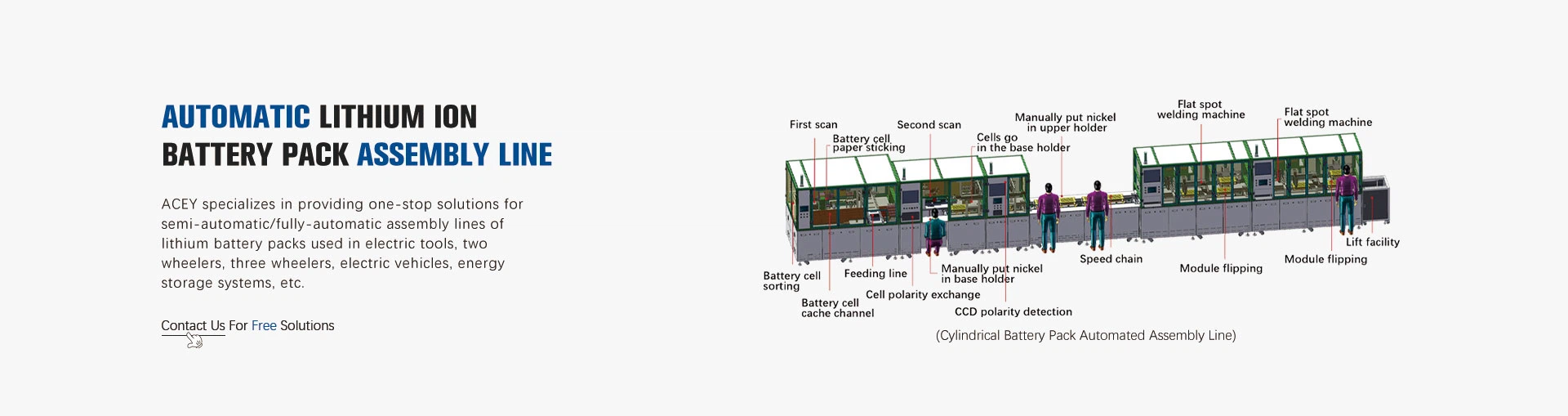
Acey Intelligent is specialized in researching and manufacturing of high-end equipment for lithium-ion batteries. We can not only provide one-stop solution for lithium ion battery production line for cylindrical battery, coin cell, pouch cell, but also provide one-stop solution for lithium battery pack assembly line, if you are new in lithium ion battery industry, and want to build your own lithium ion battery production line or lithium ion battery pack assembly line, we can provide you professional technical support and guidance, please feel free to contact us!