

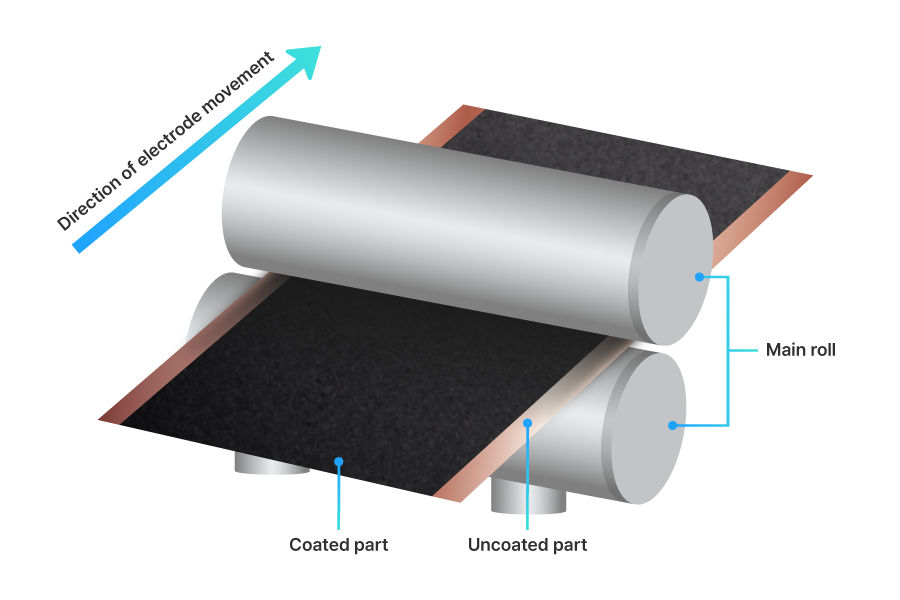
A common problem encountered during the rolling process of a electrode calendering machine is that while the equipment's set thickness reaches the target value and the electrode thickness is generally within tolerance after exiting the roll, the electrode thickness rebounds after a period of time. This phenomenon is particularly pronounced in high-compaction systems. Based on field experience, electrode rebound cannot be simply attributed to insufficient rolling pressure. When diagnosing the rebound problem, it's necessary to separate the compression deformation during rolling from the structural recovery after decompression.

1. The Essence of Electrode Rebound
After entering the roll gap, the coating of the electrode is subjected to radial compression, accompanied by slippage, compression, and rearrangement between particles. For electrodes with high initial porosity, the initial deformation mainly involves particle rearrangement and pore compression, which is relatively easy to retain. As the compaction degree continues to increase, the contact area between particles increases, local contact stress rises rapidly, and some particles begin to undergo plastic deformation or even breakage. The structural evolution of the electrode during roll forming is a continuous process from "particle rearrangement → contact reinforcement → plastic deformation/fracture." Higher compaction leads to a greater proportion of plastic deformation and fracture, resulting in higher structural stability.
Problems mainly occur during the decompression stage. After the roller leaves the electrode, the external load is rapidly released, but the internal stress of the coating does not disappear simultaneously. Elastic or viscoelastic deformation exists at particle contact points, in the binder, and in the conductive agent network. This stored energy drives structural recovery, causing some pores to reopen, ultimately manifesting as thickness rebound.
Therefore, from an engineering perspective, electrode rebound can be simply understood as: Total electrode deformation = Irreversible deformation + Recoverable deformation. The irrecoverable portion mainly comes from particle rearrangement, plastic deformation, and permanent collapse of some pores; the recoverable portion is mainly related to particle elasticity, binder viscoelasticity, conductive network recovery, and current collector deformation. The difference in rebound between different material systems is essentially due to the different proportions of these two components.
The main sources of irreversible deformation (retained and not recovered) include: particle rearrangement, plastic deformation or breakage of particles leading to shape changes, and permanent collapse of some pores under high pressure. The main sources of recoverable deformation (recovery after energy release) include: elastic deformation of particles under pressure followed by recovery after pressure relief, bending or collapse of the conductive agent network followed by partial recovery after pressure relief, and elastic bending of the current collector under pressure followed by recovery after pressure relief.
The essence of the difference in rebound between different material systems lies in the different proportions of irreversible and recoverable deformation: a higher proportion of irreversible deformation results in smaller rebound and structural stability; a higher proportion of recoverable deformation results in larger rebound and significant thickness recovery.
Key conclusions are:
1. Rebound is the result of the release of internally stored energy after pressure relief;
2. The total deformation of the electrode consists of "irreversible deformation" and "recoverable deformation";
3. The core of reducing rebound is to reduce the proportion of recoverable deformation while ensuring compaction effect.
2. The Influence of Material System on Rebound
In actual production, the rebound behavior of positive and negative electrodes usually differs significantly.
Negative End: Taking the graphite system as an example, graphite particles have a certain lamellar structure, which easily undergoes orientation changes during rolling. After compaction, a denser packing structure forms between the particles, but due to the remaining resilience of the binder and conductive agent network, the thickness will increase again after decompression.
Positive End: The positive electrode system is more complex. The particle morphology, particle size distribution, and mechanical strength of materials such as ternary materials and lithium iron phosphate differ, resulting in different responses to rolling. Taking a secondary particle system as an example, when the pressure is high, cracks or localized breakage may occur inside the particles. While the compaction density of the electrode increases, the internal residual stress may also increase. In other words, high compaction does not necessarily correspond to low rebound; there is a reasonable window between the two.
Binder and Conductive Agent: The influence of binders and conductive agents is also quite significant in actual production. If the binder is unevenly dispersed, forming localized binder-rich areas, these areas are prone to significant recovery after rolling. The conductive agent, especially the CNT system, forms a network with a certain spatial support effect; the network bends or collapses during compression and partially recovers after decompression. Therefore, simply comparing the mechanical properties of the active material itself sometimes fails to explain the actual rebound differences in electrode sheets.
3. Relationship between Rolling Parameters and Rebound
3.1 Compaction Density
Compaction density is one of the most direct parameters affecting rebound. As compaction density increases, electrode porosity continuously decreases, leading to more thorough particle contact. However, after reaching a higher compaction range, the effective compression from further increasing pressure gradually decreases, while residual stress and recoverable deformation may increase. As compaction density increases, porosity continuously decreases, leading to more thorough particle contact. After reaching a higher compaction range, the effective compression from further increasing pressure gradually decreases. In high-pressure and excessively high-pressure zones, residual stress and recoverable deformation increase significantly, increasing the risk of rebound. Therefore, in process development, we should not only focus on "the more compacted, the better," but also seek a window where both compaction density and rebound rate are acceptable, ensuring compaction density while balancing low rebound and structural stability.
3.2 Rolling Speed
The effect of rolling speed on rebound is easily overlooked. Electrode coatings exhibit viscoelasticity. During the rolling process, deformation requires a certain amount of time to complete. Higher roller speeds result in shorter pressing times, leaving insufficient time for the material to relax. This leads to inadequate internal stress release after exiting the roller, more pronounced rebound, and ultimately a larger stable thickness. Conclusion: Increased speed leading to increased thickness is not necessarily due to equipment clearance issues; it could also be due to enhanced rebound caused by the material's viscoelasticity. The specific mechanism is as follows: at low speeds, the longer pressing time allows for sufficient viscoelastic deformation and internal stress relaxation, resulting in smaller rebound and a smaller final stable thickness. At high speeds, the shorter pressing time leads to insufficient viscoelastic deformation and internal stress relaxation, resulting in larger rebound and a larger final stable thickness. Therefore, process optimization requires comprehensive consideration of both roller speed and material viscoelastic characteristics to select an appropriate roller speed range for a stable final thickness.

3.3 Roll Gap and Reduction Amount
Special attention needs to be paid to the reduction amount when adjusting the roller gap. Reduction Amount = Roll Gap Inlet Gap - Actual Inlet Gap (A positive value indicates reduction amount). Insufficient compression results in inadequate particle contact, larger pores, insufficient effective compression, and significant recovery after pressure release. Moderate compression ensures adequate particle contact, moderate pore size, large and stable effective compression, small recovery after pressure release, and stable thickness. Excessive compression leads to particle breakage, pore collapse, internal stress concentration, high residual stress, increased elastic recovery after pressure release, and increased rebound. Problems associated with excessive compression include: broken active particles affecting electrochemical performance, high residual stress within the coating increasing rebound, uneven thickness due to abnormal edge stress, and defects such as surface cracks and powder shedding on the electrode. Conclusion: There is a reasonable window for compression; both insufficient and excessive compression lead to increased rebound and electrode quality issues.
Furthermore, the thickness rebound along the electrode width is not necessarily consistent. Different rebound amounts may occur in the central and edge regions due to varying stress conditions, coating surface density, and current collector constraints. If a thicker center and thinner edges, or localized periodic thickness fluctuations are observed, it is necessary to simultaneously investigate the roll gap accuracy and coating transverse surface density, rather than attributing it solely to material rebound.
Summary: When adjusting the roller gap, the reduction should be controlled within a reasonable range to avoid insufficient or excessive compaction. When inconsistent thickness rebound is observed in the width direction, a comprehensive investigation is needed, considering equipment accuracy, roller deflection, coating surface density, and material properties; it cannot be simply attributed to material rebound.
4. Practical Verification Methods for Rebound Issues
When encountering electrode rebound issues in the field, it is recommended to first establish a unified testing method. For example, fix the sampling location and test the thickness at 0 min, 10 min, 30 min, 2 h, and 24 h after exiting the roller. Use the thickness change curve to determine whether the rebound is a rapid recovery or a continuous, slow recovery. Simultaneously record the compaction density and porosity. If it is found that increasing the compaction density results in a significant decrease in initial thickness, but the thickness after 24 h gradually approaches the original process level, it indicates that a large portion of the increased compaction is recoverable deformation. Further, a Design of Effect (DOE) test can be performed at different roller speeds and reductions, using "exit thickness" and "stable thickness" as response values.
This allows for differentiation of the impact of equipment parameters on immediate compaction effects and long-term stability. For the material side, SEM can be used to observe the particle morphology and pore structure before and after rolling. If the particles are significantly broken but the rebound is still large, the problem may stem more from the binder or conductive agent network than from simple particle rearrangement.
5. Process Optimization Directions
To address the rebound problem, a more effective approach in actual production is not simply to increase the rolling pressure, but to control the entire deformation process. First, ensure uniform slurry dispersion to avoid localized enrichment of binders and conductive agents. Second, determine a reasonable compaction density range based on the material system to avoid excessive rolling in pursuit of high compaction. For systems with significant rebound, try reducing the roller speed, using multi-pass progressive compaction, or improving the material's deformation and stress release conditions through appropriate roller temperature. For continuous production, it is also necessary to pay attention to the electrode's placement time after rolling, because if the electrode exhibits a significant time dependence, directly setting slitting and winding process parameters based on the exit thickness can easily lead to subsequent dimensional deviations.

Summary
The rebound of the electrode after rolling is essentially a result of the release of recoverable deformation within the coating. The influencing factors are not simply pressure or roll gap, but are jointly determined by the active material particles, binder, conductive agent, current collector, and electrode pore structure. From an engineering application perspective, judging whether the rolling process is reasonable cannot only look at the instantaneous thickness and compaction density of the roll, but should also focus on the stable thickness of the electrode after a certain period of time. Only by combining the two indicators of "instantaneous compaction" and "long-term stability" can the appropriate rolling window be truly determined.