

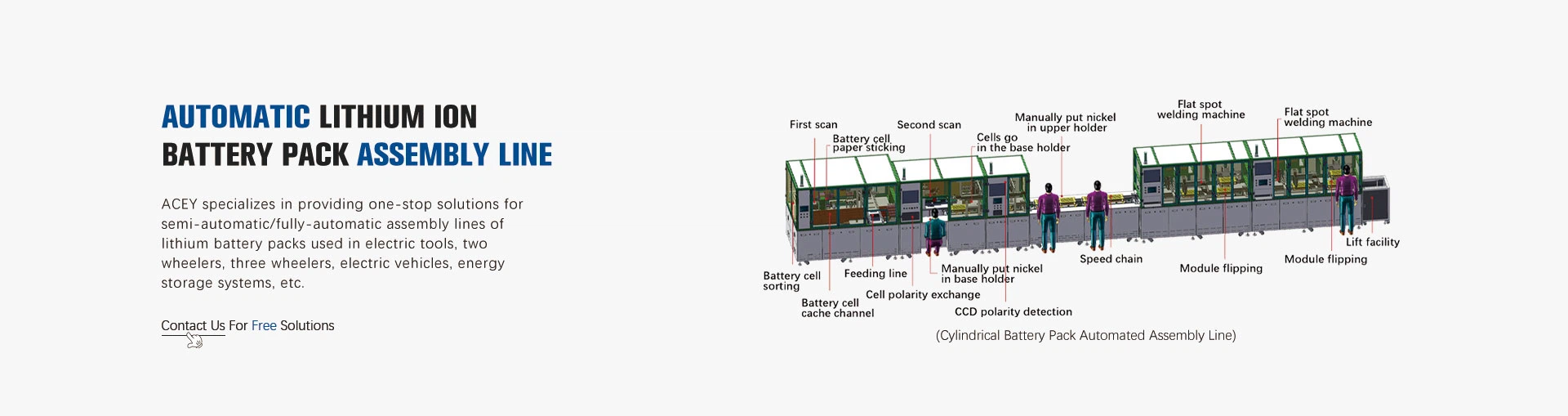
Cylindrical, prismatic, and pouch cells differ in structure, dimensions, and handling requirements. Choosing the right Battery Sorting Machine therefore requires more than comparing sorting speed. Key factors include cell type, compatible size range, testing requirements, production capacity, changeover requirements, and data management.
This article compares three equipment examples for different battery cell types and explains the key specifications to consider when selecting Battery Sorting Equipment.
1. Frequently Asked Questions (FAQ)
Q: What Is the Difference Between Cylindrical, Prismatic, and Pouch Battery Sorting Machines?
A: The main difference is the feeding, positioning, conveying, and clamping configuration required for each cell type.
Cylindrical cells: Focus on cell size, automatic feeding, testing, and sorting channels.
Prismatic cells: Focus on cell dimensions, terminal position, and fixture compatibility.
Pouch cells: Focus on flexible conveying, positioning, and clamping requirements.
Q: How Do You Choose a Battery Cell Sorting Machine?
A: First, confirm the cell type, dimensions, testing requirements, and production capacity. Then evaluate sorting channels, feeding method, changeover requirements, and data management functions.
For multiple cell models, also check fixture adjustment and parameter switching capabilities.
Q: What Parameters Should Be Considered When Choosing a Battery Sorting Machine?
A: Key parameters include cell compatibility, testing range and accuracy, sorting channels, sorting speed, changeover capability, data management, MES/SPC integration, and installation requirements.
The machine should be selected according to the actual cell specifications and production process rather than sorting speed alone.
2. How to Choose Among Three Battery Sorting Machine Examples?
2.1 Cylindrical Battery Sorting Machine
Common cylindrical cell specifications include 18650, 21700, and 32700, which differ in diameter and length. When selecting Battery Cell Sorting Equipment, confirm the compatible cell size range, feeding method, positioning structure, testing items, and number of sorting channels. For applications involving multiple cell models, also consider fixture replacement and parameter adjustment methods.
Reference example - ACEY-AS11S Battery Sorting Machine.
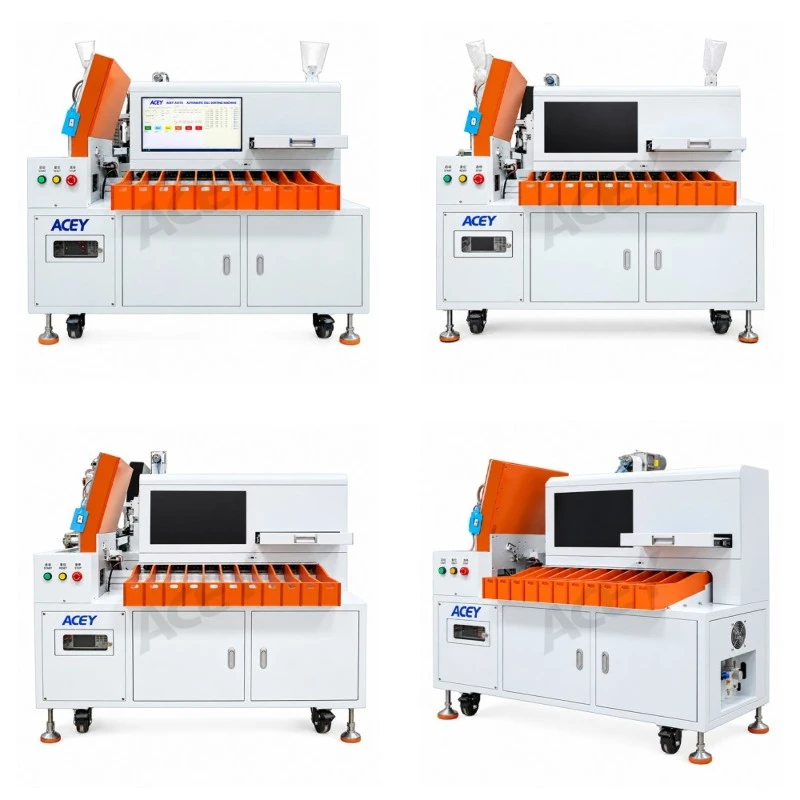
ACEY-AS11S Battery Sorting Machine.
This automatic sorting machine is suitable for medium and large cylindrical cells, including 18650 and 26650, with other sizes available for customization. The machine uses the HK3561 internal resistance tester to sort cells based on AC internal resistance and DC voltage. The internal resistance range is 10µΩ–3.2kΩ, with an accuracy of ±0.5% reading, while the voltage range is 0–6V/0–60V, with an accuracy of ±0.1% reading. It provides 10 sorting/grouping channels + 1 NG channel, supports freely configurable sorting thresholds, and features a PC operating interface and one-key intelligent setting function. Total power consumption is less than 800 W, and the dimensions are 1430×660×1350 mm.
The nominal sorting speed of the AS11S is 4,000 pcs/h (pieces per hour). When comparing sorting efficiency between different machines, use the same unit to ensure a clear and consistent basis for comparison.
2.2 Prismatic Battery Sorting Machine
Prismatic cells vary significantly in length, width, height, and terminal position. When selecting a Lithium Battery Sorting Machine, focus on cell dimensions, terminal position, positioning fixtures, testing range, and accuracy. For multi-specification production, also consider fixture replacement and changeover methods.
Reference example - ACEY-PS8 Battery Cell Sorting Machine
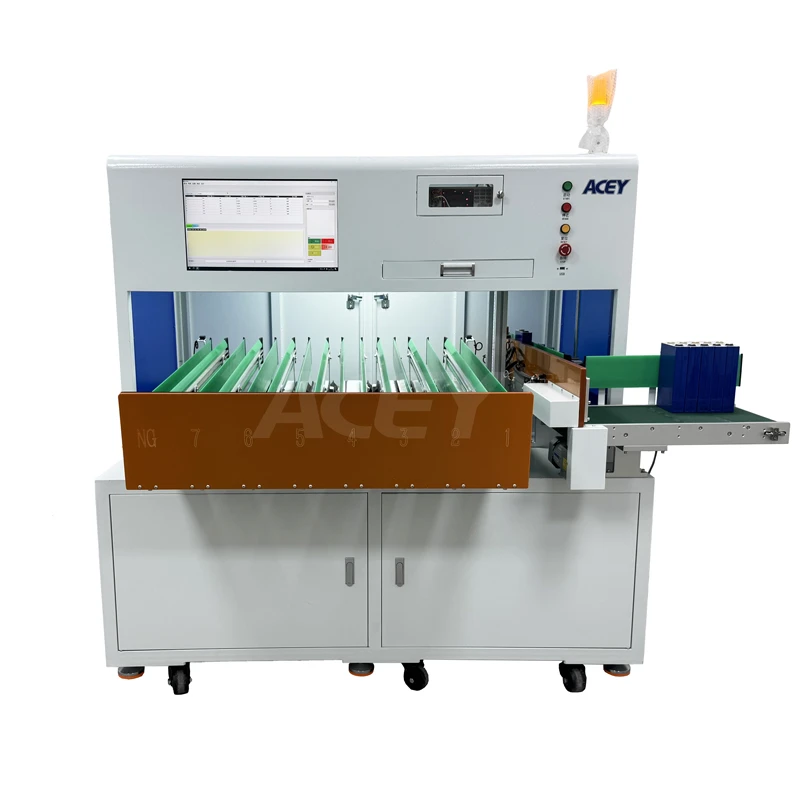
ACEY-PS8 Battery Cell Sorting Machine.
This 8-channel automatic sorting machine is compatible with cells measuring 90–300 mm in length, 12–85 mm in width, and 90–300 mm in height. It provides 7 OK channels + 1 NG channel. The equipment uses PLC control and linear modules, with a belt conveyor for cell feeding. It supports manual loading and automatic inspection, with barcode scanning configured according to the cell type. It also supports an MES interface and SPC data analysis. The maximum sorting speed is approximately 1,000 pcs/h.
Because prismatic cell specifications vary significantly, confirm equipment compatibility based on the actual cell dimensions, terminal positions, and fixture configuration before selecting the machine.
2.3 Pouch Battery Sorting Machine
Pouch cells use flexible packaging and are available in a wide range of dimensions. Therefore, in addition to electrical performance testing, the conveying, positioning, and clamping methods should also be considered to minimize excessive squeezing or scratching during automated handling.
Reference example - ACEY-PCSM7 Battery Sorting Machine.
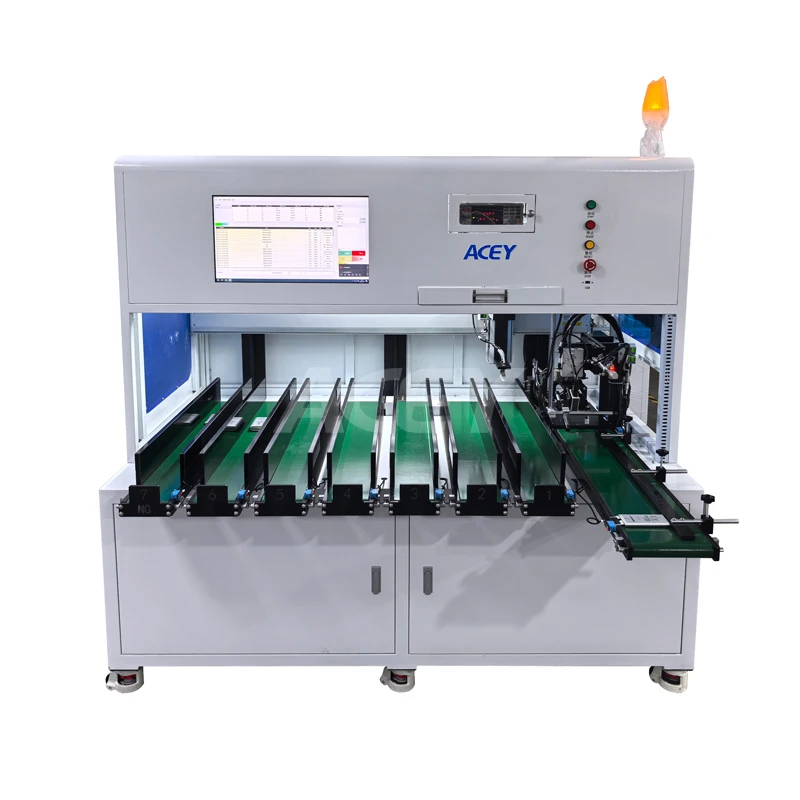
ACEY-PCSM7 Battery Sorting Machine.
This pouch battery sorting machine is compatible with cells measuring 50–170 mm in length, 20–100 mm in width, and 4–20 mm in thickness. It integrates manual loading, electrical performance testing, barcode scanning, and automatic sorting, while supporting MES data recording and SPC analysis. The sorting speed can reach 1,000 pcs/h. Overall dimensions are 1800×1570×1750 mm, and power consumption does not exceed 1.5 kW.
For pouch cells, confirm that the clamping and conveying structures are compatible with the cell dimensions and handling requirements. Proper equipment configuration can help minimize squeezing, scratching, and edge damage during automated handling.
3. Key Parameters for Selecting Battery Sorting Equipment
In addition to cell type and dimensions, several equipment parameters should be evaluated before selecting a Battery Sorting Machine. These include testing capability, production capacity, changeover requirements, data management, and installation conditions.
3.1 Testing Capability and Sorting Capacity
Testing capability should match the requirements of the battery production process. Common testing items include open-circuit voltage (OCV) and AC internal resistance (ACIR). When comparing machines, check the testing range and accuracy as well as the sorting channels and nominal sorting speed.
For example, the ACEY-AS11S provides an internal resistance measurement range of 10µΩ–3.2kΩ with an accuracy of ±0.5% reading, and a voltage range of 0–6V / 0–60V with an accuracy of ±0.1% reading. It provides 10 sorting/grouping channels + 1 NG channel and a nominal sorting speed of 4000 pcs/h.
However, nominal sorting speed does not necessarily represent actual continuous production capacity. Testing time, loading method, cell feeding, sorting and unloading methods, operator intervention, and cell specifications can all affect actual throughput. Therefore, compare equipment using the same capacity unit, such as pcs/h (pieces per hour) or ppm (pieces per minute), and consider the complete production cycle.
3.2 Changeover and Data Management
For production involving multiple cell models, changeover capability can directly affect equipment flexibility. Check whether the Battery Cell Sorting Machine supports fixture replacement, parameter storage, recipe management, quick parameter switching, and adjustment for different cell dimensions.
Data management is also important when production traceability is required. The equipment may need to record cell identification numbers, test results, sorting grades, production batches, and barcode information. For digitally managed production lines, check whether the machine supports MES communication and SPC data analysis.
For example, ACEY-PS8 and ACEY-PCSM7 support MES-related data management and SPC functions according to their configurations. These functions can be considered when the sorting equipment needs to connect with a broader production data system.
3.3 Installation Requirements
Installation conditions should be checked before selecting Battery Sorting Equipment. Depending on the equipment configuration, relevant requirements may include ambient temperature, relative humidity, compressed-air pressure, power supply, floor load, equipment dimensions, workshop space, and noise level.
For example, an application may specify an ambient temperature of 5–35°C, relative humidity of 20%–90%, air pressure of 0.5–0.6 MPa, floor load of no more than 200 kg/m², and noise of no more than 80 dB.
These values should be verified against the specification of the selected machine rather than treated as universal requirements for all battery sorting equipment.
4.Comparison of Specifications for Three Reference Battery Sorting Machines
The table below summarizes the specifications of the three reference Battery Cell Sorting Equipment models.
|
Comparison Item |
ACEY-AS11S (Cylindrical) |
ACEY-PS8 (Prismatic) |
ACEY-PCSM7 (Pouch/Polymer) |
|
Applicable Cells |
Medium and large cylindrical cells |
Prismatic cells |
Pouch/polymer lithium batteries |
|
Compatible Dimensions |
18650, 21700, 26650, 32650, 32700 |
Length 90~300mm Width 12~85mm Height 90~300 mm |
Length 50~170 mm Width 20~100 mm Thickness 4~20 mm |
|
Testing Items |
AC internal resistance + DC voltage |
AC internal resistance + DC voltage |
AC internal resistance + DC voltage |
|
Testing Accuracy |
AC internal resistance: 10µΩ ~ 3.2kΩ, Accuracy: ±0.5% |
Depends on tester configuration |
Depends on tester configuration |
|
Sorting Channels |
10 sorting + 1 reject, threshold configurable |
7 OK + 1 NG |
Multi-channel grading |
|
Sorting Speed |
4000PCS/H (pieces/hour) |
1000 pieces/hour |
1000 pieces/hour |
|
Control/MES |
PC operation · one-key setting |
PLC + linear module · optional MES/SPC |
PLC · MES interface + SPC |
|
Power Supply / Dimensions |
220V · <800W · 1430×660×1350 mm |
220V · approximately 1955×1624 mm |
220V · ≤1.5kW · 1800×1570×1750 mm |
5.Summary
Choosing the right Battery Sorting Machine depends on the cell type, dimensions, testing requirements, and production capacity.
- Cylindrical cells: Focus on size compatibility, automatic feeding, sorting channels, and testing accuracy. ACEY-AS11S is suitable for medium and large cylindrical cells.
- Prismatic cells: Focus on cell dimensions, terminal positioning, fixtures, and testing requirements. ACEY-PS8 is designed for prismatic cells.
- Pouch cells: Focus on clamping, positioning, and cell protection. ACEY-PCSM7 is designed for pouch/polymer cells.
For multi-model production, also consider changeover, parameter adjustment, data management, and MES/SPC integration. Select equipment according to actual production requirements, not sorting speed alone. Sample testing can help confirm compatibility before final selection.