

Supercapacitors vs. Lithium-Ion Batteries: What Is the Engineering Difference?
Author: [2026-09-16] | By Xiamen Acey New Energy Technology Co., Ltd. Allen Tang, allen@aceymachinery.com
Supercapacitors and lithium-ion batteries solve different energy-storage problems. Supercapacitors deliver very high power and extremely fast charge/discharge, while lithium-ion batteries store substantially more energy for a given mass or volume. For equipment developers and battery laboratories, the practical choice depends on voltage, energy demand, pulse power, operating temperature, cycle life, self-discharge and total system cost.
1. What Is a Supercapacitor?
A supercapacitor is an energy-storage component whose behavior sits between a conventional capacitor and a battery.
The technology is commonly divided into three groups:
- Electric double-layer capacitors (EDLCs)
- Pseudocapacitors
- Hybrid supercapacitors
The EDLC is the most widely recognized type.
Unlike a lithium-ion battery, an EDLC primarily stores charge through the formation of an electrical double layer at the electrode/electrolyte interface rather than relying on the same type of bulk chemical reaction used in a conventional rechargeable battery.
A typical EDLC uses highly porous activated carbon electrodes. The extremely large effective surface area allows substantial capacitance to be packed into a relatively small component.
Pseudocapacitors add fast surface redox reactions, commonly involving conductive polymers or metal oxides.
Hybrid supercapacitors combine capacitor-like and battery-like electrodes. One electrode may use activated carbon while the other uses a battery-type electrode. This changes the balance between power capability and energy storage.
That distinction matters when selecting supercapacitor testing equipment because different cell chemistries can produce very different voltage, capacitance, impedance and cycling behavior.

2. Supercapacitors vs. Lithium-Ion Batteries: The Numbers
The easiest way to understand the difference is to compare the engineering parameters that determine how an energy-storage device behaves in a real circuit.
| Parameter | Supercapacitor | Lithium-Ion Battery |
|---|---|---|
| Main storage mechanism | Electrostatic / surface electrochemical storage | Electrochemical |
| Typical single-cell voltage | About 1.5–2.7 V for many EDLCs | Commonly around 3.2–3.7 V nominal, depending on chemistry |
| Power density | Very high | High, but generally lower than supercapacitors |
| Energy density | Relatively low | Much higher |
| Charge/discharge time | Seconds to minutes, depending on system | Typically much longer |
| Cycle life | Often orders of magnitude higher | Typically hundreds to thousands of cycles, depending on chemistry and conditions |
| Low-temperature behavior | Generally favorable | Performance can decrease significantly at low temperature |
| High-temperature behavior | Degradation accelerates at elevated temperature | Elevated temperature accelerates aging |
| Self-discharge | Relatively high | Much lower |
| Deep discharge effect | Generally less damaging to cycle life | Operating outside specified limits can accelerate degradation or create safety risks |
| Best use case | Short high-power pulses | Long-duration energy storage |
The actual values vary significantly with cell chemistry, construction, temperature, current rate and manufacturer specifications. These ranges should therefore be treated as engineering guidance rather than universal component specifications.

3. Power Density and Energy Density: The Fundamental Difference
This is where the two technologies diverge most clearly.
For a capacitive energy-storage device, stored energy can be approximated by:
E = ½CV²
where:
E = stored energy
C = capacitance
V = voltage
The available power is strongly influenced by the equivalent series resistance, or ESR/Req:
P ≈ V² / (4Req)
A supercapacitor has a very low equivalent resistance compared with many battery systems. That allows it to deliver a large amount of power over a short period.
A lithium-ion battery, on the other hand, provides much higher energy storage because its electrochemical reactions store substantially more energy per unit mass and volume.
This creates a simple engineering trade-off:
- Need a short, high-current pulse? Supercapacitors are attractive.
- Need energy for hours rather than seconds? Lithium-ion batteries are generally more suitable.
For engineers developing battery cell testing equipment, this difference also affects test strategy. A tester designed for conventional lithium-ion cells may not be configured optimally for high-capacitance devices.
4. Capacitance Does Not Tell the Whole Story
Supercapacitor capacitance can reach thousands of farads.
Typical commercial examples include devices rated around:
| Device Type | Example Capacitance |
|---|---|
| Conventional EDLC | 3,000 F |
| Hybrid supercapacitor | 7,500 F |
| Capacitor-battery type device | Up to 40,000 F |
These figures illustrate why supercapacitors can deliver significant pulse power.
However, capacitance alone should never be used to compare a supercapacitor directly with a lithium-ion battery.
Engineers need to consider:
- Operating voltage
- Usable voltage window
- ESR
- Energy density
- Power density
- Temperature
- Leakage/self-discharge
- Cycle requirements
- Series/parallel configuration
For a series-connected supercapacitor bank, voltage balancing also becomes an important design issue.
5. Low-Temperature Performance
Temperature changes the behavior of both technologies, but not in exactly the same way.
Supercapacitors generally maintain useful power capability at temperatures below 0°C better than many lithium-ion battery systems. This makes them attractive for applications involving short-duration power delivery in cold environments.
However, supercapacitors are not immune to temperature-related degradation.
At temperatures above approximately 50°C, accelerated performance degradation can become a concern, depending on the component design and electrolyte.
Lithium-ion batteries also experience significant temperature dependence. At low temperature, ionic transport and electrochemical kinetics can become less favorable, increasing impedance and reducing available power.
For laboratory evaluation, temperature should therefore be controlled rather than treated as a background variable.
A proper lithium-ion battery testing system may be integrated with environmental chambers to evaluate:
- Capacity retention
- DC internal resistance
- Charge acceptance
- Discharge power
- Cycle life
- Temperature rise
6. Cycle Life: Where Supercapacitors Have a Major Advantage
Supercapacitors are designed for repeated charge and discharge.
Their cycle life can be several orders of magnitude higher than that of conventional lithium-ion batteries, depending on operating conditions and the definition of end-of-life.
Another practical advantage is that repeated deep discharge generally has a much smaller effect on supercapacitor life than it does on many battery systems.
The equivalent resistance of a supercapacitor also does not behave in exactly the same way as a battery's resistance as depth of discharge changes.
For applications requiring frequent power pulses-such as regenerative braking or engine start-stop assistance-this difference can be valuable.
But high cycle life does not automatically make supercapacitors the better energy-storage device. Their relatively low energy density remains a limitation.
7. Operating Voltage and Charging Speed
A typical EDLC cell has a relatively low working voltage, often around 1.5–2.7 V, depending on its construction and electrolyte.
That means multiple cells may need to be connected in series to achieve a practical system voltage.
Lithium-ion cells generally operate at a higher nominal voltage per cell, depending on chemistry.
The difference becomes even more obvious when charging time is considered.
A supercapacitor can often be charged and discharged within seconds, provided that the charging source and current rating support it.
Lithium-ion batteries normally require much longer charging periods because the charging process is limited by electrochemical kinetics, heat generation and cell safety requirements.
For a test laboratory, this means a battery charge-discharge tester must be selected according to the device under test. High-current pulse testing and long-duration battery cycling can place very different requirements on the instrumentation.
8. Self-Discharge: The Trade-Off for Fast Response
The same characteristics that make supercapacitors excellent for high-power applications create another limitation: self-discharge.
A supercapacitor can lose stored voltage substantially faster than a lithium-ion battery.
That makes it unsuitable for applications where energy must remain stored for days or weeks with minimal loss.
For example, a smoke detector or backup device that needs to retain stored energy for a long period is generally better suited to a low-self-discharge energy-storage technology.
In contrast, applications that repeatedly charge and discharge the storage device within short intervals can tolerate this characteristic much more easily.
9. Cost: Compare the Complete System, Not Just the Cell
Looking only at cost per watt-hour can make supercapacitors appear expensive compared with batteries.
But the component price does not tell the whole story.
A system using supercapacitors may reduce costs elsewhere by:
- Reducing battery peak-current requirements
- Extending battery service life
- Handling regenerative energy
- Reducing replacement frequency
- Providing rapid pulse power
- Simplifying high-cycle operation
- A good example is an engine start-stop system.
Supercapacitors can be connected in parallel with a 12 V battery system to provide short-duration high-current assistance. The supercapacitors handle the power pulse while reducing the instantaneous load placed on the battery.
The correct comparison is therefore total system cost over the expected service life, rather than simply dollars per watt-hour.
10. Where Supercapacitors and Lithium-Ion Batteries Work Together
The comparison does not always have to be "one or the other."
Hybrid systems can combine both technologies.
The lithium-ion battery provides the energy reservoir, while the supercapacitor handles short, high-power events.
A simplified architecture looks like this:
- Lithium-ion battery → long-duration energy
- Supercapacitor → short-duration power
This approach can be useful where the system experiences frequent current spikes.
For manufacturers developing such systems, testing needs to cover both components and the complete hybrid system.
That may require:
- Cell charge/discharge testing
- Pulse-current testing
- ESR measurement
- Capacity measurement
- Thermal testing
- Cycle-life testing
- Voltage balancing
- System-level power testing
Need equipment for lithium-ion batteries and hybrid energy-storage R&D?
11. SCALDO: Using a Supercapacitor to Improve Linear Regulator Efficiency
One interesting application of supercapacitors is the Supercapacitor Assisted Low Dropout regulator, commonly referred to as SCALDO.
A conventional linear regulator is simple and produces very low electromagnetic interference, but its efficiency becomes poor when the input voltage is much higher than the output voltage.
For an ideal linear regulator:
η ≈ Vout / Vin
For example, with:
Vin = 12 V
Vout = 5 V
the theoretical maximum efficiency is approximately:
5 / 12 = 41.7%
The remaining input power is largely dissipated as heat.
SCALDO takes a different approach by using a supercapacitor as a controlled voltage-dropping element.

12. How the SCALDO Charging Cycle Works
Consider a 5 V output LDO that operates correctly when its input remains around or above 5.1 V.
If the input supply is 10.3 V, a precharged supercapacitor can be introduced into the circuit so that the voltage presented to the LDO is much closer to the required input level.
\
During the charging stage, the capacitor voltage changes gradually.
The relationship is:
ΔV = I × t / C
where:
ΔV = capacitor voltage change
I = average load current
t = charging/discharging time
C = capacitance
For example:
| Parameter | Example Value |
|---|---|
| Load current | 1 A |
| Capacitance | 1 F |
| Voltage change | 0.1 V |
| Time | 0.1 s |
| Approximate cycle frequency | 5 Hz |

Once the capacitor reaches the upper voltage threshold, the circuit switches its configuration and allows the capacitor to discharge through the LDO.
Because the supercapacitor has low equivalent resistance, the voltage-drop process can be substantially more efficient than simply dissipating the excess voltage as heat.
Under idealized conditions, the example can approach approximately 97% conversion efficiency, although actual efficiency is lower because of capacitor ESR, switching losses, semiconductor losses and other circuit losses.

13. Why SCALDO Can Matter in Low-EMI Equipment
SCALDO uses relatively slow switching rather than the high-frequency switching commonly associated with conventional switching converters.
That can be useful in equipment where electromagnetic interference is a major design concern.
Potential applications include:
- Medical electronics
- Industrial instrumentation
- Precision measurement systems
- Sensitive laboratory equipment
The concept also shows an important point about supercapacitors: their value is not limited to energy storage. Their low ESR and rapid charge/discharge behavior can be used as part of power-management architectures.
14. What Does This Mean for Battery Equipment Manufacturers?
The differences between supercapacitors and lithium-ion batteries directly influence how their cells should be characterized.
A lithium-ion battery laboratory may need equipment for:
- Constant-current/constant-voltage charging
- Capacity testing
- Cycle-life testing
- Pulse discharge
- Coulombic efficiency
- Internal resistance
- EIS
- GITT/PITT
- Environmental testing
Supercapacitor characterization may place greater emphasis on:
- Capacitance
- ESR
- Leakage current
- Rapid charge/discharge
- Pulse power
- Voltage retention
- High-cycle testing
For manufacturers and research institutes, the testing platform should therefore be selected from the test method backward, rather than buying a generic tester and trying to adapt the experiment afterward.
15. Supercapacitor vs. Lithium-Ion Battery: Engineering Decision Table
| Requirement | Supercapacitor | Lithium-Ion Battery |
|---|---|---|
| Very high short-duration power | Strong fit | Possible, but chemistry-dependent |
| High energy storage | Limited | Strong fit |
| Charge in seconds | Strong fit | Usually unsuitable for unrestricted rapid charging |
| Very high cycle count | Strong fit | Lower than supercapacitors |
| Long-term energy retention | Weak due to self-discharge | Stronger |
| Cold-weather pulse power | Generally favorable | Temperature-sensitive |
| High-temperature operation | Requires careful control | Requires careful control |
| Compact long-duration storage | Limited | Strong fit |
| Regenerative braking | Strong fit | Commonly used, sometimes hybridized |
| Engine start-stop assistance | Strong fit | Commonly used |
| Consumer electronics energy storage | Limited | Strong fit |
| Laboratory research | Requires dedicated characterization | Extensive testing ecosystem |
There is no universal winner. The engineering requirement determines which storage technology makes sense.
16. How Acey New Energy Supports Lithium-Ion Battery Testing
Xiamen Acey New Energy Technology Co., Ltd. focuses on equipment for lithium-ion battery research, development and manufacturing.
Established in 2009, the company operates three factories covering more than 20,000 m² and has a professional R&D and after-sales team with more than 17 years of experience in the field.
Its equipment portfolio covers several stages of the battery development chain:
| Equipment Category | Typical Application |
|---|---|
| Battery raw-material equipment | Material preparation and research |
| Coin cell fabrication equipment | Laboratory electrochemical research |
| Cylindrical cell equipment | Cell development and evaluation |
| Pouch cell equipment | Laboratory and prototype development |
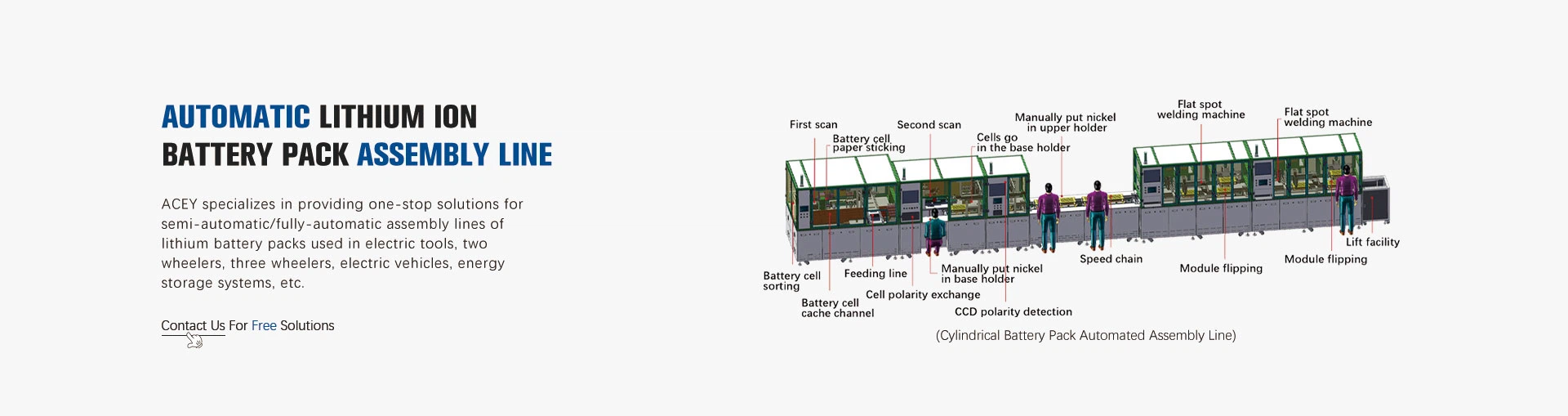
| Battery pack assembly equipment | Semi-automatic and fully automatic pack production |
| Battery cell testing systems | Cell performance characterization |
| Battery pack testing systems | Pack-level electrical testing |
| Environmental safety testing equipment | Thermal and safety evaluation |
Acey New Energy works with university laboratories, research institutes, battery manufacturers and international partners.
For importers, distributors and private-label buyers, the practical advantage is access to equipment across several stages rather than a single standalone machine.
For battery factories, equipment configuration can be specified around the cell format, chemistry, current range, voltage range, throughput and testing workflow.
17. FAQ
What equipment is needed to test lithium-ion battery cells?
A typical laboratory setup requires a battery charge-discharge tester, appropriate cell fixtures, measurement software and safety controls. Advanced R&D may also require EIS, environmental chambers, temperature acquisition and other auxiliary measurement modules.
Can Acey New Energy supply equipment for cylindrical battery testing?
Yes. Acey New Energy supplies cylindrical-cell laboratory equipment and battery cell testing systems. Equipment can be configured according to cell format, voltage, current, test profile and research requirements.
What is the typical production lead time for battery testing equipment?
Lead time depends on the equipment configuration and degree of customization. Standard equipment and customized systems should be quoted separately after confirming technical specifications, quantity and factory requirements.
What is the MOQ for Acey New Energy battery equipment?
MOQ depends on the equipment category and project configuration. International distributors, battery factories and private-label buyers can request a project-specific quotation based on quantity and required specifications.
Can Acey New Energy provide installation and after-sales support?
Yes. Acey New Energy has a dedicated R&D and after-sales team and provides technical support for equipment installation, commissioning, operator training and ongoing application requirements.
Supercapacitors and lithium-ion batteries are not direct substitutes in every application.
Supercapacitors are built around high power, rapid charge/discharge and very long cycle life. Lithium-ion batteries are built around much higher energy storage and longer energy retention.
The difference becomes clear in the numbers: supercapacitor cells commonly operate around 1.5–2.7 V, can reach thousands of farads, can be cycled extremely frequently, and can respond to high-power demands within seconds. Lithium-ion cells provide substantially higher energy density and are better suited to applications where stored energy must be delivered over much longer periods.
For battery and energy-storage developers, the important step is to measure the parameters that actually determine system performance-voltage, current, capacity, ESR, temperature, cycle behavior, self-discharge and transient response.
That requires the right testing architecture.
If your project involves lithium-ion cells, cylindrical cells, pouch cells, battery packs or related energy-storage research, the testing system should be specified around the actual chemistry, cell format and test protocol-not simply around a machine name.
Request An Equipment Configuration For Your Battery R&D Project
Xiamen Acey New Energy Technology Co., Ltd. supplies equipment for lithium-ion batteries, including laboratory cell fabrication equipment, battery cell testing systems, cylindrical-cell equipment, battery pack assembly equipment and environmental safety testing equipment.
For Importers, Distributors, Wholesalers, university laboratories, research institutes and battery manufacturers, send the following information to the engineering team:
- Cell chemistry
- Cell format and dimensions
- Voltage range
- Current range
- Required test methods
- Number of test channels
- Expected daily throughput
- Laboratory or production environment
- Required automation level
Acey New Energy can then recommend an equipment configuration based on the actual testing or production requirement.
For lithium-ion battery testing equipment, cylindrical cell equipment or a complete battery R&D line, contact Acey New Energy for a project-specific quotation.