

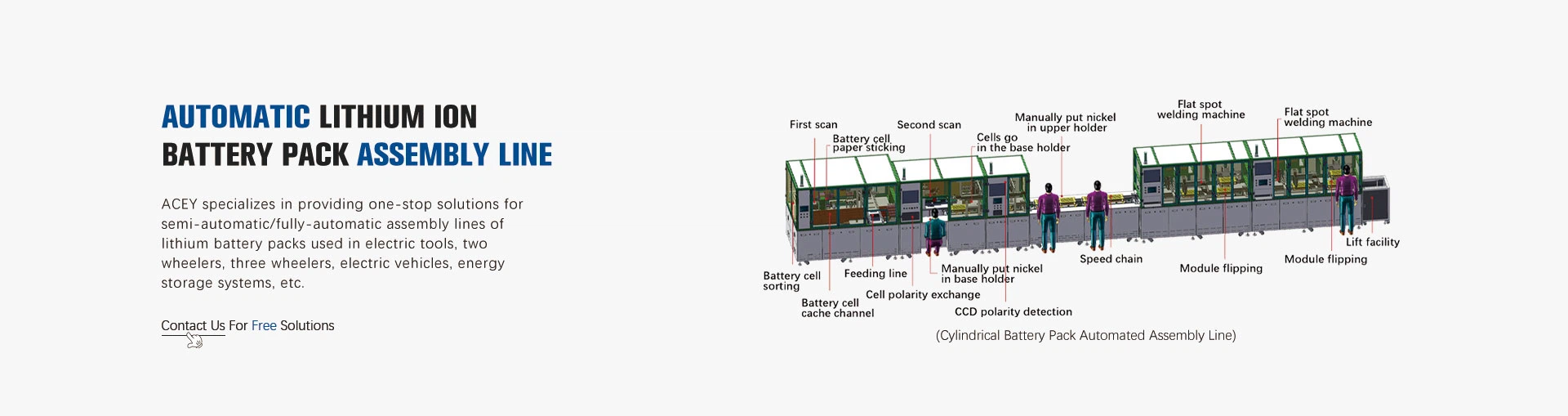
The manufacturing process of cylindrical batteries is a deep integration of precision engineering and material science, and the process optimization and equipment upgrade of each link directly affect the performance and mass production efficiency of the battery. The following are the steps of the simple laboratory solid cylindrical cell manufacturing process:
1. Material preparation and pretreatment
Material mixing and crushing
Ball mill: The cathode active material (such as ternary lithium NCM, lithium iron phosphate LFP) is mixed with conductive agent (carbon black) and binder (PVDF) in proportion, and nano-scale grinding is achieved through a high-speed rotating grinding ball to ensure uniform distribution of particles (particle size D50 ≤5μm).
Tube furnace: high-temperature sintering of materials (e.g., calcination of ternary material precursors at 800-1000°C) to optimize the crystal structure and improve electrochemical stability.
Slurry preparation
Vacuum mixer: In a vacuum environment (-0.098MPa), the active substance, solvent (NMP or water-based solvent) and binder are mixed to avoid bubble residue (bubble rate <0.1%), and the stirring speed is adjustable from 0-1400rpm, and the time is 30-120 minutes.
Viscometer: Real-time monitoring of slurry viscosity (target range: 2000-8000cP) to ensure the stability of the coating process.
Slurry filtration and drying
Slurry filter: Remove agglomerated particles in the slurry through a 20μm filter screen to improve electrode uniformity.
Vacuum drying oven: dry the electrode at 80-120°C in a vacuum environment, and the solvent residue ≤ 100ppm.
2. Electrode manufacturing
Coating and compaction
Film coating machine: evenly coat the slurry on the surface of copper foil (anode) or aluminum foil (cathode), the coating thickness accuracy is ±1μm, and the electrode film is formed after drying (positive electrode surface density: 20-25mg/cm²).
Roller press: through 10-20 tons of pressure compacting electrode, the compaction density deviation is ≤1% (e.g. graphite anode compaction density 1.5-1.7g/cm³).
Pole piece slitting
Slitting machine: The wide electrode is divided into specific widths (such as 18mm, 21mm), the cutting accuracy is ±0.1mm, and the edge burr is ≤5μm, which is suitable for subsequent winding needs.
3. Battery assembly
Pole piece winding
Winding machine: stack the slitted positive and negative electrode pieces and separator (PP/PE) in the order of "negative electrode-diaphragm-positive electrode-diaphragm", and wind them into a cylindrical "jelly roll" with an alignment error of ≤0.2mm.
Grooving machine: cutting grooves in the tab area to improve the welding strength of the tabs.
Soldering & Encapsulation
Ultrasonic spot welding machine: welding tabs and current collectors (copper/aluminum), solder joint strength ≥ 50N, contact resistance ≤ 0.5mΩ.
Pulse spot welding machine: seal the battery cover plate and steel shell, and the helium leak detection rate < 0.01Pa·m³/s.
Glove box: Inject electrolyte in an inert atmosphere (Ar) with a dew point of ≤-40°C (injection volume error±0.1g) with a moisture content of ≤ 10ppm.
4. Formation and detection
Resting and activating
Vacuum static box: After liquid injection, the battery is left in a vacuum environment for 24 hours to ensure that the electrolyte is fully infiltrated with the separator and electrode.
Formation equipment: SEI film is formed on the first charge (0.1C), the voltage range is 2.5-4.2V, and the temperature is controlled at 25±2°C.
Performance testing and packaging
Battery Tester: Cycle Test: 0.5C Charge and Discharge, Capacity Retention Rate ≥80% After 500 Cycles; Internal resistance test: AC impedance≤15mΩ; Safety test: overcharge, short circuit, pinprick, etc.
Sealer: Secondary encapsulation (laser welding or mechanical pressure sealing) to ensure IP67 protection level.

From material mixing to final testing, only through strict parameter control and equipment collaboration can we achieve a highly consistent and safe product output. With the iteration of technology, automation and intelligence will become the core driving force to improve manufacturing efficiency.