

1. What is an energy storage PACK package?
In simple terms, an energy storage PACK package is an independent, rechargeable and dischargeable energy storage unit formed by connecting multiple single cells in a specific series-parallel manner and equipped with corresponding management systems and protection measures. If the entire energy storage system is compared to a person, then the energy storage PACK package is equivalent to the "heart", which is responsible for storing and releasing electrical energy and providing power support for the entire system. It is a key link in the energy storage system. It has a wide range of applications in renewable energy generation, electric vehicles, grid energy storage and other fields. For example, our common solar power stations and wind power stations need energy storage PACK packages to store excess electrical energy so that it can be released when needed to ensure a stable supply of electricity.
2. Air cooling and liquid cooling
2.1 In-depth analysis of air-cooled PACK packages
Working principle: Air-cooled PACK packages, as the name suggests, use low-temperature air as a heat dissipation medium. It uses the principle of heat convection to allow low-temperature air to fully contact the battery cell, thereby taking away the heat generated by the battery cell during operation and achieving the purpose of reducing the battery temperature. In practical applications, air cooling is divided into two methods: natural cooling and forced cooling. Natural cooling is like opening the window to let the natural wind blow in to cool down in the hot summer. It relies on the flow of natural wind to achieve heat dissipation and does not require additional power equipment. Forced cooling is like using a fan to accelerate air flow. Through equipment such as a fan, low-temperature air is forced into the PACK package to exchange heat with the battery cell, making the heat dissipation effect more efficient. This method was widely used in early electric passenger cars. Models such as Nissan Leaf and Kia Soul EV all use air cooling technology. Today, air cooling still occupies a place in electric buses,
electric logistics vehicles and some energy storage systems.

Example of applicable scenarios: The air-cooled PACK package is suitable for some scenarios where the heat dissipation requirements are not particularly high and the power density is relatively low. For example, household energy storage, the average household's electricity consumption is relatively small, the power of the energy storage system is not large, and the heat generated is small, so the air-cooled PACK package can meet its heat dissipation needs. In addition, the air-cooled system has a simple structure, low cost, and is easy to install and maintain, making it very suitable for home use.
2.2 In-depth analysis of liquid-cooled PACK
Working principle: Liquid-cooled PACK adopts liquid cooling technology. Its principle is to take away the heat generated by the battery through liquid convection heat exchange by utilizing the high specific heat capacity and good thermal conductivity of the coolant. Common coolants include water, ethanol, refrigerant, etc. In the liquid cooling system, the coolant circulates in the liquid cooling plate. The liquid cooling plate is usually designed with evenly distributed guide grooves. These guide grooves are like small water channels, guiding the coolant to flow in an orderly manner. The battery cell is in indirect contact with the liquid cooling plate. When the coolant flows through the liquid cooling plate, it absorbs the heat emitted by the battery cell, thereby reducing the temperature of the battery cell. Taking the liquid-cooled battery system in electric vehicles as an example, the coolant circulates in the liquid cooling plate at the bottom of the battery, effectively taking away a large amount of heat generated by the battery during the charging and discharging process, ensuring the performance and life of the battery. Compared with air cooling, liquid cooling has a faster cooling speed, can more effectively reduce the maximum temperature of the battery, and improve the consistency of the battery pack temperature field.

Examples of applicable scenarios: Liquid-cooled PACK packages are suitable for scenarios with high heat dissipation requirements, such as large-scale energy storage power stations and high-power density energy storage applications. In large-scale energy storage power stations, the battery pack is huge, and a large amount of heat is generated during the charging and discharging process. If the heat cannot be dissipated in a timely and effective manner, the performance of the battery will be seriously affected, and may even cause safety accidents. Liquid-cooled PACK packages can meet the heat dissipation needs of large-scale energy storage power stations and ensure the stable operation of battery packs with their efficient heat dissipation capabilities. For example, in the energy storage systems of some large data centers, liquid-cooled PACK package technology is widely used to meet their high power density and high reliability requirements.

3. Air cooling VS liquid cooling
3.1 Heat dissipation efficiency comparison
There are significant differences in heat dissipation efficiency between air cooling and liquid cooling PACKs. From the perspective of heat transfer coefficient, the heat transfer coefficient of air cooling is relatively low, generally between 25 - 100W/(m²・K) , because the specific heat capacity of air is small and the thermal conductivity is relatively poor. The heat transfer coefficient of liquid cooling is much higher, usually reaching 1000 - 50000W/(m²・K) . This allows liquid cooling to take away more heat in the same time and has higher heat dissipation efficiency. Liquid cooling also has obvious advantages in terms of heat dissipation uniformity. The liquid cooling system can accurately control the temperature difference of the battery cell within 3℃, ensuring that each battery cell is in a relatively consistent temperature environment.
3.2 Cost-effectiveness analysis
Initial investment cost: The air cooling system has a relatively simple structure, and the main equipment is fans, air ducts and heat dissipation fins, etc. Its initial investment cost is relatively low, which makes it more attractive in some projects that are more cost-sensitive. In contrast, the initial investment cost of the liquid cooling system is relatively high. The liquid cooling system needs to be equipped with liquid cooling plates, coolant circulation pumps, heat exchangers and other equipment, and the purchase and installation costs of these equipment are relatively high. In addition, the liquid cooling system has higher requirements for sealing and protection, which further increases the cost.
Operation cost: From the perspective of operation cost, during the operation of the air cooling system, the fan needs to run continuously to promote air flow, which consumes more electricity and has relatively high energy consumption. The energy consumption of the liquid cooling system is relatively low. Although the coolant circulation pump also consumes a certain amount of electricity, due to the high heat dissipation efficiency of liquid cooling, it can more effectively reduce the battery temperature, thereby reducing the energy loss caused by battery overheating. Moreover, the liquid cooling system can control the battery temperature more accurately, which helps to extend the battery life and reduce the replacement cost of the battery. In the long run, the liquid cooling system may have more advantages in operating costs.
3.3 Comparison of maintenance difficulty
The structure of the air cooling PACK package is simple, and the maintenance of major components such as fans and air ducts is relatively easy. In contrast, the maintenance of the liquid cooling PACK package is much more complicated. The liquid cooling system involves liquid circulation, and the level and quality of the coolant need to be checked regularly to ensure that the coolant does not leak or deteriorate. Once the coolant is found to be insufficient or deteriorating, it needs to be replenished and replaced in time, which requires professional tools and skills.
3.4 Safety and reliability competition
In terms of safety and reliability, the liquid cooling PACK performs better. Because liquid cooling can more effectively control the battery temperature and reduce the risk of thermal runaway. When the battery is abnormally hot, the liquid cooling system can quickly take away the heat to prevent the temperature from rising further, thereby reducing the possibility of fire or explosion caused by thermal runaway. Moreover, the liquid cooling system has good sealing and protection, which can effectively prevent impurities such as dust and moisture from entering the battery, reducing the probability of battery short circuit and other faults.
Both air cooling and liquid cooling technologies have their own advantages and disadvantages, and need to be selected as needed. In the future, both air cooling and liquid cooling technologies will develop in a more efficient, intelligent and reliable direction.
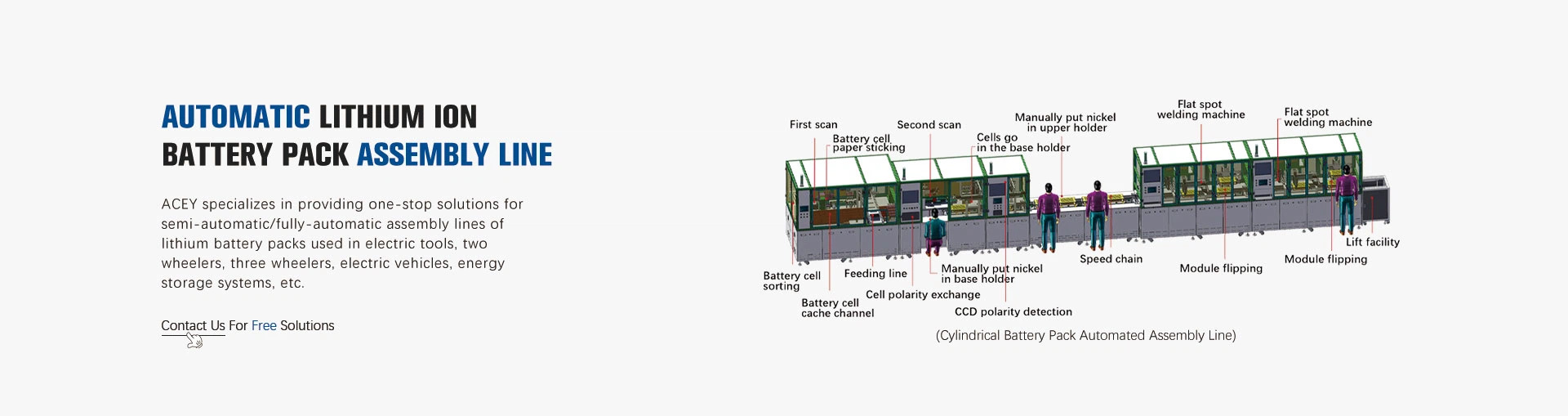
Acey Intelligent specializes in providing one-stop solutions for semi-automatic/fully-automatic assembly lines of lithium battery packs used in ESS, UAV, E-Bike, E-Scooter, Power Tools, Two/Three Wheelers, Etc. In Addition, we provide a complete set of battery pack assembly equipment, such as Cell Grading Machine, Battery Sorting Machine, Insulation Paper Sticking Machine, CCD tester, Manual/Automatic Spot Welding Machine, BMS Tester, Battery Comprehensive Tester and Battery Pack Test System, etc. We can provide you professional technical support and guidance, please feel free to contact us!