

What Is the Process of a Lithium-Ion Battery Pack Assembly Production Line? A Complete Step-by-Step Guide
Author: [2025-11-16] | By Xiamen Acey New Energy Technology Co., Ltd. Allen Tang allen@aceymachinery.com
Table of Contents
- Introduction: Why Battery Pack Assembly Matters
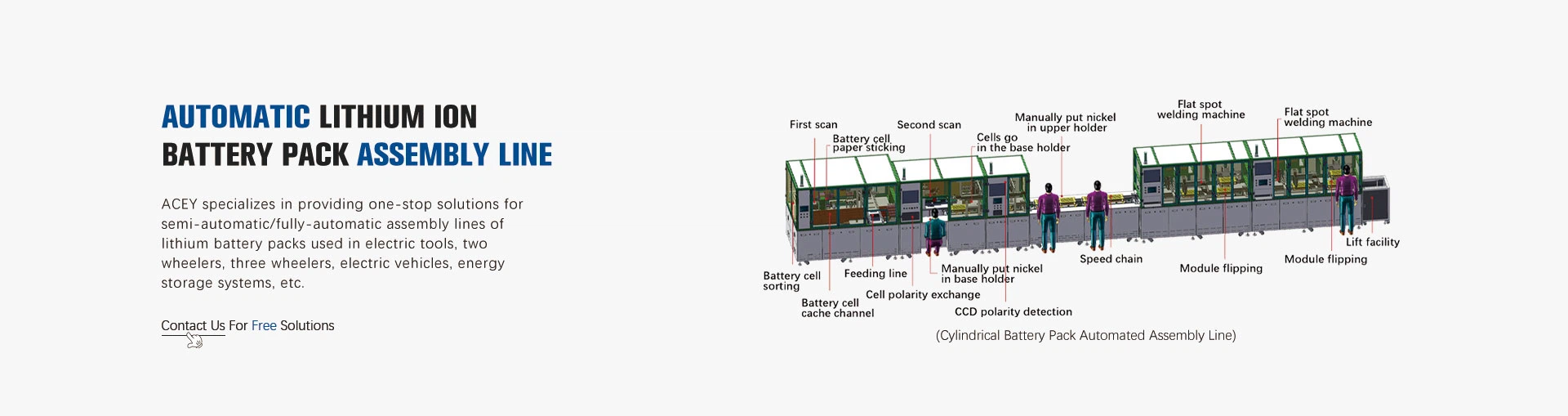
- Overview of the Lithium-Ion Battery Pack Assembly Production Line
- Step-by-Step Lithium Battery Pack Assembly Process
3.3 Semi-Finished Module Assembly
3.4 Aging & Performance Testing
3.5 PACK Testing
3.6 PACK Packaging
4. Composition of a Lithium Battery PACK
5. Core Processes & Key Equipment (With Table)
6. Characteristics of Lithium Battery PACKs
7. Welding Methods Used in Battery Pack Manufacturing
8. Why Automation Is Critical in Li-ion PACK Production
9. FAQ
10. Call to Action (ODM / OEM Partnership Invitation)
The battery pack is the "brain + power unit" of any lithium-ion energy system. It links upstream cell manufacturing with downstream EVs, energy storage systems, consumer electronics, tools, and robots.
Today's customers expect:
- Higher energy density
- Longer cycle life
- Safety under extreme conditions
- Traceable QC data
- Stable performance at scale
This is why a well-designed Lithium-Ion Battery Pack Assembly Production Line is essential. A single inconsistency at the cell, welding, or testing stage can shorten the pack's lifespan by 20–30% or even cause safety risks.
A modern PACK production line integrates automation, precision welding, quality inspection, safety testing, and smart logistics.
Typical workflow includes:
✓ sorting
✓ welding
✓ assembly
✓ aging
✓ testing
✓ PACK packaging
A fully optimized line can improve:
- Production efficiency by 30–60%
- Product consistency by 25%
- Defect rates reduced below 0.5%
3.1 Cell Sorting & Matching
Every battery cell is tested and grouped by:
- capacity
- voltage
- internal resistance (IR)
- self-discharge rate
Using well-matched cells ensures consistent lifespan and balanced charging.
Typical Matching Tolerance:
| Parameter | Matching Deviation |
|---|---|
| Capacity | ±1–2% |
| Voltage | ≤ 10mV |
| IR | ≤ 3mΩ |
3.2 Automatic Welding
Cells are welded into modules using:
- Laser welding (most precise)
- Ultrasonic welding
- Pulse welding
Laser welding is preferred for EV-grade packs due to:
- stronger joints
- low heat impact
- high accuracy (±0.1 mm)
Automation reduces welding defects by over 90%.
3.3 Semi-Finished Module Assembly
After welding, modules are combined with:
- busbars
- BMS protection boards
- flexible connectors
- brackets
- insulation components
This step requires high precision to ensure pack reliability and safety.
3.4 Aging & Performance Testing
Aging simulates real-world usage to eliminate early failures.
Common tests include:
- charge/discharge cycles
- temperature rise monitoring
- thermal behavior under load
- balancing accuracy
- long-term stability test (24–72 hours)
Aging can quickly identify manufacturing defects that would appear later in use.
3.5 PACK-Level Testing
After assembly, full PACK testing checks:
- voltage accuracy
- capacity output
- internal resistance
- insulation performance
- overcharge/over-current protection
- communication protocol (CAN / RS485)
PACK testing ensures every product meets OEM/ODM standards.
3.6 PACK Packaging
The final step ensures the pack can be transported safely without vibration, compression, or static damage.
Packaging typically includes:
- protective foam
- anti-static bags
- shock-proof outer boxes
- serial labels & traceability codes
A standard PACK includes:
- Battery cells
- Busbars (Ni/Cu/Al)
- Flexible connectors
- BMS protection board
- Housing/outer casing
- Connectors (XT60, XT90, custom terminals)
- Barley paper or insulation film
- Plastic brackets
- Temperature sensors & wiring harness
5. Core Processes & Key Equipment
Core Process Flow
| Step | Process | Typical Automation Level |
|---|---|---|
| 1 | Loading & feeding | 70–100% |
| 2 | Bracket pasting | 50–80% |
| 3 | Laser/ultrasonic welding | 90–100% |
| 4 | Module assembly | 40–70% |
| 5 | Testing | 80–100% |
| 6 | PACK packaging | 40–60% |
Key Equipment
- Laser welding machines
- Ultrasonic welding machines
- IR and capacity sorting machines
- Automatic cell assembly lines
- BMS testing systems
- PACK aging cabinets
- Vision detection systems
Acey New Energy leads the market in laser-welding PACK equipment thanks to advanced laser technology and strong system integration capability.
- High Consistency Requirement: All cells must perform close to identical levels.
- Shorter Cycle Life vs. Single Cell: PACK performance depends on the "weakest cell."
- Strict Working Conditions: Controlled charge/discharge current, method, and temperature.
- Sophisticated Protection System: BMS safeguards against overcharge, over-temperature, and over-current.
There are two main connection methods:
7.1: Metal Welding (Laser/Ultrasonic/Pulse)
Pros:
- Highest reliability
- Suitable for high-current packs
- Ideal for automotive, ESS, power tools
Cons:
- Hard to replace cells
7.2: Elastic Sheet Contact
Pros:
- Easy battery replacement
Cons:
- Possible poor contact
- Not ideal for high-power applications
Although PACK standards are not yet unified globally, automation is becoming essential.
Automation benefits include:
- Higher consistency
- Lower labor cost
- Reduced human error
- Higher throughput
- Better quality traceability
Manufacturers adopting automated PACK lines often reduce production costs by 15–25%.
1. What determines the quality of a lithium-ion battery pack?
Cell consistency, welding quality, BMS performance, and aging test results are the biggest factors.
2. Is laser welding better for battery pack production?
Yes. Laser welding offers precision, low heat impact, and high strength-ideal for EV-grade battery packs.
3. How long does PACK aging usually take?
Most manufacturers run aging for 24–72 hours, depending on application requirements.
4. Can Acey New Energy provide OEM/ODM PACK equipment solutions?
Yes. Acey New Energy is an ODM manufacturer behind many global lithium battery brands and provides equipment, integration, and customized PACK line solutions.
Xiamen Acey New Energy Technology Co., Ltd. is a trusted ODM manufacturer behind many top international lithium battery brands, offering:
✓ Lithium-ion battery pack assembly production lines
✓ Laser welding equipment
✓ Automated PACK aging & testing systems
✓ Complete OEM/ODM solutions for global brands
If you're looking for a reliable manufacturing partner, distributor, or wholesale supplier, our engineering team is ready to support your next project.
Contact Acey New Energy today to get a customized Lithium-ion Battery PACK Production Line Solution!
Website: https://www.aceyintelligent.com/