

Sealing pin welding is the final sealing process for square batteries. Poor welding can affect cell performance and even lead to electrolyte leakage, causing significant lithium-ion battery safety issues.

I. What are the specific types of "poor welding"?
1. Insufficient Welding/False Welding: Insufficient weld strength; the interface is not truly fused. It can be easily pried off by hand or with a tool.
2. Sparking/Splattering: Violent sparks are generated during welding, causing metal particles to splatter. This can contaminate the cell and potentially puncture the separator.
3. Weld Through: Excessive energy can weld through the sealing pin or the underlying plastic ring, leading to seal failure.
4. Excessively Deep Dent: Over-welding causes excessive melting of the sealing pin material, forming a deep pit, weakening its mechanical strength and affecting its explosion-proof function.
5. Discontinuous Weld/Porosity: Incomplete welds with breaks or holes result in poor sealing.
6. Oxidation/Blackening: The welded area appears black or bluish, indicating oxidation during the welding process.

II. Systemic Cause Analysis and Solutions
1. Materials
Sealing Nails
Cleanliness: The surface contains oil, dust, and oxides. Cleaning (e.g., plasma cleaning, ultrasonic cleaning) should be performed before use, and storage and transfer should be ensured in a clean environment.
Plating: The plating (usually nickel) is uneven in thickness, has poor adhesion, or has defects. This can lead to uneven resistance during welding, resulting in spatter or weak welds. Solution: Strengthen the inspection of incoming materials and use a metallographic microscope to check the plating quality and thickness.
Flatness: The sealing nail itself is uneven, creating gaps when it mates with the casing.
Battery Casing
Cleanliness: The cleanliness of the area around the filling hole is also critical.
Material and Plating: The material and plating of the casing (usually aluminum or steel) must match the sealing nail. Incompatible materials (such as dissimilar metals) are difficult to weld and easily form brittle intermetallic compounds.
Flatness: An uneven plane where the injection hole is located prevents the sealing nail from fitting completely.
2. Equipment and Parameters
This is the most common problem area, especially in laser welding.
Before starting the automatic laser welding machine each day: The protective lens and focusing lens must be checked and cleaned.

Regular Calibration: Ensure the laser focus is correctly positioned on the workpiece surface (or slightly offset according to process requirements).
Use a weld spot monitoring system: Monitor the laser spot quality in real time.
Unstable Energy: Laser power attenuation and unstable output.
Solution: Regularly use a power meter to check the actual laser output power and calibrate it.
Improper Waveform/Pulse Settings: Pulse welding is typically used for sealing nail welding. Solution: Optimize the pulse waveform (e.g., a slowly rising and falling waveform can effectively reduce spatter), power, frequency, and pulse width. The initial power should not be too high; using a multi-segment welding process sometimes yields better results.
Misaligned Optical Path/Inaccurate Focus: This is a common cause of uneven welds and concentrated energy.
Welding Speed: Too high a speed results in insufficient penetration (false weld), while too low a speed leads to excessive heat input (burn-through, dent).
3. Process Methods
Tooling and Fixtures
Match Clearance: This is a critical factor. The fit clearance between the sealing pin and the battery casing's electrolyte filling hole must be strictly controlled (usually within 0.05mm). Excessive clearance directly leads to burn-through or incomplete welds.
Clamping Force: During welding, a uniform and appropriate force must be applied to press the sealing pin firmly onto the casing. Insufficient pressure will create gaps, while excessive pressure will cause deformation of the casing or the sealing pin.
Concentricity: The fixture must ensure perfect alignment between the sealing pin and the laser beam. Solution: Design high-precision contouring fixtures and regularly check the wear of the fixtures.
Welding Process Specifications
Parameter Window Too Narrow: Developing a welding process parameter window (i.e., the acceptable range of each parameter) that is too narrow will cause defects even with slight fluctuations during production. Solution: Find a wide and stable process window through extensive Design of Experiments (DOE).
Lack of Process Monitoring: Relying solely on post-weld inspection cannot detect problems in real time. Solution: Introduce welding process monitoring systems, such as PLS (Pulse Surface Mount System) and infrared thermal imagers, to monitor energy fluctuations and temperature profiles of each weld point in real time, and immediately issue alarms upon detecting anomalies.
4. Measurement and Inspection
Unclear Inspection Standards: Lack of clear and quantifiable inspection standards (e.g., allowable depth of indentation, standards for pore diameter and quantity, etc.).
Destructive Testing: Regularly conduct tear tests (removing welded sealing pins to check the size and shape of the weld nugget), which is the most direct method to verify weld quality.
Non-Destructive Testing:
Visual Inspection: Use a microscope to inspect the appearance, color, and continuity of the weld.
Air Tightness Testing: This is a mandatory inspection item. 100% of the battery cells undergo helium leak testing to ensure airtightness. X-ray Inspection: Allows viewing of internal porosity, cracks, and weld depth.
about US
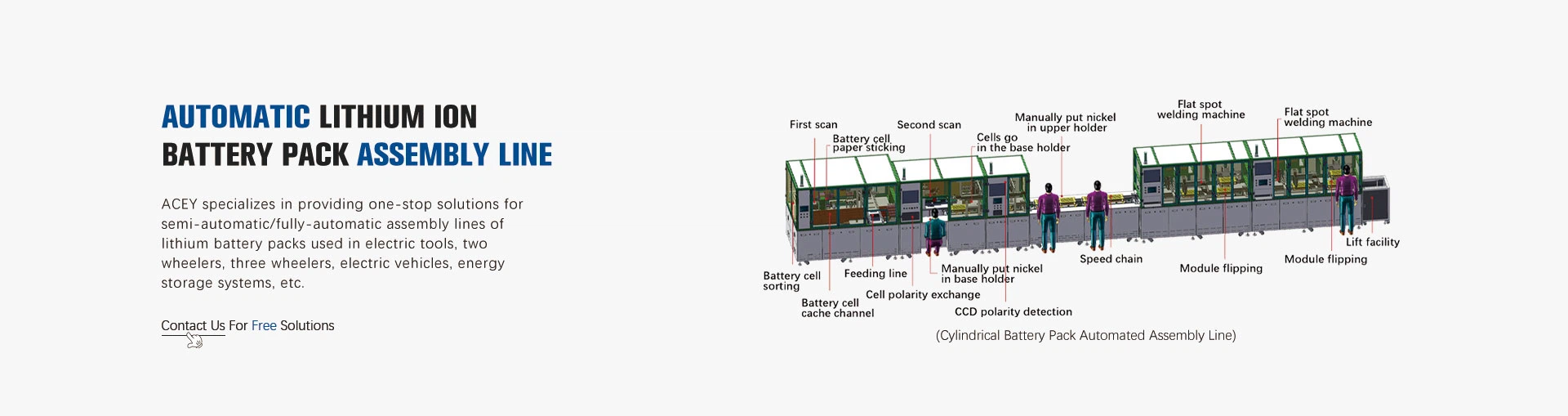
Acey Intelligent specializes in providing one-stop solutions for semi-automatic/fully-automatic assembly lines of lithium battery packs used in ESS, UAV, E-Bike, E-Scooter, Power Tools, Two/Three Wheelers, Etc. In Addition, we provide a complete set of battery pack assembly equipment, such as Cell Grading Machine, Battery Sorting Machine, Insulation Paper Sticking Machine, CCD tester, Manual/Automatic Spot Welding Machine, BMS Tester, Battery Comprehensive Tester and Battery Pack Test System, etc.