

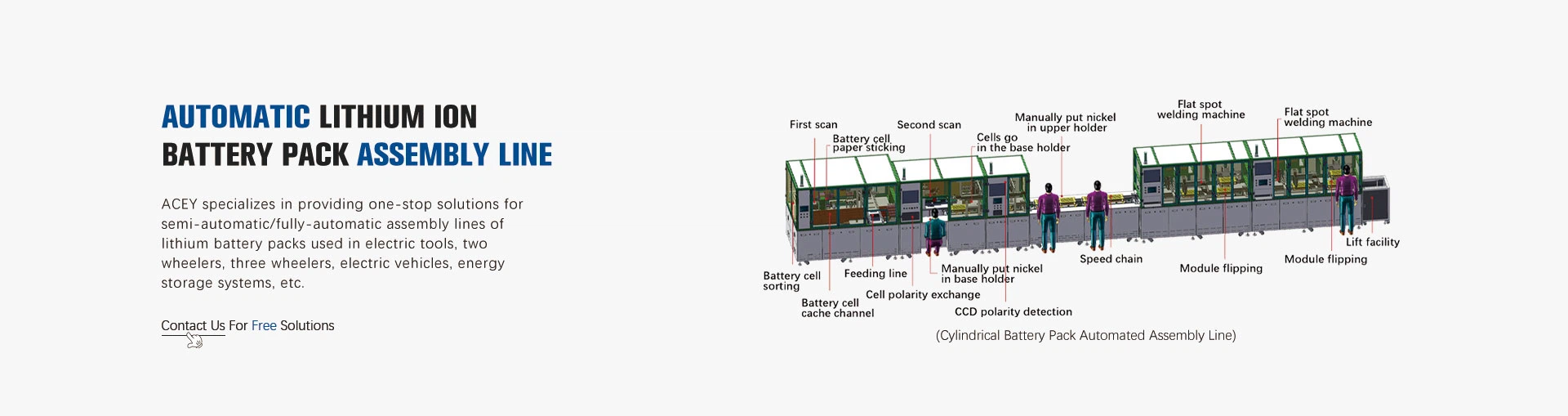
PACK systems generally provide customized solutions based on the needs of different vehicle models: several individual battery cells are connected in series and parallel to form module units, and then through reasonable layout, the module units, PACK structural components, high and low voltage acquisition harnesses, battery management system, etc., are assembled into a PACK system.

I. Composition of Different Single-Cell Modules
Soft-pack Module
Generally composed of soft-pack battery cells, casing, end plates, terminal brackets, foam, sampling wire components, insulation protection plates, and other main components.
Square-shell Module
Generally composed of square aluminum-shell battery cells, side plates, end plates, top cover plates, busbars, sampling harness components, insulation film, and other main components.
Cylindrical Module
Generally composed of 18650/21700 and other specifications of cylindrical steel-shell battery cells, upper and lower brackets, busbars, sampling harness components, insulation plates, and other main components.
II. Comparison of Performance Advantages and Disadvantages of Different Structure Modules
| Item | Pouch Cell Module | Prismatic Cell Module | Cylindrical Cell Module | |||
| Packing Efficiency | Pouch-type plastic square structure facilitates integration; relatively high module integration efficiency | Good | Shell uses high-strength steel or aluminum alloy; single cell energy density lower than pouch cells, but high mechanical strength and square structure favor integration; relatively high module integration | Good | Limited by the cylindrical geometry; space must be reserved for thermal management and safety, leading to low module integration efficiency. | Average |
| Energy Density | High energy density for same material system; high integration efficiency and space utilization lead to high energy density | Best | Relatively high energy density for same material system; high integration efficiency and space utilization lead to high energy density | Good | Low integration efficiency and poor space utilization result in less-than-ideal energy density. | Average |
| High-rate Charge/Discharge Capability | Strong heat dissipation and current conduction enable high-power fast charging/discharging | Good | Strong heat dissipation and current conduction enable high-power fast charging/discharging | Best | The cylindrical structure has poor current conduction and heat dissipation, making it unsuitable for high-power fast charging/discharging. | Average |
| Life & Reliability | Good heat dissipation and current conduction; pouch structure requires mechanical fixation; cells can be connected by laser or ultrasonic welding | Best | Good heat dissipation and current conduction; steel/aluminum shell provides high mechanical strength; laser sealing welding process ensures high life and reliability | Good | Poor heat dissipation/current conduction, along with numerous connection and welding points, lead to average module lifespan and reliability. | Average |
| Cost | Pouch structure requires mechanical fixation, adding extra cost | Good | High integration efficiency, good mechanical performance, easy thermal management; thus lowest cost | Best | Due to the high number of individual cells, extra costs are incurred to ensure temperature uniformity and module safety. | Good |
| Key/Special Processes | Pressure-sensitive adhesive spraying, thermal conductive adhesive coating, module stacking and compression, module housing insertion, welding | Adhesive coating, module stacking and compression, plasma cleaning, welding | Ultrasonic wire bonding (aluminum wire), adhesive coating, liquid cooling | |||
| Advantages | High packing efficiency, high energy density, good safety, good cycle performance, high lightweight potential | High packing efficiency, relatively high energy density, high integration efficiency, low cost | High integration flexibility, unified product models, mature process technology | |||
| Disadvantages | Complex process, high equipment requirements, relatively high cost | Single cell energy density lower than pouch cells; poor thermal runaway safety | limited capacity improvement potential, low energy density, complex management methods | |||
About us
Acey Intelligent specializes in providing one-stop solutions for semi-automatic/fully-automatic assembly lines of lithium battery packs used in ESS, UAV, E-Bike, E-Scooter, Power Tools, Two/Three Wheelers, Etc. In Addition, we provide a complete set of battery pack assembly equipment, such as Cell Grading Machine, Battery Sorting Machine, Insulation Paper Sticking Machine, CCD tester, Manual/Automatic Spot Welding Machine, BMS Tester, Battery Comprehensive Tester and Battery Pack Test System, etc.
