

When dealing with the measurement of fluid viscosities, the task becomes particularly challenging when the viscosities are extremely low. Low - viscosity fluids, such as certain solvents, light oils, and some pharmaceutical solutions, require specialized viscometers that can accurately capture their flow characteristics. As a viscometer supplier, I am well - versed in the different types of viscometers available in the market and their suitability for measuring very low viscosities.
Types of Viscometers and Their Suitability
Capillary Viscometers
Capillary viscometers are one of the oldest and most widely used types for measuring low viscosities. The principle behind capillary viscometers is based on Poiseuille's law, which states that the flow rate of a fluid through a capillary tube is related to its viscosity. When a low - viscosity fluid is forced through a narrow capillary tube under a known pressure difference, the time it takes for the fluid to travel a certain distance can be used to calculate its viscosity.
Capillary viscometers are highly accurate for low - viscosity fluids because they can precisely measure the flow of these fluids. They are relatively simple in design and operation, with few moving parts. However, they have some limitations. For instance, they are sensitive to temperature changes, and any fluctuations in temperature can significantly affect the measurement results. Also, they may not be suitable for fluids that contain particles or are non - Newtonian, as the presence of particles can block the capillary tube, and non - Newtonian fluids do not follow the simple flow behavior assumed by Poiseuille's law.
Rotational Viscometers
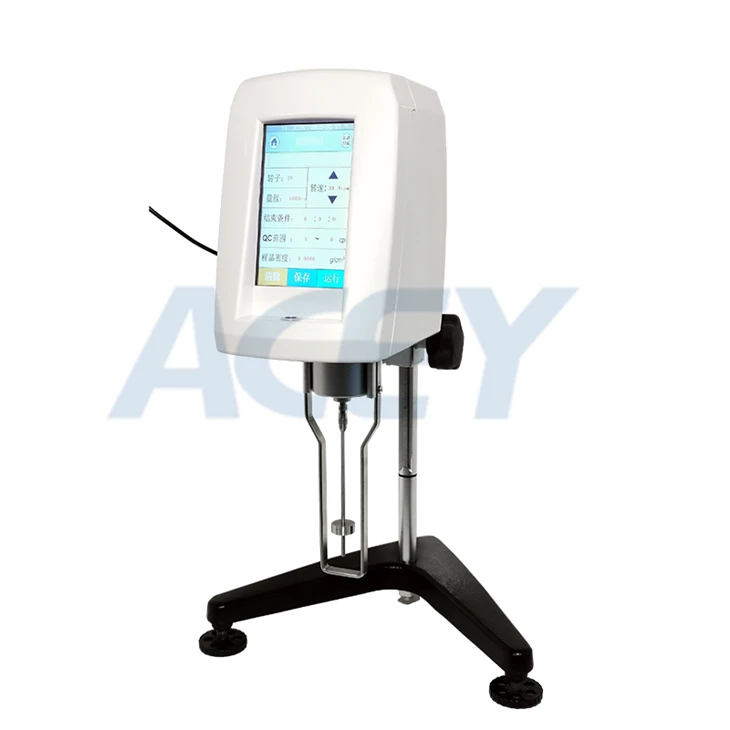
Laboratory Rotational Viscometer is another option for measuring low viscosities. Rotational viscometers work by rotating a spindle or bob in the fluid and measuring the torque required to maintain the rotation. For low - viscosity fluids, a small - diameter spindle or a high - speed rotation may be used.
These viscometers offer several advantages. They can measure a wide range of viscosities, including very low ones, by adjusting the spindle size and rotation speed. They are also less affected by temperature compared to capillary viscometers, as they can be equipped with temperature - controlled jackets. Moreover, they can handle non - Newtonian fluids better than capillary viscometers, as they can measure the viscosity at different shear rates. However, they are generally more expensive and complex to operate than capillary viscometers.
Falling - Sphere Viscometers
Falling - sphere viscometers operate on the principle of Stokes' law, which describes the motion of a sphere falling through a viscous fluid. A small sphere is dropped into the fluid, and the time it takes for the sphere to fall a certain distance is measured. The viscosity of the fluid can then be calculated based on the properties of the sphere and the fluid.
Falling - sphere viscometers are suitable for low - viscosity fluids, especially those that are transparent. They are relatively easy to use and can provide accurate results. However, they require a large sample volume, and they are sensitive to the presence of air bubbles in the fluid, which can affect the falling speed of the sphere.

Vibrational Viscometers
Vibrational viscometers use the principle of a vibrating element immersed in the fluid. The damping of the vibration due to the fluid's viscosity is measured, and this damping is related to the fluid's viscosity. These viscometers are very suitable for measuring low viscosities because they can detect even small changes in the fluid's resistance to the vibrating element.
They have a fast response time and can provide continuous viscosity measurements. They are also compact and can be easily integrated into process systems. However, they may be affected by the density of the fluid, and they may not be as accurate as other types of viscometers for some complex fluid systems.
Our Viscometer Offerings for Low - Viscosity Measurements
As a viscometer supplier, we offer a range of viscometers that are well - suited for measuring very low viscosities. Our Digital Viscometer is a state - of - the - art instrument that combines the advantages of rotational viscometry with digital technology. It allows for precise control of the spindle speed and provides accurate viscosity readings. With its user - friendly interface, it is easy to operate, even for those with limited experience in viscosity measurement.
The Portable Digital Electric Viscosity Meter Viscometer is another excellent option for measuring low viscosities. It is designed for on - site measurements and can be easily carried to different locations. Despite its portability, it does not compromise on accuracy. It is capable of measuring a wide range of low viscosities and can store measurement data for further analysis.
Considerations When Choosing a Viscometer for Low - Viscosity Fluids
When selecting a viscometer for measuring very low viscosities, several factors need to be considered.
Accuracy Requirements
The level of accuracy needed for the viscosity measurement is crucial. If high - precision measurements are required, such as in pharmaceutical or high - tech industries, a more advanced viscometer like a digital rotational viscometer may be necessary. On the other hand, if approximate measurements are sufficient, a simpler viscometer like a capillary viscometer may be adequate.
Fluid Properties
The properties of the fluid being measured, such as its Newtonian or non - Newtonian behavior, the presence of particles, and its density, should be taken into account. Non - Newtonian fluids require viscometers that can measure viscosity at different shear rates, such as rotational viscometers. Fluids with particles may clog capillary viscometers, so other types like rotational or vibrational viscometers may be more suitable.
Sample Volume
The amount of sample available for measurement is also an important consideration. Some viscometers, like falling - sphere viscometers, require a large sample volume, while others, like vibrational viscometers, can work with very small sample volumes.
Temperature Control
Since viscosity is highly temperature - dependent, especially for low - viscosity fluids, the ability to control the temperature during measurement is essential. Viscometers with built - in temperature - control mechanisms, such as rotational viscometers with temperature - controlled jackets, are preferred in applications where temperature stability is critical.
Conclusion
In conclusion, there are several viscometers suitable for measuring very low viscosities, each with its own advantages and limitations. Capillary viscometers are simple and accurate for Newtonian low - viscosity fluids, while rotational viscometers offer more flexibility and can handle non - Newtonian fluids. Falling - sphere viscometers are easy to use but require a large sample volume, and vibrational viscometers provide fast and continuous measurements.
As a viscometer supplier, we understand the unique requirements of measuring low viscosities and offer a range of viscometers to meet these needs. Whether you need a laboratory - grade instrument for precise research or a portable device for on - site measurements, we have the right solution for you. If you are interested in learning more about our viscometers or would like to discuss your specific viscosity measurement requirements, please feel free to contact us for procurement and further discussions.
References
- ASTM D445 - 19 Standard Test Method for Kinematic Viscosity of Transparent and Opaque Liquids (and Calculation of Dynamic Viscosity).
- ISO 3219:1993 Plastics -- Polymers/resins in the liquid state or as emulsions or dispersions -- Determination of viscosity using a rotational viscometer with defined shear rate.
- Barnes, H. A., Hutton, J. F., & Walters, K. (1989). An Introduction to Rheology. Elsevier.