


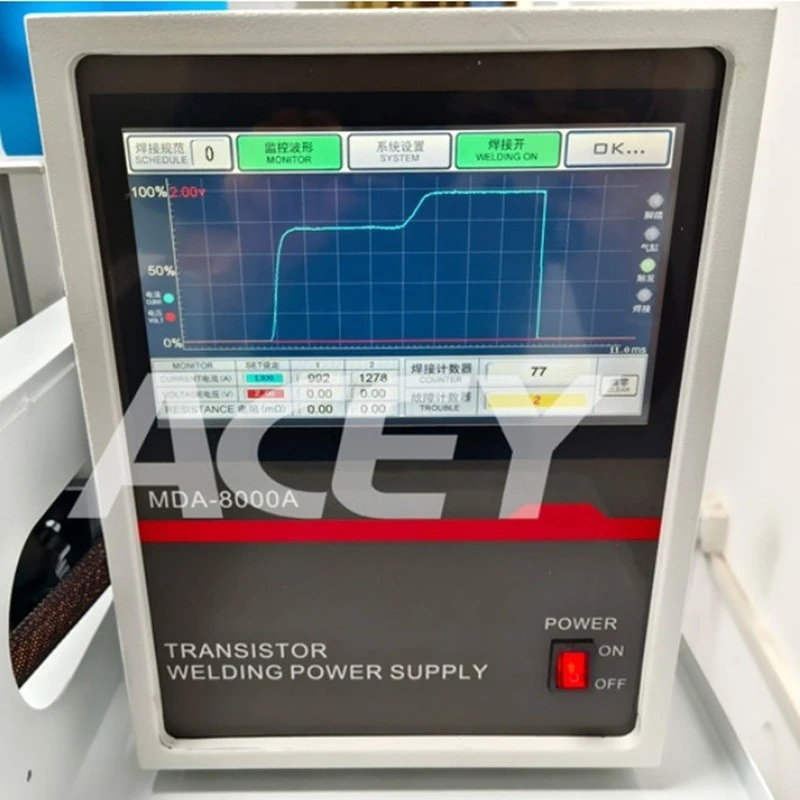
Lithium Battery Spot Welding Plant for Cylindrical Battery Packs
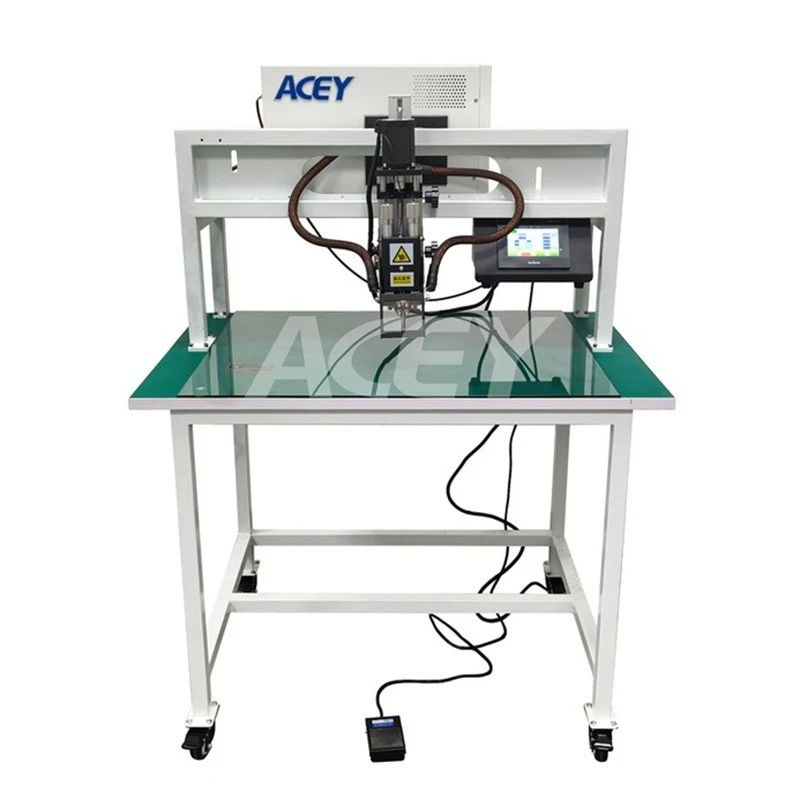
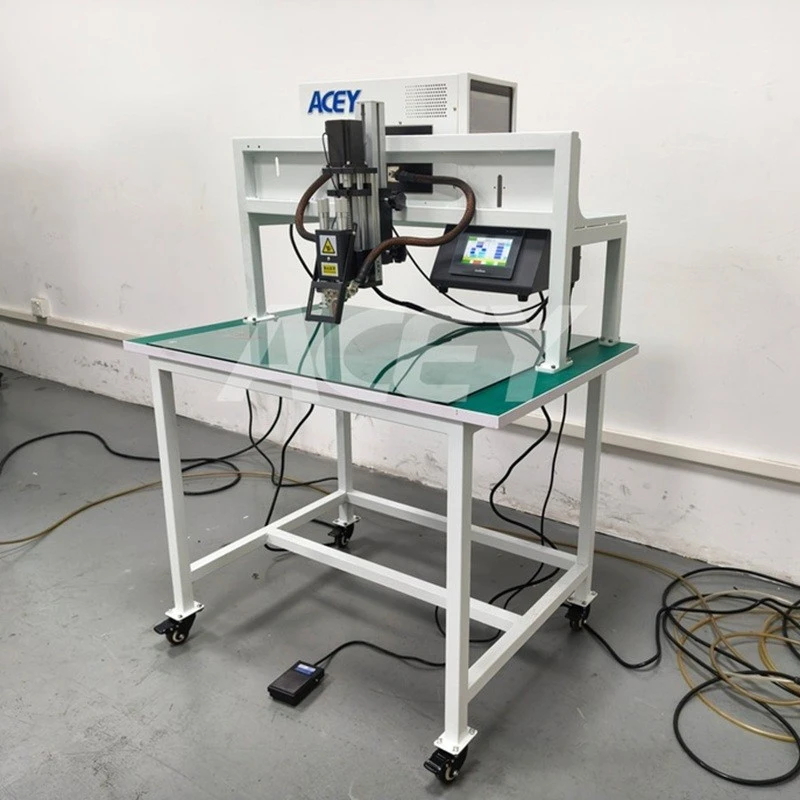
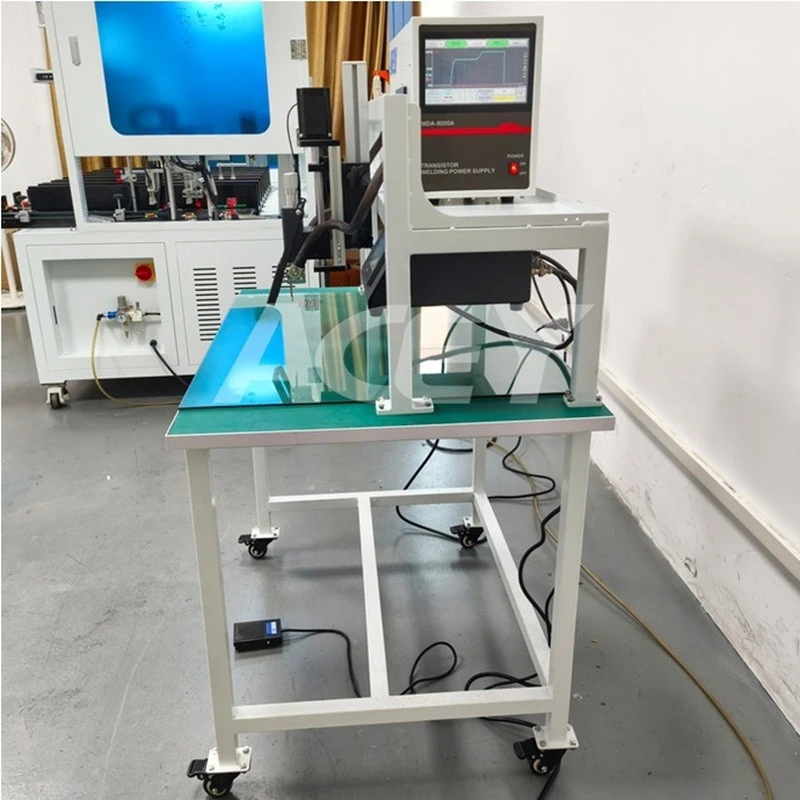
An 8000A lithium battery spot welding plant needs enough welding current, controlled electrode pressure, and repeatable pulse timing to form consistent joints between cylindrical cells and nickel or nickel-plated steel. The ACEY-8000T uses an 8000A transistor welding power supply, adjustable welding parameters, and weld-point monitoring for 18650, 21700, 26650, 32700, 32140, and 33140 battery pack assembly.
For small-batch production, pilot lines, laboratory development, and battery pack manufacturers, the machine provides a practical manual welding platform without requiring a fully automated production line.
Engineering takeaway: Welding quality is not determined by current alone. Current, pulse duration, electrode pressure, contact resistance, electrode geometry, material thickness, and cell terminal condition must be controlled together.

1. What Does a Lithium Battery Spot Welding Plant Actually Control?
Resistance spot welding works by passing electrical current through two conductive workpieces while applying electrode force. Heat is generated primarily at the electrical resistance of the welding interface:
Q ≈ I²Rt
where:
Q = heat generated
I = welding current
R = electrical resistance at the welding path
t = welding time
This relationship explains why simply increasing current is not a reliable way to solve a weak weld.
If electrode pressure is too low, contact resistance can rise and produce excessive localized heating or spatter. If pressure is too high, interface resistance can fall and the weld may not generate enough heat. A stable process therefore depends on the interaction between electrical and mechanical parameters.
For cylindrical lithium battery packs, the main variables include:
| Parameter | Engineering consideration |
|---|---|
| Welding current | ACEY-8000T output up to 8,000 A |
| Welding time | Adjustable through the microcomputer controller |
| Electrode pressure | Adjustable according to cell and strip configuration |
| Welding material | Pure nickel, nickel-plated steel, copper and other compatible metals |
| Cell formats | 18650, 21700, 26650, 32650, 32700, 32140, 33140 |
| Welding head | Pneumatic or electric options |
| Cooling | Forced-air cooling |
| Control | Industrial modular intelligent control platform |
| Weld monitoring | Weld tracking, false-weld and missed-weld detection |
| Process records | Welding events can be monitored and recorded |
For a battery pack manufacturer, these controls matter because a visually acceptable weld can still have inadequate mechanical strength or electrical conductivity.
A Practical Point for Procurement Teams
When comparing a lithium battery spot welder manufacturer, do not compare machines only by the advertised maximum amperage.
Ask for the actual welding window for your:
- Cell format
- Nickel or nickel-plated steel grade
- Strip thickness
- Number of weld points
- Required pull strength
- Pack configuration
- Production quantity
A machine rated at a higher current is not automatically the better machine if its current control, electrode movement, pressure stability, or welding pulse repeatability are unsuitable for the material stack-up.
If you already know your cell format and strip specification, send the cell type, strip material/thickness, pack configuration, and target production volume to ACEY. The welding head and process parameters can then be evaluated against the actual assembly requirement rather than a generic machine specification.
2. Material Selection: Nickel, Nickel-Plated Steel or Copper?
The welding material strongly affects resistance, heat generation, mechanical strength, and required welding energy.
For many cylindrical lithium battery packs, nickel-plated steel and pure nickel are commonly considered because they provide a practical balance between conductivity, weldability, corrosion resistance, and cost.
Copper presents a different engineering problem. Its electrical conductivity is much higher than that of nickel, so achieving suitable resistance heating at the interface can require different welding conditions and electrode arrangements.
| Welding material | Typical engineering characteristic | Process implication |
|---|---|---|
| Pure nickel | Good corrosion resistance and conductivity | Common choice for battery interconnects |
| Nickel-plated steel | Steel substrate with nickel surface | Lower material cost; process depends on plating and substrate |
| Copper | Very high electrical conductivity | Requires careful control of current, pressure and electrode configuration |
| Other metal combinations | Depends on electrical resistance and surface condition | Requires application-specific welding validation |
The material thickness is equally important. A welding program developed for a thin nickel strip cannot simply be copied to a thicker strip or a different metal combination.
Why Surface Condition Matters
Resistance welding takes place at the contact interfaces. Oxidation, contamination, plating variation, burrs, uneven strip surfaces, or poor cell-terminal contact can change the local electrical resistance.
That means two nominally identical strips can behave differently if their surface condition differs.
For production procurement, the recommended qualification process is to test the actual production material, not just a nominal material specification.
Useful checks include:
- Visual inspection of the weld nugget and surrounding area
- Pull or peel testing
- Weld penetration assessment where applicable
- Electrical resistance verification
- Spatter inspection
- Electrode wear monitoring
- Repeatability testing over multiple weld points
-
Image Suggestion

3. ACEY-8000T Lithium Battery Spot Welding Plant Specifications
The ACEY-8000T is designed around a manual operating configuration for cylindrical battery pack assembly. Its 8,000A transistor welding power supply provides the current capacity required for a range of battery interconnect materials, while the control system stores adjustable welding parameters.
| Specification | ACEY-8000T |
|---|---|
| Model | ACEY-8000T |
| Welding current | Up to 8,000 A |
| Power supply | Transistor welding power supply |
| Total power | ≤1.5 kW |
| Power supply voltage | 220 V or 380 V, 50/60 Hz |
| Welding control | Microcomputer-controlled |
| Welding operation | Foot pedal switch |
| Welding head | Pneumatic or electric |
| Pneumatic pressure | 0.4–0.6 MPa |
| Cooling | Forced air |
| Equipment dimensions | 900 × 650 × 1,220 mm |
| Equipment weight | Approx. 60 kg |
| Maximum floor load requirement | ≤200 kg/m² |
| Equipment noise | ≤80 dB |
| Ambient temperature | −30°C to 50°C |
| Relative humidity | Below 90% |
| Installation condition | Flat, vibration-free and shock-free |
| Grounding | Direct grounding |
| Installation environment | Free from pollution and strong electromagnetic interference |
| MOQ | 1 set |
| Lead time | 7–35 days |
| Compliance | CE certified |
| Warranty | 1 year, with lifetime support |
The relatively compact footprint is useful for pilot production, laboratory battery assembly, engineering departments, and small-volume pack manufacturing where a large automated line would not be economically justified.
4. Weld Monitoring: The Difference Between Making Welds and Controlling Weld Quality
A battery pack can contain hundreds or thousands of individual weld points. A single missed weld may create an open electrical connection, while a false or weak weld can survive visual inspection and fail later during mechanical or electrical testing.
The ACEY-8000T therefore incorporates monitoring functions for:
- Weld-point tracking
- Sparking detection
- False-weld detection
- Missed-weld detection
- Event recording
- Alarm functions
This is particularly useful in manual battery pack production because operator-dependent processes can otherwise make defect tracing difficult.
What Is a False Weld?
A false weld occurs when the equipment completes a welding cycle but the intended metallurgical or mechanical connection is not properly formed.
Possible causes include:
- Contaminated contact surfaces
- Incorrect electrode pressure
- Poor electrode alignment
- Excessive electrode wear
- Incorrect welding current
- Incorrect pulse duration
- Strip movement
- Poor contact with the cell terminal
A welding machine cannot compensate for every upstream process problem. The objective is to make the welding process measurable and repeatable so that abnormal conditions can be identified early.
If your current process has intermittent weak welds, missed welds, or unexplained spatter, provide ACEY with your cell diameter, strip material, strip thickness, and existing welding parameters. These details are more useful for process evaluation than simply specifying the required output current.
5. Battery Cell Formats Supported by the ACEY-8000T
The machine is intended for cylindrical cell battery packs across several common diameters and lengths.
| Cylindrical cell format | Typical application context |
|---|---|
| 18650 | Consumer electronics, tools and compact battery packs |
| 21700 | E-bikes, power tools, energy storage and higher-capacity packs |
| 26650 | High-capacity cylindrical battery assemblies |
| 32650 | Larger cylindrical battery packs |
| 32700 | E-mobility and energy-storage applications |
| 32140 | Larger-format cylindrical cell assemblies |
| 33140 | Large cylindrical battery pack configurations |
The machine can be used for e-bike battery pack welding, power-tool battery assembly, scooter battery packs, prototype packs, and other cylindrical lithium-ion battery applications.
However, cell format alone does not determine the welding program. The terminal geometry, nickel strip configuration, number of layers, strip thickness, electrode tip geometry, and required weld strength must also be considered.
6. Manual Spot Welding vs. Fully Automatic Battery Pack Welding
For purchasing managers, the right question is not always "Which machine is more automated?"
The better question is: What production volume and process consistency does the factory actually need?
| Production requirement | Manual spot welding machine | Automatic battery pack welding line |
|---|---|---|
| Prototype development | Strong fit | Often excessive |
| University laboratory | Strong fit | Usually unnecessary |
| Small-batch production | Strong fit | Depends on volume |
| Frequent product changes | Flexible | Requires more changeover planning |
| Large-volume standardized packs | Limited by operator cycle | Strong fit |
| Initial equipment investment | Lower | Higher |
| Operator involvement | Higher | Lower |
| Process integration | Basic to moderate | High |
| Product flexibility | High | Depends on automation design |
The ACEY-8000T is therefore positioned between laboratory-scale welding and high-volume automated production. It is suitable when a buyer needs controlled welding without committing to a complete automated battery pack production line.

7. Installation Requirements for a Lithium Battery Spot Welding Plant
Installation conditions affect machine stability and operator safety. The ACEY-8000T has defined environmental requirements that should be checked before shipment.
| Installation factor | Requirement |
|---|---|
| Temperature | −30°C to 50°C |
| Humidity | <90% RH |
| Pneumatic supply | 0.4–0.6 MPa for pneumatic configuration |
| Floor loading | ≤200 kg/m² |
| Noise | ≤80 dB |
| Power | 220 V or 380 V, 50/60 Hz |
| Grounding | Direct grounding |
| Floor | Flat and vibration-free |
| Environment | Free from pollution and strong electromagnetic interference |
For overseas buyers, the power supply configuration should be confirmed before the purchase order is released. A machine intended for a 220V/50Hz site should not be configured from assumptions made for another market.
The pneumatic option also requires a stable compressed-air supply within the specified pressure range.
8. Quality Control Points Before Accepting a Battery Spot Welding Machine
A factory acceptance inspection should go beyond checking whether the machine powers on.
For procurement and QA teams, a useful acceptance checklist includes:
| Inspection item | What to verify |
|---|---|
| Current output | Confirm welding power supply performance |
| Parameter adjustment | Verify current and welding-time adjustment |
| Parameter storage | Confirm welding programs can be stored |
| Electrode pressure | Check adjustment and repeatability |
| Weld head | Verify selected pneumatic/electric configuration |
| Weld monitoring | Test false-weld and missed-weld functions |
| Alarm system | Trigger defined abnormal conditions |
| Cooling | Confirm forced-air cooling operation |
| Electrical safety | Check grounding and electrical protection |
| Dimensional inspection | Confirm machine footprint |
| Test welding | Use the customer's actual cell and strip materials |
| Weld quality | Conduct mechanical and electrical validation |
For a serious production project, the final weld test should use the same cell format and interconnect material that will be used after installation.
A factory test performed only with an unrelated nickel strip does not prove production suitability.
9. Where the ACEY-8000T Fits in a Battery Manufacturing Project
The machine can serve several stages of a battery equipment project:
Laboratory development → prototype pack → pilot production → small-batch manufacturing
University laboratories and research institutes may use it for battery pack construction and process development. Battery factories can use it for small-volume production, engineering validation, product changeovers, or secondary production stations.
For importers and distributors, the machine can also be supplied as part of a wider battery manufacturing equipment package.
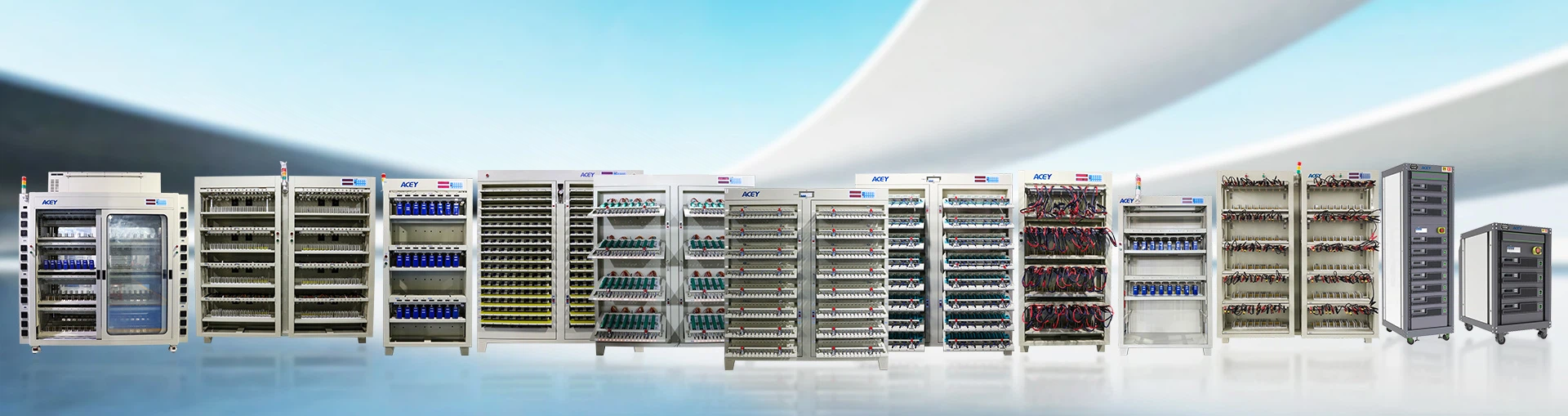
ACEY New Energy's product scope covers:
- Lithium battery raw materials
- Coin cell laboratory equipment
- Cylindrical cell fabrication equipment
- Pouch cell fabrication equipment
- Battery pack assembly equipment
- Battery cell and pack testing systems
- Battery environmental and safety testing equipment
This broader equipment range is useful when a customer needs more than one machine and wants process equipment from a single battery equipment supplier.
If you are sourcing equipment for a laboratory, pilot line, or battery pack factory, ask ACEY for a configuration based on your cell format, welding material, production volume, site voltage, and required automation level. MOQ for the ACEY-8000T is 1 set, with a stated lead time of 7–35 days.
10. Purchasing Checklist for an 8000A Battery Spot Welder
Before placing an order, procurement teams should define the application rather than buying from the current rating alone.
Cell Specification
Record:
- Cell diameter
- Cell length
- Terminal design
- Cell chemistry
- Cell manufacturer
- Pack arrangement
-
Interconnect Material
Specify:
- Pure nickel or nickel-plated steel
- Copper if required
- Material thickness
- Strip width
- Surface condition
- Number of strip layers
Welding Process
Define:
- Target welding current
- Welding time
- Electrode pressure
- Electrode configuration
- Number of weld points per cell
- Required weld strength
- Acceptable spatter level
Factory Conditions
Confirm:
- 220V or 380V
- 50Hz or 60Hz
- Available compressed air
- Floor conditions
- Ambient temperature
- Available production area
- Grounding arrangement
Quality Documentation
Request:
- Equipment specification
- CE documentation
- Welding test results
- Factory acceptance criteria
- Installation instructions
- Maintenance instructions
- Spare-parts recommendations
- Warranty terms
This information creates a much clearer technical basis for supplier comparison.
11. Why an 8000A Rating Is Not the Complete Specification
"8000A" is an important number, but it should not be treated as the entire machine specification.
The actual weld depends on the electrical resistance of the complete current path:
Electrode → strip → cell terminal → strip → electrode
Any variation in this path can affect the heat generated at the weld interface.
For example, changing from pure nickel to nickel-plated steel changes the electrical resistance. Changing strip thickness changes the required welding energy. Changing electrode geometry changes the contact area. Changing electrode force changes contact resistance.
That is why a professional lithium battery spot welding plant manufacturer should evaluate the complete welding stack rather than simply quoting a maximum current value.
For battery pack factories, this approach also makes future process qualification easier because the welding parameters can be documented against a defined material and cell configuration.
12. ACEY-8000T Ordering and Supply Information
| Commercial item | ACEY-8000T |
|---|---|
| Manufacturer | Xiamen Acey New Energy Technology Co., Ltd. |
| Model | ACEY-8000T |
| Product type | Manual lithium battery spot welding machine |
| Main application | Cylindrical lithium battery pack assembly |
| Maximum welding current | 8,000 A |
| MOQ | 1 set |
| Lead time | 7–35 days |
| Payment | T/T |
| Origin | China |
| Certification | CE |
| Warranty | 1 year |
| Long-term support | Lifetime support |
ACEY New Energy was established in 2009 and operates three factories covering more than 20,000 square meters. The company develops equipment for lithium-ion battery laboratories, cell fabrication, battery pack assembly, testing, and environmental safety evaluation.
For international buyers, equipment selection can therefore be based on the complete battery production process rather than one standalone welding machine.
13. Frequently Asked Questions
How many ACEY-8000T lithium battery spot welding machines do I need for a small battery pack production line?
The minimum order is 1 set. The required quantity depends on pack output, weld-point count, operator cycle time, and production shifts.
What is the lead time for an ACEY-8000T battery spot welding machine?
The stated lead time is 7–35 days. Final delivery timing depends on machine configuration, order requirements, and production scheduling.
Can ACEY support installation and after-sales service for overseas buyers?
Yes. The ACEY-8000T includes a one-year warranty with lifetime support. Installation and technical support can be discussed according to the project requirements.
Can the ACEY-8000T weld both 18650 and 21700 battery packs?
Yes. The machine supports cylindrical formats including 18650, 21700, 26650, 32650, 32700, 32140, and 33140, subject to the applicable welding configuration.
What welding materials can the ACEY-8000T process?
The machine is designed for nickel-plated steel, pure nickel, copper, and other compatible metal materials. Final process parameters should be validated using the customer's actual material thickness and cell configuration.
Project-specific equipment quotation